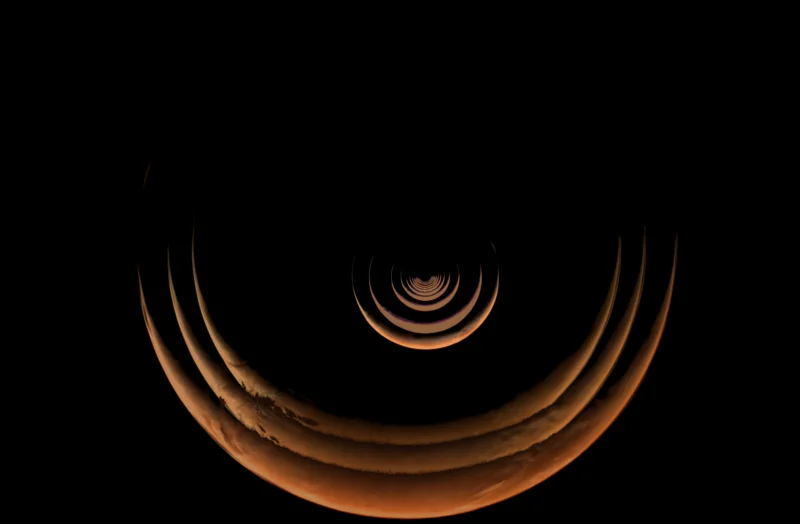
What a cool composite! This image shows the view of a crescent Mars as the Psyche mission closed in for its flyby. The most distant and smallest image is at the center. The outer ring shows the last shot before Mars filled the field of view. Psyche took the images between May 2 and 15, 2026. The mission is on its way to the asteroid 16 Psyche. See a time lapse of the flyby below. Image via NASA/JPL-Caltech/ASU.
One more image from Mars!
On July 17, 2026, NASA released one more image – really a composite of 13 images – as the Psyche mission swung past Mars for a gravity assist.
The Psyche mission, on its way to asteroid 16 Psyche, flew past Mars in May. The images above are a collection from between May 2 and 15, 2026, as the space probe grew nearer to the red planet. On Psyche’s approach, the angle of the sun meant the planet appeared as a lit crescent.
The team has also put together a time lapse of Psyche’s encounter with Mars. We get to see the approaching ruddy crescent, a view looking down at Martian craters, and then the red planet with its south polar ice cap receding from view as the space probe heads off toward the asteroid belt. It’s stunning! Watch it below.
VIDEO
Images of the Psyche mission flyby of Mars
The Psyche mission successfully completed its flyby of Mars on May 15, 2026. Mars gave the spacecraft a 1,000-mile-per-hour (1,600-km-per-hour) critical gravity assist.
It also moved its orbit by about 1 degree. So the spacecraft is now successfully it on track toward the asteroid 16 Psyche. See some of the new images of the flyby below.
Because of the angle of Psyche’s approach, Mars appeared first as a crescent. Then it saw a more fully lit Mars as it flew away.
The Psyche mission captured this view of a crescent Mars on May 15, 2026, at about 5:03 a.m. PDT (12:03 UTC). Psyche used Mars to adjust its orbit and get a gravity assist. NASA processed the image into a natural-color view using red, green and blue data acquired directly by the spacecraft’s multispectral imager. Image via NASA/ JPL-Caltech/ ASU.
The first view of a nearly “full Mars” from NASA’s Psyche spacecraft. This image is from shortly after its closest approach to the planet on May 15. The bright white spot is the south polar cap. Image via NASA/ JPL-Caltech/ ASU.
Psyche’s view of the Martian surface shows streaks from wind blowing over impact craters in the Syrtis Major region. The wind streaks extend to about 30 miles (50 km) long. And the large craters near center-bottom of the scene are around 30 miles in diameter. Image via NASA/ JPL-Caltech/ ASU.
An enhanced-color view of the heavily cratered southern highlands of Mars. Image via NASA/ JPL-Caltech/ ASU.
Psyche mission flyby of Mars
The Psyche spacecraft, launched in 2023, is headed toward a rare metal asteroid, also named Psyche (16 Psyche, the 16th known asteroid ever discovered). It will arrive in 2029. But in order to get out to the asteroid belt, the spacecraft made a close flyby of Mars to adjust its direction and pick up a boost of speed on May 15, 2026.
Psyche came within 2,800 miles (4,500 kilometers) of the red planet’s surface. That’s closer than Earth’s geostationary satellites. The spacecraft was traveling at 12,333 mph (19,848 kph).
The maneuver used Mars’ gravity as a “slingshot” to accelerate the probe and tilt its trajectory toward its final destination, the metal-rich asteroid 16 Psyche.
An early Psyche image of Mars was the one below, from May 3. In the image, Psyche was still about 3 million miles (4.8 million km) away.
This was the Psyche spacecraft’s view of Mars on May 3, 2026. Image via NASA/ JPL-Caltech/ ASU.
Does Mars have a ring?
Astronomers think Mars might have a faint, dusty ring. The ring would be the result of micrometeorites striking Mars’ two moons, Phobos and Deimos, and ejecting dust into orbit around Mars. So there’s a chance data from Psyche could reveal this dusty ring around Mars. The sun-Mars-Psyche alignment might allow the sun striking the particles to scatter light, and image processing could pick up the ring.
Colorized version of Psyche’s image of Mars from May 3, 2026. Image via NASA/ JPL-Caltech/ ASU.
Why fly past Mars?
While most flybys are planned to give a spacecraft a boost of speed, this flyby is also important to slightly change the spacecraft’s trajectory. The orbit of asteroid Psyche is skewed by about 3 degrees from the plane of the solar system. So in order to get to the asteroid Psyche, the Psyche mission must adjust its trajectory by a little bit.
In this diagram of the planets in our solar system, you can see Psyche’s orbit (green) is slightly tilted compared to the solar system’s plane. Image via In-the-Sky.org. Visit the interactive diagram here.
More about the Psyche mission and asteroid
Some scientists think the asteroid Psyche is a failed planet. Perhaps, as the nascent planet formed, something struck it and stripped off the outer layers, leaving behind the metallic core. If so, then some estimates put the massive, metal-rich object’s worth at $10,000 quadrillion. That’s more than the entire economy of Earth.
However, a 2021 study from the University of Arizona said asteroid Psyche might not be as metallic or dense as scientists once thought. Instead, these scientists said:
Rather than being an intact exposed core of an early planet, it might actually be closer to a rubble pile.
Who’s right? That’s what the Psyche mission hopes to discover when it arrives at the asteroid in 2029.
Artist’s concept of asteroid Psyche. Image via Maxar/ ASU/ P. Rubin/ NASA/ JPL-Caltech.
Bottom line: NASA released a composite image of Mars lit like a crescent as the Psyche mission flew by for a gravity assist. You can also watch a stunning time lapse of the whole flyby here.
Read more: Ancient lake on Mars? Rover finds strong new evidence
Read more: New meteor shower from an asteroid being eroded by the sun
Kelly Kizer Whitt
About the Author:
Kelly Kizer Whitt - EarthSky’s nature and travel vlogger on YouTube - writes and edits some of the most fascinating stories at EarthSky.org. She's been writing about science, with a focus on astronomy, for decades. She began her career at Astronomy Magazine and made regular contributions to other outlets, including AstronomyToday and the Sierra Club. She has nine published books, including a children's picture book, Solar System Forecast, and a young adult dystopian novel, A Different Sky.