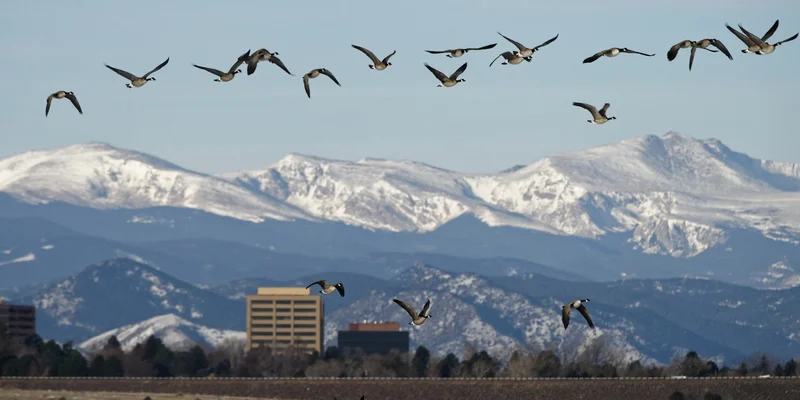
The phone call to my office was a typical one for mid- to late June: Canada geese were causing a problem. There was too much poop, and they were eating some flowers. The former was all to common, but the latter part was somewhat new, and the location was a first-time complaint. So, I found myself driving to the caller’s house to investigate and talk with the homeowner.
At the time, in 2006, I was the waterfowl biologist for the Nebraska Game and Parks Commission, and my job duties included responding to calls like this and finding an appropriate solution.
When I got there, the homeowner’s complaint intensified. Without question, she wanted the geese gone – immediately and completely. I listened and then went to check the property and the geese. Her husband came along with me, and after we went a little ways from the house, he said, in a hushed tone, “I like the geese. They could stay here as far as I’m concerned.”
And there it was – the ultimate dichotomy about what to do with nuisance Canada geese. A husband and wife weren’t even in agreement.
Disagreement about what to do with urban – and sometimes nonurban – Canada geese is typical. That’s particularly true in places like Colorado and other states where the Canada goose population has flourished since being reintroduced starting in the 1960s.
Canada geese may be a nuisance, but their management requires collaboration between community members and wildlife managers. The solutions often require patience and persistence. I currently am a professor of wildlife management at the University of Nebraska-Lincoln. While I do not deal directly with nuisance animals anymore, I sometimes work to find new control methods or provide information about animal populations and their management.
Canada goose reintroduction
As with other populations of wildlife around the turn of the 20th century, unregulated hunting decimated Canada goose populations. The Migratory Bird Treaty Act of 1918 saved the Canada goose, as well as hundreds of other bird species, by putting limits on which and when migratory birds could be hunted or taken. The act implemented a 1916 conservation treaty signed between the U.S. and the United Kingdom (on behalf of Canada).
Beginning in the 1960s, most U.S. state and Canadian provincial wildlife agencies set their sights on restoring Canada goose populations. Hunting was restricted or even prohibited in certain areas. Captive flocks were established, and Canada geese were reintroduced back into native areas by transplanting geese from those captive or existing flocks. The effort continued into the 1980s, resulting in one of the most successful wildlife restoration programs of the 20th century.
In Colorado, restoration efforts were similar to other states. Wildlife managers used a few remnant populations in the state as the source to start local populations elsewhere.
As a result, Canada goose populations flourished. For Canada goose populations that are in or travel to Colorado, surveys estimated less than 100,000 of the birds in Colorado 40 years ago. As of 2025, however, there are over 700,000 birds.
Geese in the city
Because it’s so common now to see them in urban settings, it may be somewhat difficult to believe that restoration efforts did not purposely reintroduce or transplant geese into urban environments. The geese simply moved into these cities, including Denver.
Waterfowl biologists involved in the restoration efforts probably had little inkling of the adaptability of Canada geese to urban areas. They also probably had no idea that some or most would not migrate in the fall. It was widely assumed that ice- and snow-covered food would encourage the birds to move south. There likely was little consideration and no implementation of programs to teach migration pathways to young birds released in a lot of restoration efforts, as would naturally be done by their parents. In some bird restoration programs, biologists use ultralight aircraft to train young birds on migration corridors and wintering areas.
As urban areas grew in Colorado, more ponds and lakes provided unfrozen water, some aided by fountains. During spring and summer, those same ponds and lakes provided excellent nesting and gosling-rearing areas. Food could be obtained a short flight away at the nearest agricultural fields. Good-natured souls may have also fed them – although experts advise against it.
I also suspect that waterfowl biologists during the restoration and translocation era thought that populations could be controlled by hunting. Hunting was, and still is, a majority source of mortality for Canada geese. However, once the birds were established in urban areas, exposure to hunting greatly decreased and they were not harvested at the same rates as rural geese, since hunting is not allowed in urban areas.
Further, there are not many predators of adult Canada geese or their nests in urban areas. In terms of natural selection mechanisms to overcome, rack up another couple of wins for urban geese.
Goose management
Large geese populations lead to complaints. Nuisance complaints about geese are generally the same across states, with their poop being the most common. Water quality and degradation of lawns or golf courses are also common. In more rural areas, crops can be consumed by geese. Finally, in some cases, there are human health and safety concerns, such as aircraft strikes and attacks on people.
Where some of the disagreement about the geese comes into play is with the methods used to manage populations. Common tactics include hazing and scaring. Dogs, in particular, appear to be effective in scaring geese. Habitat modifications, such as turning off water fountains during the winter or making islands accessible to humans so geese don’t get too comfortable, may also work.
An extreme method is culling. This involves collecting and euthanizing the birds, which Denver did in 2024. Despite solving the problem effectively and immediately, controversy abounds with this method.
In Nebraska, the Game and Parks Commission, in concert with U.S. Fish and Wildlife Service guidelines, initiated an egg-oiling program. It’s a permit system that allows individuals with nesting geese to coat the goose eggs with corn oil to prevent them from hatching.
But typically it takes multiple tactics to solve or reduce the nuisance geese problem. Solutions rarely come overnight and persistence is key – geese can tolerate a lot of harassment if they need a resource such as water or food.
If geese come to visit your property, consider it an opportunity to observe their beauty and strength close up. And if you decide they really have to go, be patient with the wildlife managers who are trying to help. They, too, are a treasure.
Read more of our stories about Colorado.