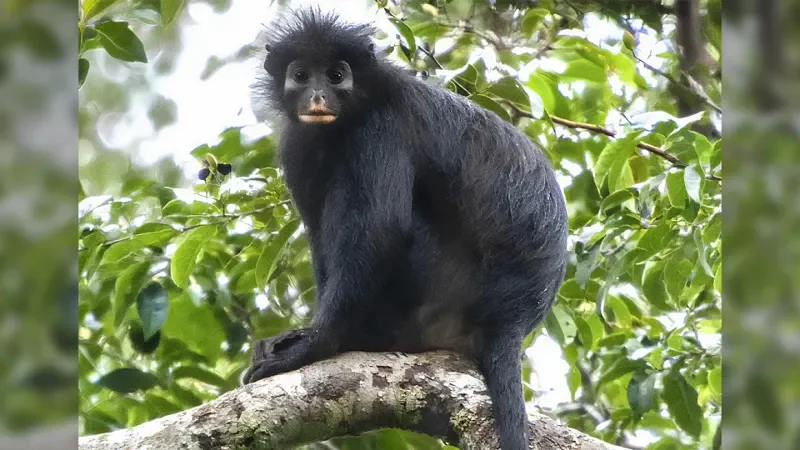
High in the forested canopy of Democratic Republic of Congo, an all-black monkey turned its back to a photographer’s camera. The partial image taken in 2008 revealed little more than the monkey’s dark coat and part of its tail. But it was enough to get Junior Amboko, a biological primatologist at Florida Atlantic University in Boca Raton, and other researchers wondering if the photo revealed a species unknown to science.
Over the next several years, Amboko and his colleagues returned to the dense, closed-canopy forest, where the mystery monkey shared its range with seven other monkey species and bonobos. From 2018 to 2022, the team logged dozens of sightings, noting a distinct orange patch around the monkey’s mouth, and recorded the primate’s deep, distinctive roars. The team also studied skulls from primate carcasses confiscated by the Congolese parks and nature authority.
“Based on the coat color, we knew [the monkey] belonged to the genus Colobus,” says Julia Arenson, an evolutionary biologist with Yale University. “And my first impression of the skull was that it was very similar to Colobus satanas but so much smaller.”
Genetic evidence eventually confirmed that the monkey represented a distinct lineage that had diverged from C. satanas at least 4 million years ago. The monkey was, in fact, a new species, to science earning the name Colobus congoensis, Amboko and colleagues report July 15 in PLOS ONE.
“New primates are rare for science,” says zoologist and primate conservationist Tim Davenport, the Africa director of the conservation group Re:wild. When new species are found, it’s only in “remote, challenging and understudied” areas, he says.
The monkey was known to some local communities by the name of Likweli, though researchers do not know when it was first given that name.
The new monkey species might already be at risk of being threatened or endangered. The monkey is hunted for meat, and its habitat is small — only about 1,700 square kilometers.
Alexander Georgiev, a primate ecologist at Bangor University in Wales not involved in the study, says researchers should prioritize studying the threats facing the new species and work with local communities to protect C. congoensis’ habitat.