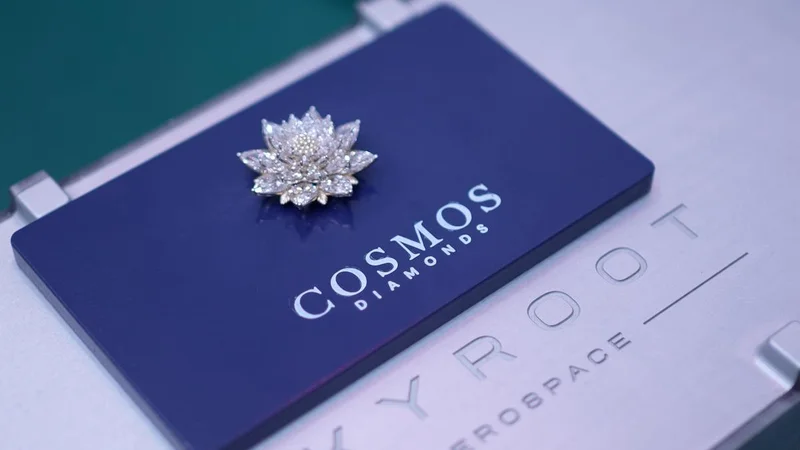
For the first time in the world, a lab-grown diamond jewel has made it to space. Named the Cosmos Bloom Diamond, the jewel, created by Bengaluru start-up Cosmos Diamonds, travelled aboard Vikram-1, the country’s first privately built orbital launch vehicle.
The lotus-shaped jewel is handcrafted in gold and set with 16.9 carats of lab-grown diamonds, and “represents the coming together of India’s heritage, craftsmanship, scientific ambition, and technological innovation”, notes a statement from the start-up.
‘Like a diamond in the sky’
The idea reportedly originated during a casual conversation between Pawan Kumar Chandana, co-founder and CEO, Skyroot Aerospace, and Sanjana, founder of Cosmos Diamonds, about the children’s nursery rhyme Twinkle Twinkle Little Star, which led the duo to wonder whether they could actually place a diamond in space.
“The project was never just about sending a diamond into space. It became a celebration of what Indian innovation can achieve when technology, design, and culture come together. Skyroot is shaping India’s future in space, while we believe lab-grown diamonds represent the future of jewellery. It felt like a natural partnership between two companies building for tomorrow while remaining deeply rooted in India,” said Ms. Sanjana.
Multiple iterations
According to the start-up, the Cosmos Bloom Diamond underwent more than 100 design sketches and 11 production iterations over the course of a year before reaching its final form. Multiple metals and materials were tested to ensure the payload could withstand launch conditions. The final jewel incorporates lab-grown diamonds from India, precision-crafted gold components, custom aluminium elements, and a gold replica of rocket screws designed to securely hold the lotus during flight.
Following extensive technical validation, the payload received approvals from both Skyroot Aerospace and IN-SPACe, the Government of India’s agency enabling space activities.
Six payloads
The other payloads that successfully reached the orbit aboard Vikram-1 include SCOPE, which is Skyroot Aerospace’s in-house atmospheric and Earth observation satellite, SOLARAS, a 1U CubeSat developed by Indian space company Grahaa Space to study solar activity, Embrace, an in-orbit robotic arm demonstration by Cosmoserve Space designed to advance space debris capture technologies, uD3PP and mD3RN, which are in-orbit technology demonstration payloads developed by Germany-based DCubed, and an 18K gold micro-sculpture featuring a rocket carrying microscopic portraits of Indian space pioneers Dr. Vikram Sarabhai, Dr. A.P.J. Abdul Kalam, and Sir C.V. Raman — each smaller than a grain of rice.
Grahaa Space, yet another Bengaluru-based space tech company, on Wednesday (July 29) had announced that SOLARAS, its technology demonstration nanosatellite that reached the low earth orbit aboard Vikram-1, successfully transmitted telemetry signals confirming healthy spacecraft operation.
Published - July 30, 2026 06:23 pm IST