Sign in. It’s quick, free and it’s up to you.
An account is an optional way to support the work we do. Find out more.
*The Housing Essay is a new weekly deepdive from a rotating variety of voices into issues impacting the property crisis in Ireland. Are there potential solutions that may be currently overlooked or traditionally ignored by policymakers? *
ONE ASPECT OF the housing crisis is generally accepted – to fix the problem, we will need higher density builds. More people need the option to live closer together for transport, infrastructure, sustainability and climate reasons.
The high cost of building apartments is well known, but the case for higher densities requires a high proportion of apartments.
However, two radically different types of housing development operate in parallel in Ireland, and raising the proportion of conventional houses in one of them would have little or no effect on the average density of new development.
Analysis of large housing permissions granted by An Bord Pleanála/An Coimisiún Pleanála under the Strategic Housing Development (SHD) and Large Residential Development (LRD) processes illustrates the difference.
Apartment-only permissions were mostly on quite small sites in Dublin, at densities of 100–300 dwellings per hectare (dph), and mixed ones on larger sites, some in Dublin but more often elsewhere, with an average density of around 40 dph.
The differences between high-density, apartment-only developments and medium density, mixed ones reflect government guidelines.
The 2009 ones prevented local authorities from setting upper limits to density in city centre and inner-city areas, and required minimum densities of 50 dph in public transport corridors. This means large applications in those areas are dominated by apartments, and once this is accepted, it makes commercial sense to fit in as many as practicable.
In outer suburban areas suitable for greenfield development, densities of 35-50 dph were required in 2009 but increased to 40-80 dph in suburban areas of Dublin and Cork in 2024.
The minimum end of these density ranges allows worthwhile numbers of semi-detached houses – much favoured by builders – if combined with some apartments, so as to increase density from 25 dph if the development was semis only, to 40 or 50 dph.
In apartment-only developments, inclusion of houses would lead to large reductions in density, often in places where apartment-only development is the obvious planning solution.
This is not so in mixed developments.
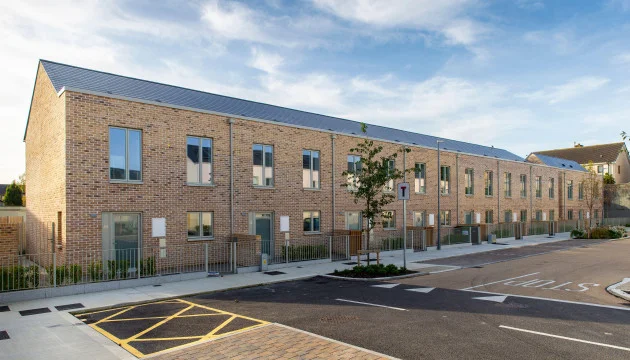
Two-bedroom terrace houses typically have a density of around 40 per ha anyway, similar to actual average densities in mixed developments shown in the graph above.
So the effect of increasing the proportion of two-bedroom houses in mixed developments on density would be neutral, providing the increase in such units was accompanied by balanced reduction in apartments and larger houses, which it would be if density controls were maintained.
If costs per square metre for semis are assumed to be representative of conventional houses in general, an apartment costs around 50% more than a house of the same size:
On this basis, a 75-square-metre terrace house in Cork would cost €290,000 and a 91-square-metre one €350,000, as compared with €420,000 for a semi, €450,000 for a duplex, and €530,000 for an apartment.
From a cost point of view, a new two-bedroom terrace house is the natural starter home.
However, prices do not always reflect costs. At the end of the 1990s, one of the Bacon reports suggested that local authority development plans should require a minimum proportion of two-bedroom terrace houses of, say, 70-square-metres at 40-50 dph. This would cost 20-30% less than a three-bedroom semi, but the report was unsure how far savings would get passed on to purchasers.
This could be addressed by more focused application of the principle that increasing supply relative to demand will reduce prices in a competitive market. At present, this principle is applied to the wrong market segment.
Constant claims that apartment development is unviable or barely viable imply that its costs are close to market prices, so scope for reducing them through competition is minimal.
This is why – rhetoric aside – the government relies on subsidies and watering down of regulations in this segment instead.
Focusing on the supply of two-bedroom terrace houses would make more sense. At present, this is a small market segment, accounting for 3-9% of units in the large mixed permissions in the second chart above.
For comparison, 23-36% of units were two-bedroom apartments (plus many more in apartment only permissions). More terrace houses would increase competition and the proportion of cost savings passed on in that segment.
If two-bedroom terrace houses are profitable, why are so few built?
History provides a clue.
The proportion of terrace houses was lowest – at 3-4% – when prices were high and rising fast, in the late 1970s and late 1990s. Terrace houses were not unprofitable then, but selling larger houses to those with greater ability to pay was more profitable. This seems to be the normal pattern.
Worthwhile amounts of terrace housing were only built in the depressed 1980s.
Developers often claim apartments are ‘unviable’ (i.e. unprofitable or insufficiently profitable) but nevertheless apply for them in large numbers.
This is not simply to allow them to both build semis and meet density requirements. The state also buys large numbers of apartments for social and affordable housing, and a subsidy of up to €144,000 is available on otherwise unviable apartments sold to owner occupiers in the five metropolitan areas under the Croí Cónaithe (cities) scheme.
These and other state interventions reinforce the perception that uneconomic apartment developments will be rescued.
This triangle of incentives – density requirements, greater profitability of larger houses, state funding – needs to be modified.
Local authorities could amend the zoning in suburban areas to require, say, 20-25% of units to be 70-90-square-metre terrace houses. In such areas, the government could limit state funded purchases for social or affordable housing – and discretionary grants like the Croí Cónaithe ones – to developments which included this percentage of terrace housing.
This should not be unduly disruptive, as developers would conform rather than lose potential sales. Density policies, apartment only sites, existing permissions and applications would all be unaffected.
Plenty of apartments would still be built, and the extra two-bedroom houses should be profitable.
There is a supply as well as an affordability case for this. The construction resources needed by different dwelling types are roughly proportional to costs, so lower costs allow more units to be built.
They also allow financial support for more units per € billion of state funding.
If more people can buy or rent new (rather than existing) units, more new construction will occur.
Dr Nicholas Mansergh MIPI was a Senior Planner with Cork County Council until his retirement in 2015. He is the author of The Irish Construction Cycle 1970-2023: policies and escape routes (Eastwood Books, 2024).
To embed this post, copy the code below on your site