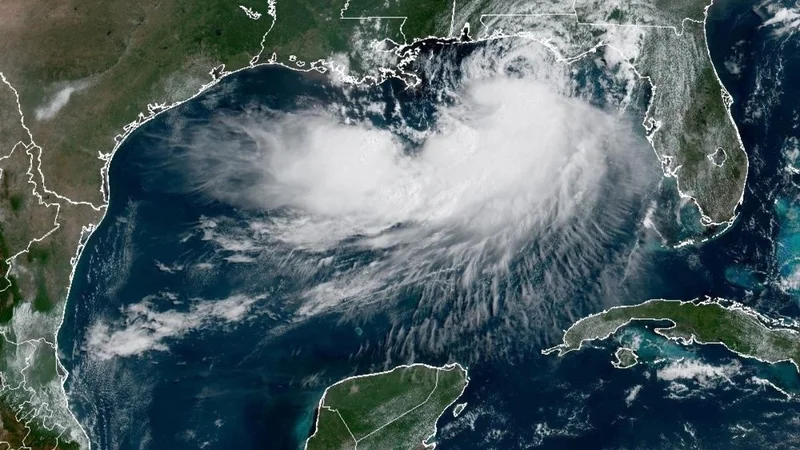
Step outside almost anywhere in India this week, and the sky tells you nothing useful. It is white, wall to wall, horizon to horizon.
That should not be happening. Not this year. Not with a Godzilla El Nino sitting in the Pacific Ocean, an informal nickname climate watchers have given to an exceptionally powerful warming event, first used for the 1997-98 El Nino and again in 2015-16.
Scientists tracking this year's version describe it developing at an unprecedented pace, with a near-certainty of lasting into early 2027. A Godzilla El Nino is meant to starve India's monsoon, not drown it in clouds.
So why is 95 per cent of the country cloudy right now? The short answer is that El Nino and the monsoon do not answer to the same clock.
WHY DOES INDIA HAVE 95% CLOUD COVER DURING GODZILLA EL NINO?
El Nino works from thousands of kilometres away, in the warm waters of the central and eastern Pacific. It bends a giant loop of rising and sinking air called the Walker Circulation, and pulls the rain-making, rising branch of that loop away from South Asia.
That is its whole trick. It tilts the odds over an entire season. It does not micromanage a single week.
This week, the India Meteorological Department has logged an upper air cyclonic circulation, a spinning pocket of low pressure, sitting over Haryana, another over northeast Madhya Pradesh, and a moisture trough stretching from the Bay of Bengal to the Arabian Sea.
Two oceans are feeding India moisture at once. El Nino cannot switch that off from the other side of the planet.
WHY ARE CYCLONIC CIRCULATIONS FORMING OVER THE BAY OF BENGAL AND ARABIAN SEA DESPITE EL NINO?
A cyclonic circulation is a pocket of air spinning inward and rising, the same basic mechanic behind a cyclone, only smaller and gentler.
El Nino discourages these by favouring sinking air over South Asia.
Yet, the IMD is tracking one such circulation over the Westcentral Bay of Bengal, with a trough running all the way to the Arabian Sea, and another over southwest Rajasthan.
These systems build on local heat and moisture, the same ingredients behind any thunderstorm, and both seas still hold plenty of warm surface water to fuel them.
El Nino can shift the odds, but it cannot stop a circulation forming the moment local conditions turn favourable, and this week, they turned favourable on both coasts at once.
WHY HAS THE MONSOON REVIVED THIS WEEK?
Picture the monsoon trough as a conveyor belt for rain. For days, it sat too far north. Now it has slid back to its normal position over the plains, and the Bay of Bengal has switched its moisture pump back on through fresh cyclonic circulations.
The IMD's July 21 bulletin already records very heavy rainfall, between 12 and 20 centimetres, across West Bengal, Himachal Pradesh, Uttarakhand and Gujarat in a single day, with more forecast through the week.
WHAT IS THE INDIAN OCEAN DIPOLE, AND HOW DOES IT HELP?
Think of the Indian Ocean Dipole as India's own backyard El Nino. It compares sea temperatures on either side of the Indian Ocean, near Africa in the west and near Indonesia in the east.
When the west runs warmer, called a positive dipole, it pumps extra moisture towards India, partly cancelling El Nino's dry pull.
The Indian Ocean Dipole acts as a natural counterweight to El Nino's drying effect on India. In 1997, a strong positive IOD saved India from drought despite a raging Super El Nino. In 2026, the IOD remains neutral and offers no such protection. (Photo: Radifah Kabir)
That is exactly what saved India from disaster in 1997-98, the very year that gave the Godzilla El Nino its name.
This year, the dipole is sitting near neutral. It is a bystander, not a rescuer.
IS THE MONSOON DEFICIT OVER?
Not yet, and probably not soon. A white sky is not the same as a full reservoir.
Rainfall deficits accumulate over months, and a Godzilla-strength El Nino keeps leaning on the season as a whole. What this week proves is smaller, but no less remarkable.
For a few days at a time, ordinary weather can outwit an extraordinary ocean.
- Ends
Published By:
Radifah Kabir
Published On:
Jul 22, 2026 13:06 IST