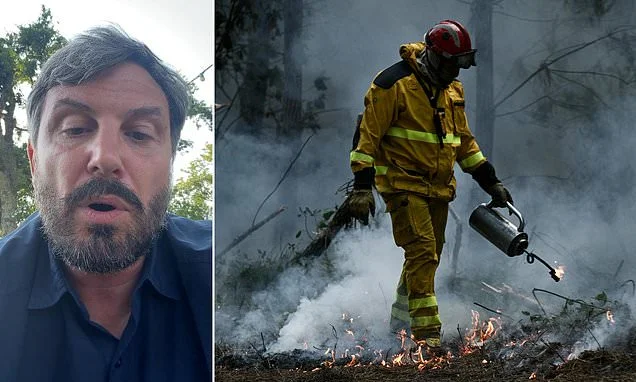
- LISTEN: France on Fire: Is the Worst Yet to Come? Listen to the latest Daily Mail Deep Dive podcast
- READ MORE: 'There's nothing left, it's all gone': Homeowner in France wildfires tells of devastation after battle to save his home
- See more Daily Mail on Google - save us as a Preferred Source
On the latest episode of the Daily Mail's Deep Dive podcast, Chief Foreign Correspondent Andy Jehring speaks to senior reporter James Fielding in Le Porge, a fire-ravaged village in southwestern France that remains largely sealed off from the outside world.
Due to unprecedented summer heat across Europe, Britain, France, Spain and Greece are all battling major wildfires, with France enduring its worst season on record.
One of the worst affected parts of the continent is southwestern France, where fire has torn through an area four times the size of Paris. Over 250,000 people have been evacuated as the inferno bears down on Bordeaux, France's wine-making capital.
The fire broke out near the village of Saumos on 22 July before winds drove it towards Bordeaux. In nearby Le Porge, one of the worst-hit villages, Fielding told Deep Dive that residents feel they were 'abandoned' as fire crews were diverted to protect Cap Ferret, an affluent enclave beloved by tourists and second-home owners.
Due to unprecedented summer heat across Europe, Britain, France, Spain and Greece are all battling major wildfires, with France enduring its worst season on record
He said: 'Speaking to a few people in Le Porge, they are unhappy with the local government. They're saying no lessons have been learned from a similar fire that happened in 2022.
'They said they didn't receive any SMS texts to their phones. There were no warnings. They only knew there was a fire because it was on the news.
'No one came to warn them prior until it was almost upon them. One resident said there were six fire crews in the vicinity, but most were diverted to Cap Ferret.
'They feel as though Le Porge was left abandoned in favour of Cap Ferret, which is home to a lot of wealthy people and tourists as well. So, there are mixed feelings on how the government and local authorities have handled it.'
Fielding and photographer Tim Clark were among the first journalists allowed onto the D106, the 41-mile road linking Cap Ferret to Bordeaux that he dubbed the 'highway to hell'.
The route cuts through the heart of the fire zone, and Fielding described an 'eerie', apocalyptic scene, with charred ruins of homes, burnt-out cars and dead animals littering both sides of what was once a busy through road.
'There was not a soul around apart from fire crews, policemen and local volunteers', he said.
'It was very apocalyptic. We looked at these houses that had been burnt to a crisp.
'There was one large house, set back just off the carriageway. Before the fire, it had been protected by a high hedge. That hedge had been completely burnt away and it exposed this sort of charred shell of what was once the house.
'Remarkably, there was a child's Wendy house that remained completely untouched, sitting just six or seven feet away from the property.'
Elsewhere in the podcast, the reporter warned that conditions on the ground mean the danger is far from over.
One of the worst affected areas on the continent is southwestern France, where fire has torn through an area four times the size of Paris
Elsewhere in the podcast, the reporter warned that conditions on the ground mean the danger is far from over
'Look, it has been 40 degrees for many days now', Fielding said.
'They have not had much rainfall at all. The conditions are that any kind of spark will set off a fire.
'That's obviously been replicated in Madrid and now in Greece… in Britain and France we've had four heatwaves.
'A few years ago, to have temperatures in the mid to late 30s in the UK was very uncommon. Now, they seem to be happening every year.'
Hear Fielding's full report by searching for Deep Dive, wherever you get your podcasts.