When Braam Collins, a South African computer programmer based in Linköping, got a message from the Migration Agency in early June inviting him to take the new civics test for citizenship on August 15th, it came completely out of the blue.
"I found it quite strange because my case had been stagnant for two-and-a-half years and then all of a sudden 'we can make movements'," he says, complaining that he had experienced "radio silence" from the Migration Agency before that point.
The first sign something was happening was a message on his Min Sida page on the Migration Agency website, telling him that he would be sent a message. "Then you have to sit and wait anxiously for a couple of days for it to reach your mailbox."
When it arrived, it was an invitation to register for the civics test, plus a link to the application website.
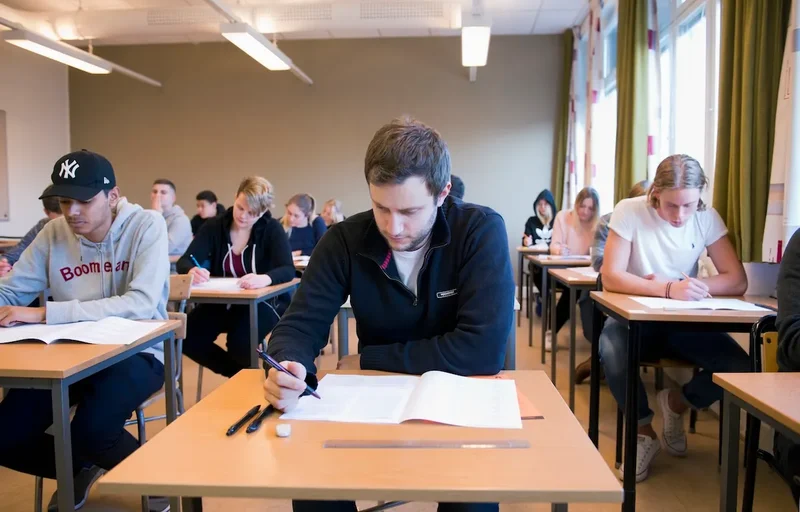
On August 15th, Sweden will hold its first civics test for citizenship, which is the only practical way of demonstrating the civics knowledge now required as part of the country's new stricter requirements for citizenship, and from June 6th those eligible to take it were contacted by the Migration Agency.
You can also qualify for the new citizenship rules by achieving a passing grade in civics (called samhällskunskap) at lower secondary school, but this is not realistically something most applicants will have done.
READ ALSO: How can you show proof of Swedish and civics knowledge for citizenship
Amanda, a software developer from Latvia, was equally surprised when she got her invite.
"I wasn't expecting it at all, because there's been absolutely nothing on my case since I sent it in and it's been two years," she says. "Then suddenly there was a message in my email that 'you've received an update in your case', and I log in and there was just this message saying I could take the test."
For Carlos, from Portugal, the surprise was more that he was not granted citizenship before June 6th, when the new stricter citizenship requirements came into force.
"They had asked me to do everything three weeks before June 6th and I sent them my passport, documents and everything," he remembers.
So when, instead, he was invited to take the civics test just a few days after the new law came into force it was "a surprise from nowhere" and, if anything, a disappointment.
READ ALSO: Everything you need to know about the civics test for citizenship
READ ALSO: How can you show proof of Swedish and civics knowledge for citizenship?
'Jumped on it straight away'
Amanda, though, saw the invite as unalloyed good news.
"It was pretty exciting. It meant that I wasn't getting rejected straight away and I had a chance, so I jumped on it straight away and booked the test," she tells The Local.
Others had more questions. Several of those who spoke to The Local were confused about a passage in the invitation telling applicants that they should not apply to take the test if they could not prove that they could speak, write and understand Swedish, either by showing their SFI leaving documents or other evidence.
Because Braam Collins has a high level of Swedish, he decided to register despite lacking any such documentation.
"I signed up anyway and they allowed me to register, so I will find out on the 15th if I can actually do it. They did say that I'm accepted to write it. But I found it very weird that it's a requirement."
For him, the most distressing aspect of the invite letter was that his wife, who arrived from South Africa in Sweden on the same day, and applied for citizenship together with him, did not receive an invite.
**READ ALSO: Can you pass The Local's mock citizenship test? **
Language concerns
Carlos, from Portugal, was confused enough not to apply. He has only done two courses at Folkuniversitetet, and had no certificate proving his level of Swedish.
He also misunderstood the nature of the test, believing he would be required to write texts in Swedish on some of the topics in Sverige I Fokus, the information booklet the Swedish Council for Higher Education prepared to help people prepare. It is in fact a multiple choice test.
"I didn't apply, because I thought I wouldn't be able to do it," he remembers. "When me and my wife looked at the booklet online, she just laughed, and said 'I'm a Swedish citizen and I know none of this'.
"So I think my Swedish is not a high-enough level," he continues. "Now I think I need to contact them to say 'do I need to apply all over again'?"
Amanda's partner, who is from the US, was also invited to apply and decided not to because he didn't think his Swedish was good enough.
"He doesn't think he has Swedish at the high level required, so he has very big doubts if he's going to get his citizenship now," she said. "We don't know what will happen if he doesn't take the test. Does he get more time or something? We have no clue."
READ ALSO: What's in the study guide for the Swedish civics citizenship test?
No grading criteria
A PhD holder based in Sodertalje, working for Scania, said that she had decided not to apply because neither the Migration Agency, the Swedish Council for Higher Education (which is organising the tests) or Gothenburg University (which designed the questions and required knowledge), had spelled out how many questions examinees need to answer correctly to pass.
"I found it very risky to apply for a test with a high level of uncertainty about the assessment criteria," she told The Local in an email.
Collins is also worried by this, but as with the need to prove language knowledge, decided to take the test anyway.
"They haven't posted what the passing score should be: should you get eighty percent? Should you get eighty five percent? Should you get ninety percent?" he said. "That's something that I find strange, I did some research, and it's not quite illegal, but to me it feels the first set of people that write this test are going to set the passing rate. I guess we're gonna be used as a benchmark."
**Travel and practical preparations **
The decision to hold the test in Stockholm went down badly with Amanda, who has to travel from Lund.
"It's a long and expensive trip. I had to book a train and a hotel and it's going to cost me quite a bit. And I have to take time off on Friday to travel there for Saturday," she says. "It would be great if it was somewhere closer like Malmö."
Collins can do it as a day trip from Linköping.
"It's probably a blessing in disguise that that my wife didn't get to write the test as well because we have two kids and we don't really have family here, so I don't have anywhere to leave them on a Saturday," he says.
Both he and Amanda plan to take as little as possible into the examination room – just a pencil and an eraser.
"I hope they have good storage for everything, since I'm coming across the country," Amanda said. "I hope they have safe storage for phones and watches."
Confident
Both Amanda and Collins seem to think the test will not be particularly challenging.
"I've read the Sverige i Focus and it seemed really basic and easy," Amanda said. "I think for a person who just generally follows the news and reads and has studied a bit, there's nothing really special. It seems really easy to pass."
Collins has also been reading through the Sverige i Fokus booklet and trying to learn any facts he does not yet know.
"I don't think it's that difficult, but with some of the questions, I don't understand why it should be so important for someone to know – like, 'what mountain range was important for Sweden's economy in the 17th century?'. To me it's not gonna it's not gonna affect me or anyone else knowing that information."
He is upbeat about his prospects.
"I've been living here for ten years so I feel like I know quite a bit," Collins says. "Someone has made an online questionnaire you can do, and I got, like 90 percent of them right. I'm quite confident that I'll pass."