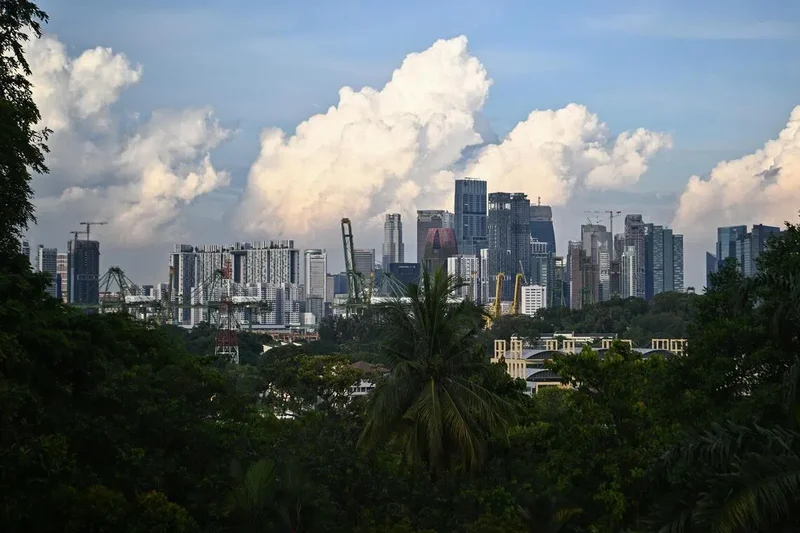
Two-thirds of buildings in S’pore are now green, on track to meet targets set for 2030
AI generated
SINGAPORE – Two-thirds of Singapore’s buildings are now green, achieving lower carbon footprint and higher energy savings to stay on track to meet the building sector’s 2030 targets.
The target is to have 80 per cent of all buildings here attain the Building and Construction Authority’s (BCA) Green Mark certifications awarded to residential and commercial developments, or meet environmental sustainability regulations by 2030.
Such regulations include ensuring that chiller plants in new and existing buildings use energy more efficiently.
The target is one of three goals set for the building sector under the Singapore Green Building Masterplan.
The other goals set for 2030 are to have 80 per cent of new developments to be Super Low Energy (SLE), and to have the highest performing green buildings use 80 per cent less energy than buildings in 2005.
SLE buildings must use at least 60 per cent less energy than they did in 2005. More than 30 per cent of new developments today have achieved SLE status. Also today, the highest performing green buildings use 72 per cent less energy than buildings in 2005.
The building sector contributes 20 per cent of Singapore’s greenhouse gas emissions and is the second-largest consumer of electricity after the industrial sector.
“The ongoing Middle East crisis is a timely reminder of the importance of energy resilience,” said Minister for Sustainability and the Environment Grace Fu on July 30.
“Beyond strengthening our energy supply chains, improving energy efficiency and conservation are equally important to manage energy demand and operational risks. These efforts lower operational costs and support broader sustainability goals.”
She was speaking at the Singapore Green Building Council’s awards gala dinner at The Ritz-Carlton, Millenia Singapore.
“These targets are not just about decarbonisation. Green buildings make strong business sense,” Fu said.
She said that developers of SLE commercial buildings typically recover their upfront investments within five to six years. After that and throughout the buildings’ lifespan, they continue to save on energy bills.
The public sector has been leading the way in making SLE buildings, including the Singapore Examinations and Assessment Board’s headquarters, mainstream.
A study BCA commissioned in 2024 identified alternative methods to cool buildings to allow leading green buildings to achieve 80 per cent energy efficiency, up from 72 per cent now.
They include setting the air-conditioning at a higher temperature while turning on fans, or running chilled water through special ceiling panels to absorb heat in a room. Building owners can also spell out eco-friendly requirements in tenant leases.
Energy-guzzling conventional air-conditioning are responsible for 40 to 60 per cent of a building’s energy consumption.
Fu noted that nearly 50 buildings in Singapore have adopted alternative cooling methods to date.
BCA said that the use of air-conditioning set at a higher temperature of up to 27 deg C and fans, known as hybrid cooling, is the most widely used as there is no need for major retrofits. To date, 26 buildings have adopted this cooling method.
One of them is The GEAR, Kajima Corporation’s regional headquarters in Changi. It is one of 24 building projects, professionals and organisations that received a Leadership in Sustainability Awards on July 30 for its contributions to Singapore’s green building movement.
Another award recipient is Paya Lebar Green, an office development that has installed ceiling-mounted beams with coils circulating chilled water to absorb room heat.
“While the solution involved a modest upfront investment, the cost premium was less than 1 per cent of the overall construction cost,” said Yong Siew Onn, director of DP Sustainable Design, the architect behind the facility.
This investment is projected to be recovered in less than five years through reduced energy use and lower operating costs, he said.
Fu added: “As the world grapples with a warmer environment and more frequent and extreme heatwaves, technology and knowhow in building and running resource efficient buildings represent green growth opportunity.”