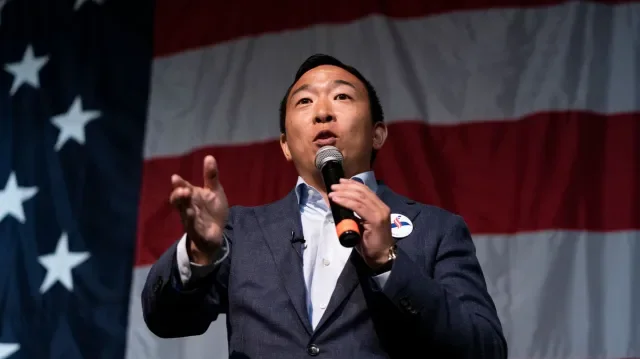
“Hey, Yang, where’s my thousand bucks?” It’s a question entrepreneur and political commentator Andrew Yang hears a lot. So often, he turned it into the title of his new memoir, Hey Yang, Where’s My Thousand Bucks? and Other True Stories of Staggering Depth. It’s not a bad question to ask. Universal basic income (UBI) was a core talking point of Yang’s energizing but ultimately unsuccessful 2020 presidential campaign, as well as his run for mayor of New York two years later, where he hoped to test its potential in a city-wide pilot study. It is, however, far from the only question worth asking Yang. Though he has spent the past few years on the political sidelines, many of his once unconventional talking points — UBI, ranked-choice voting, and the dysfunction of the two-party system — have become far more mainstream. Between AI threatening white-collar jobs and political polarization creating opportunities for independent candidates, one wonders whether Yang was ahead of the curve and the rest of us have finally caught up. If so, what then does he think the country’s future will look like? In a New York state of mind Timing definitely appears to have played a role in Yang’s previous electoral defeats, especially in New York. “When I ran for mayor in 2021,” he tells Big Think, “the city was still closed down for COVID, and there was a primal concern about crime and safety.” This concern played to the strengths of his rival candidate Eric Adams, a former police officer who opposed defunding law enforcement. Four years later, things were different. Post-pandemic inflation had raised the city’s cost of living to new heights, and Adams’ involvement in corruption scandals left many voters desperate for a politician who could represent the working class. These conditions created a favorable climate for New York’s current mayor, Zohran Mamdani, who, much like Yang before him, ran on a platform that emphasized affordability. Though by no means identical, their agendas did overlap. Mamdani has expressed interest in UBI and credited Yang for bringing the concept “to the forefront of consciousness across the country.” This suggests that Yang may have stood a better chance in 2025. But while Mamdani’s election as mayor left many progressives feeling hopeful, the challenges he has encountered in office — such as his struggle to free up funding from the state legislature in Albany — point to something Yang has been saying for years: Improving the lives of ordinary Americans is not a matter of electing the correct politicians, but changing politics itself. The greatest political evil Although a former Democrat, Yang is one of the country’s most vocal critics of the two-party system. “We are witnessing the worst of all possible worlds,” he tells Big Think. “For one, we are subject to authoritarianism because the majority of people in a particular party will back their own party no matter what because they find the other party totally unacceptable.” He adds that the two-party system not only makes government more dangerous, but also ineffective. “What actually happens to families and communities is pretty much irrelevant. Imagine that you are a farmer or a teacher in Montana. What is your feedback mechanism? It’s increasingly a one-party state, so the party in charge can more or less ignore you.” He also doesn’t think this system is what the Founding Fathers envisioned when they won independence from England 250 years ago. “There is nothing in the Constitution about the two-party system,” Yang says. “Washington warned against factions on his way out. John Adams said having only two parties would be the ‘greatest political evil.’ It’s not an intelligent design.” Despite these warnings, the U.S. has never managed to become a multi-party state like Germany or Canada. Although third-party and independent candidates have popped up from time to time, their influence on politics, especially national politics, often lands somewhere between limited and negligible. Today, third-party and independent candidates seem to be facing even slimmer odds than they did in the past. The most successful third-party candidate for president in recent memory, Ross Perot, secured 18.9% of the popular vote in 1992 and 8.4% in 1996. Compare that to the Green Party’s Jill Stein, who in 2024 won only 0.6% of the popular vote yet was still the best-performing third-party candidate of that year. Part of this development can be linked to polarization. America’s political landscape is more divided today than it was in 1992, when Bill Clinton and George H.W. Bush both ran relatively centrist campaigns. But polarization also brings opportunity, Yang points out. The more fed up voters get with Democrats and Republicans playing musical chairs, the more open they’ll be to considering alternatives. “The Democratic Party currently has the highest disapproval rating I’ve ever seen in my lifetime,” Yang says. “And the Republicans are right there with them.” Meanwhile, the number of Americans who think a third party is needed has increased. For many, fear of a “spoiler effect” — of additional candidates splitting the vote to their preferred major party’s disadvantage — no longer outweighs their frustration with partisan gridlock. The demand is there, and has been for some time; what’s missing is a robust supply. Forward This is why, after severing his ties with the Democratic Party in 2021, Yang helped found Forward: a political action committee that endorses independent, Democratic, and Republican candidates across the country, focusing on state and local elections. Representing the “common-sense majority,” Forward hopes that by avoiding ideological conflicts in favor of practical problem-solving, they can attract voters from across the political spectrum. So far, they have supported dozens of elected officials. The recent victories of several Mamdani-backed candidates in New York’s Democratic primary also reflect the growing demand for political alternatives. Though technically part of the Democratic Party, Mamdani’s success arguably results from his willingness to break with the establishment. In this sense, he and other members of the Democratic Socialists of America (DSA) represent a party within a party. But seeking change from within has its limits. One advantage Forward has that the DSA does not, Yang explains, is that the independent or Republican candidates they affiliate with can “compete in places where a Democratic candidate would be unsuccessful.” Of course, Forward has its critics also. In an article published by The Atlantic, a former Republican said they left the North Carolina chapter after becoming frustrated with its lack of structure and direction. “Officials,” they wrote, “seem hesitant to commit to specific issue positions,” while vague slogans like “free people” and “vibrant democracy” feel more like empty buzzwords than helpful goalposts. Forward’s insistence on community-driven policy also raised concerns with the author. Even after hosting several town halls to learn what people really wanted from their representatives, questions “never seemed to be answered.” Then there is the party’s name and what it represents. Is there really such a thing as moving forward in politics, as opposed to left or right? Is it possible to formulate policies without running into irresolvable conflicts of interest between different groups? Many people who support candidates like Mamdani doubt it. The way they see it, politics will always be a struggle between capital and labor, and one cannot thrive without doing so at the expense of the other. According to this view, the only way to improve the quality of life of working-class people is to have a government that fights on their side, and their side only. The crisis is already with us While the effectiveness of Forward’s positioning and strategy is up for debate, the phenomenon that underpins it is not: People are increasingly sick of both primary parties and desire something else. Consequently, it stands to reason that candidates who promise something else can become more popular. “A multi-party system is no panacea,” Yang admits. If it were, a country like the Netherlands — whose current parliament counts no less than 17 parties — wouldn’t be facing many of the same issues America does. However, he still thinks having more than two parties would change things for the better, not least because of the pressure they’ll exert on the two main ones. The less intense the competition, the lower the incentive to improve, Yang adds. That’s true in economics, and it’s true for politics as well. If a third party, one able to cut through the divide, could actually deliver on its promises, Democrats and Republicans alike will have to step up their game if they wish to stand a chance at reelection. In the Roman Republic, endless back-and-forth between plebeian and patrician political factions created such chaos and deadlock that the state gave way to one-man rule. That’s one potential future awaiting America, and many scholars fear that’s where we’re headed. Another, more democratic route would see the country transition from a two-party into a multi-party system, one where mutually exclusive interests no longer cancel each other out. Whatever will happen, Yang doesn’t think we’ll wait much longer. “I would argue that the crisis is already with us in terms of Americans’ ability to afford a decent life for themselves and their families,” he concludes. “Young people don’t feel like they have the same level of opportunity that their parents did, and their parents agree with them. The need is there.” This article America doesn’t need new politicians. It needs a more political competition. is featured on Big Think.
America doesn’t need new politicians. It needs a more political competition.