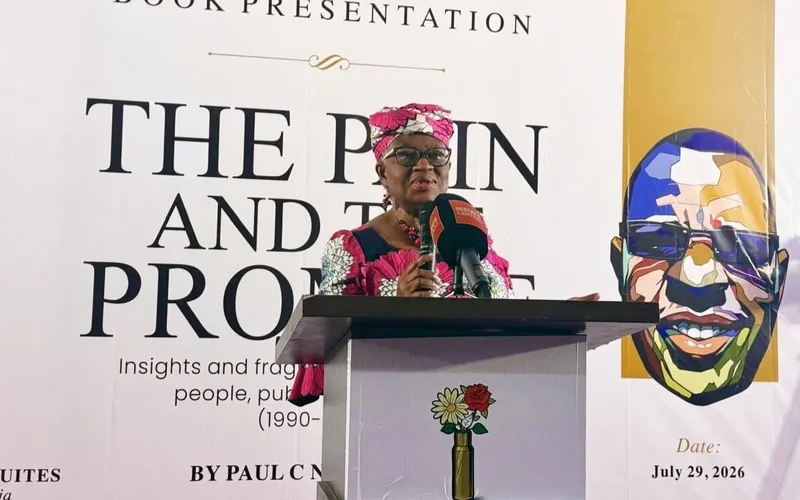
The Director-General of the World Trade Organisation (WTO), Ngozi Okonjo-Iweala, on Wednesday reflected on Nigeria’s economic reform programme under former President Olusegun Obasanjo, saying public understanding and support were indispensable to the reforms that culminated in the country’s landmark debt deal.
Mrs Okonjo-Iweala spoke in Abuja at the public presentation of a book titled ‘The Pain and the Promise: Insights and Fragments on Nigeria and People, Public and Personal (1990–2026), written by communications strategist and public policy analyst Paul Nwabuikwu.
The WTO boss said strategic public communication played a crucial role in Nigeria’s successful negotiations for Paris Club debt relief.
Before the agreement, Nigeria’s external debt had grown to about $36 billion, much of it accumulated during the military era. In 2005, Nigeria secured about $18 billion in debt relief from the Paris Club after agreeing to pay about $12 billion, significantly reducing the country’s external debt burden and creating fiscal space for economic reforms and public spending.
| | |
|---|
Ms Okonjo-Iweala, who served as finance minister and led Nigeria’s economic management team during the negotiations, said she understood from the outset that implementing the reforms would require not only sound economic policies but also effective communication with Nigerians.
“I had been brought in from the World Bank to help straighten up and strengthen Nigeria’s weak finances, including getting rid of the $30 billion of the country’s debt owed to the Paris Club,” she said.
“To do this work, I knew Nigeria would have to undertake serious economic reforms of the type that would demand understanding and sacrifices from Nigerians,” she added.
She said that conviction led her to bring Mr Nwabuikwu into the economic management team to help explain the reforms to Nigerians.
“One important component in my mind then was that we would need a crack communications person or team to help us reach Nigerians, to explain all of this in simple language. That is where Paul came in.”
Describing the author as “smart, articulate, compassionate, a terrific writer and communicator,” Ms Okonjo-Iweala said his ability to simplify complex economic policies helped build public understanding of the reforms.
“I can say without fear of contradiction that we wouldn’t have had as much success with the reform programme if we had not had a masterful steering of communications from Paul,” she noted.
She added that democratic reforms require more than sound policy design.
“Reform is not just about writing new laws and enforcing new policies. It’s about persuading people, explaining trade-offs and building enough trust that governments can keep pushing through obstacles.”
National consensus
Beyond the debt negotiations, the WTO chief said Nigeria’s long-term economic progress would depend on its ability to overcome ethnic, religious and regional divisions.
She argued that sustainable development requires a national consensus on key policy directions that outlives successive governments.
“Until Nigerians can overcome the ethnic, religious and regional divides embedded in our society to forge a social compact that agrees key directions for the nation, directions that remain steady no matter who is in government, I think Nigeria will find it difficult to move forward at the pace required to create enduring prosperity for our people,” she said.
Reviewing the publication, Ms Okonjo-Iweala described the 300-page book as “a great achievement” that combines decades of public commentary with vivid memories and thoughtful reflections on Nigeria’s evolution.
She said the work captures the country’s journey through military rule, democratic transition, economic reforms and other defining moments, recommending it particularly to young Nigerians seeking to better understand the country’s history and contemporary challenges.
Former Minister of Aviation and Chairman of the Athena Centre, Osita Chidoka, also lauded the publication, describing Mr Nwabuikwu as one of his favourite columnists whose writing consistently combines analytical depth with humanity.
According to Mr Chidoka, the author has distinguished himself over the years through thoughtful commentary and a remarkable command of language, making his interventions on national issues both insightful and accessible.
Similarly, the Vice-Chancellor of Baze University, Abiodun Adeniyi, who reviewed the book, described it as “a chronicle of Nigeria’s contemporary experience” and “an archive of conscience.”
Mr Adeniyi said the collection transcends a compilation of newspaper essays, documenting Nigeria’s political, economic and social evolution while preserving the country’s aspirations, contradictions and defining moments through the eyes of an experienced journalist and public affairs analyst.
The book
According to the organisers, The Pain and the Promise is a collection of essays, commentaries, analytical articles, poems and a short story written between 1990 and 2026.
The publication explores themes of leadership, governance, citizenship, justice, memory and hope, while revisiting major episodes in Nigeria’s history, including military rule, the return to democracy, economic reforms and contemporary public affairs.
The organisers said the book also reflects on prominent figures, including Nelson Mandela, Obafemi Awolowo, Chinua Achebe, M.K.O. Abiola, Fela Anikulapo-Kuti, Sani Abacha and Burna Boy, alongside lesser-known Nigerians whose stories have shaped the country’s public discourse.
In the book’s foreword, Vanderbilt University professor of African history, Moses Ochonu, described the publication as “a rare blend of exquisite prose styling, poetic word crafting, piercing sociopolitical commentary and deep philosophical reflection.”
He said Mr Nwabuikwu’s experience across journalism, public service and corporate communications enabled him to document and interpret many defining moments in Nigeria’s contemporary history, producing a work that blends literary craftsmanship with thoughtful reflections on the nation’s public life.