Here is the unglamorous truth about consumer crypto: the interface is maybe a tenth of the product. Anyone can ship a slick app that shows a Bitcoin balance going up.
What separates a toy from a financial platform is everything the user never sees: the identity checks that satisfy three regulators on two continents, the fraud engine watching every card transaction, the custody architecture holding the assets, and the liquidity plumbing that decides whether a customer's buy order fills at a fair price or a bad one.
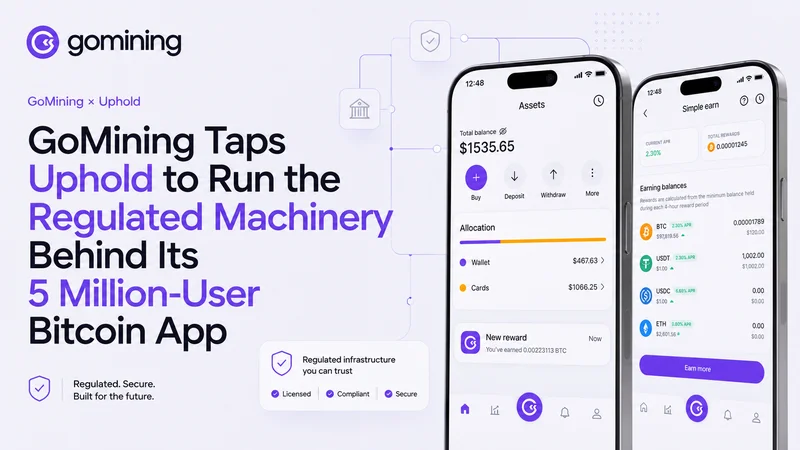
GoMining just made a decision about that invisible nine-tenths, and it is one of the more instructive infrastructure deals in crypto this year. The company, which has grown a tokenized-hashrate experiment into a Bitcoin superapp with 5 million users and a top-10 global position by hashrate, has integrated Uphold's Platform-as-a-Service to run its digital asset operations end to end. Uphold takes onboarding, compliance workflows, fraud controls, custody and liquidity. GoMining keeps the thing that actually compounds: the customer.
The integration is deliberately invisible. GoMining's users will set up accounts, fund them, and buy, sell and hold crypto without ever leaving GoMining's branded interface, while Uphold fulfils the workflows in the background. That word "invisible" is doing a lot of work. It is the same architecture that let Stripe turn payments into a line of code and let banking-as-a-service turn neobanks into a product category. Crypto is now having the same moment, and this deal is what it looks like in practice.
The Several-Years Problem
The release contains one sentence that explains the entire transaction: building the required features and acquiring the appropriate licenses itself would have taken GoMining several years. That is not corporate modesty. It is an accurate description of the compliance wall every consumer crypto company eventually hits.
The industry benchmarks make the calculus vivid. Building a production-grade wallet and custody stack in-house runs 12 to 18 months of development and $2 to 5 million over three years before a single license application is filed. Multi-jurisdiction licensing stacks years on top of that. Crypto-as-a-service integrations, by contrast, compress time-to-market from 12 to 18 months to weeks, with cost savings industry analysts put above 80% versus custom development.
And the clock matters more now than at any point in crypto's history, because the deal's most revealing detail is buried in the details, the integration will initially benefit US users. Read that against Uphold's credential sheet, regulated by FinCEN and state regulators, with a broker-dealer subsidiary registered with the SEC and a member of FINRA and SIPC and the shape of the play emerges. With US regulatory clarity finally hardening into workable rules, the US is the growth market again, and GoMining is buying compliant American distribution off the shelf rather than spending three years assembling it. Speed to market is not a convenience here. It is the entire trade.
What Five Million Users Actually Inherited
The liquidity mechanics deserve more attention than partnership announcements usually get, because this is where the deal quietly upgrades the end user's economics. Uphold integrates with more than 30 trading venues across centralized and decentralized exchanges, and polls the market on every transaction to optimize pricing. For a retail user buying $50 of Bitcoin inside a mining app, that is the difference between taking one exchange's spread and receiving something closer to institutional best execution, without knowing the machinery exists.
Layer on the trust architecture and the picture completes. Uphold never loans out customer assets except at customer request, holds 100% reserves, and publishes its assets and liabilities every 30 seconds on a public website, a radical-transparency posture it pioneered years before proof-of-reserves became an industry talking point. For GoMining's audience, mainstream consumers who came for accessible mining rather than crypto ideology, inheriting that stack matters precisely because they will never have to think about it. Mark Zalan, GoMining's CEO, framed the evolution plainly: the company has moved beyond democratizing mining access to supporting payments, education and ecosystem products in one app, and partnering with what he called Uphold's battle-tested platform is what lets that growth stay sustainable.
The Miner That Became a Fintech
The counterparty here is not a startup renting credibility. GoMining's trajectory over nine years is one of the quieter compounding stories in Bitcoin. Founded in 2017, it tokenized its first 100,000 TH/s of real capacity in 2021, turning Bitcoin hashrate into a liquid, tradable asset class years before real-world asset tokenization became a narrative. By October 2025 it counted 4.5 million users and more than 10.7 million TH/s deployed across data centers in the US, Africa and Central Asia. In 2026 alone it launched the GoBTC Pay protocol at Consensus Miami and, in June, became the first miner to build its own block template using Stratum V2's Job Declaration feature, a genuine technical first for mining decentralization.
That last milestone is worth pausing on, because it frames the Uphold deal correctly. GoMining is not outsourcing because it lacks engineering depth; a company shipping Stratum V2 firsts clearly does not. It is outsourcing because compliance infrastructure is a different discipline from mining infrastructure, one where the moat belongs to whoever accumulated the licenses, the fraud data and the regulator relationships over a decade. Recognizing which layer of the stack is yours to win and which is rented is what operating maturity looks like, and it is the same judgment call Freehand's Fortune 500 customers and every serious fintech before them have made.
The deal cuts the other way too. For Uphold, whose enterprise arm is turning a decade of consumer-grade licensing and liquidity into a Platform-as-a-Service business, GoMining delivers something no marketing budget can: five million users of distribution in a single contract, with zero customer acquisition cost, and a marquee logo for the next enterprise pitch. O'Connell's note that partners can adopt each new Uphold retail innovation as it ships turns the platform into a subscription to Uphold's entire roadmap.
Final Thoughts
Strip away the partnership language and this deal is a statement about where value sits in consumer crypto's next phase. The interface layer is commoditizing; the regulated layer is consolidating. Companies that own audiences, and at 5 million users GoMining owns a genuine one, will increasingly rent the compliance perimeter from the handful of platforms that spent a decade building it, the way every neobank rents banking rails today. The winners on the infrastructure side will be decided by exactly the factors GoMining says drove its selection: approval rates, geographic license coverage, and the pace at which new capabilities ship through the API.
The subtler signal is what this says about Bitcoin mining as a category. The industry's public story in 2026 is hyperscale, AI compute pivots and power contracts. GoMining is running the opposite play: aggregating millions of small participants into top-10 hashrate and then wrapping them in consumer fintech, recurring buys, staking, cards, payments. That model lives or dies on trust and regulatory durability, which is precisely what this integration purchases. Watch two things from here: how quickly the initial US rollout extends into Uphold's 140-plus-country footprint, and whether other audience-rich crypto brands follow GoMining behind the same API. If they do, the market will have confirmed that in crypto, as in fintech before it, the front stage and the back office are now separate businesses.
Don’t forget to like and share the story!
Vested Interest Disclosure: HackerNoon has reviewed the report for quality, but the claims herein belong to the author. All market data is independently sourced and hyperlinked. Do your own research. #DYOR.