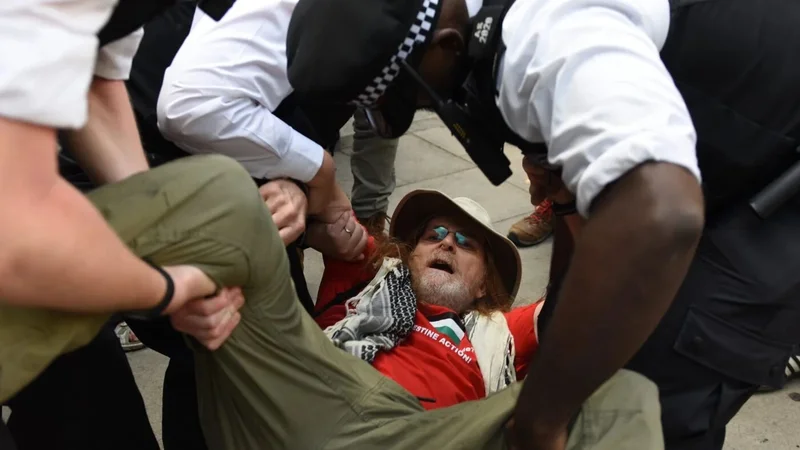
Chaos at London court as over 1,500 Palestine Action cases listed in one day
Over 1,500 people facing terrorism charges in connection with Palestine Action protests had their cases listed for hearings in London on Thursday, causing "chaos" in the city.
The campaign group Defend Our Juries (DOJ) reported that hundreds of people who faced terrorism charges for allegedly holding signs in support of the banned direct action group Palestine Action had been informed that their trials, initially scheduled for 30 July, were postponed until October.
However on Wednesday some 1,579 people - including those who had received letters notifying them of the adjournment - were listed for trials on Thursday by Westminster Crown Court.
Notices contained contradictory information. One letter seen by Middle East Eye informed the recipient that they “must attend” the 30 July hearing, before instructing them: “Please do not attend court” on that day.
DOJ said that the confusion is symptomatic of the “chaos” unleashed by the ban, which has sent the criminal justice system into “complete meltdown”.
On Thursday, the Supreme Court ruled that Palestine Action could challenge its ban, which was first imposed by former Prime Minister Keir Starmer's government in July 2025.
The proscription has seen thousands arrested over the past year, many while holding placards or wearing clothing in solidarity with the group.
'That is crazy. That's not how the court system is meant to work'
- Tim Crosland, lawyer
MEE saw a printed list of some 2,000 cases numbering 82 pages taken from the CourtServe listings service. Some people were listed multiple times with different spellings of their names.
Defendants milled around the court on Thursday holding their notices and were given contradictory explanations by court staff.
One defendant said her hearing had been listed for a courtroom which does not exist.
People arriving at court were handed letters addressed “To Whomever it May Concern”, informing them that “parties are not required to attend court on 30 July” and that the court has adjourned all cases to 26 October.
It stated that this would be “an administrative hearing at which further directions will be made,” adding that attendance is not mandatory.
“That is crazy. That's not how the court system is meant to work,” former government lawyer Tim Crosland said.
“What a court normally does is they send a letter to people who have a hearing, and it tells you when and where. That's how courts communicate, not with flyers addressed ‘to whom it may concern'.
“You would want to come to a court concerning your case about a terrorism charge,” Crosland added “You don't want the prosecutor in court without you there discussing how your case is going to be handled.
“It feels like there's been a real effort from the court to try and avoid the practical problem of hundreds and hundreds of people appearing in court at the same time and trying to turn it into a kind of sausage machine.”
MEE contacted the Crown Prosecution Service for comment but did not receive a response by the time of publication.
London’s Metropolitan police issued a statement late on Wednesday warning that a planned protest outside the court was "nonsensical" as "no hearings related to Palestine Action" were taking place on Thursday.
DOJ wrote a letter in response asking the Met to explain where they are getting their information from.
"If court hearings have been postponed, that fact should be communicated by the court to the parties, not via a police statement the evening before the hearing," the letter read.
'If you’re going to call me a terrorist, treat me like a terrorist”
MEE spoke to a number of defendents who preferred only to give their first names for legal reasons.
Steve, a defendant who had travelled from Norwich to attend a hearing scheduled for 11am, was given a notice advising that his attendance was not required.
“That’s very polite of them, but I can’t see them in any other circumstances saying to people, you're a criminal or we want to charge you as a criminal, particularly for terrorism, but don't bother coming to court," he said.
“I’ve had lots of letters, it’s all very confusing,” Tony, another defendant said, showing a letter which advised “the defendant need not come to court but they may do so if desired".
'You can see it says I have a right to say at any hearing, and they're not letting us in. So are there secret courts?'
-
Marji, Defend Our Juries spokesperson
“So here I am. I wouldn’t miss it. If you’re going to call me a terrorist, treat me like a terrorist.”
Tony explained that his terror charge is preventing him from travelling to the US to see his family. It is also impacting his work.
“I’m a contractor, and I’ve just finished one contract, it will absolutely affect my ability to get another one,” he said.
Bernie and Heather travelled the eight-hour journey from mid-Wales to attend their hearings.
“We booked our hotels and then on Friday got a letter saying it was adjourned to October, so we thought we’d come anyway. Then yesterday the court listing had our name on it, so we’ve come here,” Bernie said.
Marji, a 69-year-old DOJ spokesperson who travelled two hours from Chichester, said that she was listed for three hearings with two different spellings of her name. She held a letter from the court which simultaneously advised her that her attendance on 30 July was mandatory, while instructing her not to attend the hearing.
“I'm entitled under the law to attend any of my hearings,” she told MEE.
“You can see that they're not letting us into court. You can see that there's going to be a court hearing because it's listed. You can see it says I have a right to say at any hearing, and they're not letting us in. So are there secret courts?”
Miriam, a defendant from east London, explained that she is facing five charges under the Terrorism Act, but only received adjournment letters for three of them.
She explained that on Wednesday four of the five cases were listed for today.
“I am here because it's very unclear whether we're supposed to be here or not but also because I strongly object to the adjournment of the 26th October,” she said.
“I'm not represented by a lawyer like many of us. I'm self-representing, so I need to be here in person to see what's going on."
Clive Dolphin, a DOJ spokesperson, said that the court’s handling of the cases was “unlawful”.
“There's been no communication to the defendants. The courts appear to be dealing with this as a block booking, but it isn't,” he told MEE.
“All of these cases are different, all of them involve different people,” he said.
Under Section 13 of the Terrorism Act, a person commits an offence if they display an article or wear an item of clothing “in such a way or in such circumstances as to arouse reasonable suspicion that he is a member or supporter of a proscribed organisation”.
“The way in which one person held a sign and the way in which another person held it may be different," said Dolphin.
“You can't take all of these people and just say, you're all one block booking, and I'm just going to move you arbitrarily from this place to another place. I'm going to deal with all of you in the same way. This is not the way that justice is supposed to be done.”
Protest and arrests outside court
Outside the court, police began hauling away protestors who staged a sit-in during which some 200 people were set to risk arrest under Section 12 of the Terrorism Act for reading statements inviting support of Palestine Action.
So far, the majority of people arrested for participating in silent vigils in support of Palestine Action have been arrested under the lesser charge of Section 13.
Section 12, the more serious charge under the legislation, which criminalises inviting support for a proscribed organisation, carries a custodial sentence of up to 14 years.
The Met reported on social media that 77 people had been arrested, adding that "the majority of arrests have been for expressing support for a proscribed organisation. Four people have been arrested for encouraging or assisting a criminal offence".
DOJ reported that two people were arrested before the action for setting up a podium in preparation for speakers.
The group said in a statement: “It is understood that the Met Police are making what appear to be arrests without basis of people who aren’t showing or stating support for Palestine Action as a result of their proximity to the action.”