Get the Popular Science daily newsletter💡
Breakthroughs, discoveries, and DIY tips sent six days a week.
By signing up, you confirm you are 16+, will receive newsletters and promotional content and agree to our Terms of Use and acknowledge the data practices in our Privacy Policy. You may unsubscribe at any time.
New, from the culture that brought you the fat-forward keto diet, the carb-hostile Atkins diet, and the amino-obsessed high-protein craze comes the latest (and last remaining) macronutrient fetish promising weight loss, heart health, disease prevention, and a shiny coat: fibermaxxing!
The hashtag has exploded on social media, with health influencers extolling the biohacking benefits of dietary fiber. Consumer goods manufacturers are shoehorning it into soda, cookies, and coffee creamers, much as they were with protein earlier in the year. People are monitoring their digestive tracts like they’re the Dow Jones. Improbably, a nutrient previously associated with octogenarian irregularity and Saturday Night Live sketches now has crazy aura.
But is fibermaxxing actually a legitimate nutritional strategy?
“What people don’t understand when they follow these trends is that there’s no one thing that’s going to fix everything,” says Dr. Sunana Sohi, M.D., a gastroenterologist in Louisville, Kentucky. “A healthy lifestyle is comprised of much more than just maximizing one macronutrient.”
That’s not a “no.” But before you start packing psyllium husk down your gullet like an old rifle, it’s important to know what fibermaxxing gets right and what it gets wrong, especially since the consequences can mean the difference between making it through a whole movie or not.
What is fibermaxxing?
A relatively new movement—both cultural and bowel—fibermaxxing entails introducing sewer-destabilizing amounts of roughage into your diet, often in “sneaky” ways that turn low-fiber foods into cable-knit nourishment. For instance, fibermaxxing influencers suggest adding chia or flax seeds to yogurt bowls, smoothies, or overnight oats, or swapping blended beans for heavy cream in soups.
Fiber is really the last remaining macronutrient besides alcohol to get a social media glow-up and frankly, even TikTok would have a hard time selling scrollers on the benefits of ethanolmaxxing. But these kinds of trends enable those following them to turn off their brains and follow a simple script.
“It’s something we’ve been saying forever,” says Dr. Rabia De Latour, M.D., associate professor of medicine at NYU School of Medicine and the director of endoscopy at Bellevue Hospital. “So when you throw a hashtag in front of it, if it can reach more people, that’s great.”
Dr. Sohi concurs. “We’ve recommended the same things over and over again, but maybe sometimes it needs to hit different in order for people to actually hear it.”
So, it turns out fibermaxxing is little more than the gastroenterological guidance we’ve gotten from experts for generations. Of course, anything that can be taken too far predictably will be, so there are also outrageous recommendations being made in the name of fibermaxxing. Some influencers have gamified their fiber intake, running up gram counts like a high score in Ms. Pac-Man.
Dry scooping, for instance, encourages people to spoon supplements like Metamucil directly into their mouths, a practice that carries a choking and even asphyxiation risk. Meanwhile, some die-hards advocate eating banana peels and even the woolly, nigh-bulletproof skin of the kiwi fruit to score bonus fiber points at the expense of their palates.
Why do we need fiber?
The primary role of dietary fiber is to enable proper digestion, which eventually turns what we eat into energy, muscle, bone, and—every fibermaxxer’s favorite—waste. It takes two forms:
Insoluble fiber. Largely the same coming out as it is going in, insoluble fiber gives structure, or bulk, to solid waste, absorbing water and sweeping digested bits through the GI tract.
Soluble fiber. With a gel-like consistency that eases the movement of food, soluble fiber slows digestion in the small intestine so nutrients can be absorbed, and feeds bacteria in the colon.
“Soluble fiber also helps us with managing our sugar and our cholesterol,” Dr. De Latour says. That’s because slowing digestion moderates carb absorption, blunting glucose spikes. Further, soluble fiber binds to cholesterol-containing fats and acids, flushing them out in stool.
The reason why fiber hasn’t heretofore gotten the attention commanded by the other macronutrients is because it’s non-caloric, so it isn’t turned into fat or muscle, the two tissues we associate with body composition and healthy weight. In fact, it isn’t stored in the body at all. Despite being classified within carbohydrates on nutrition labels, fiber is not a source of energy.
However, there are four main benefits to a high-fiber diet:
- Digestion: Fiber helps provide form and mobility to digested food.
- Weight management: Fiber promotes satiety, moderating appetite.
- Healthy blood sugar: Fiber helps slow glucose absorption, preventing spikes.
- Heart health: Fiber aids cardiovascular function by binding to plaque-prone cholesterol.
There are two types of fiber. Image: Getty Images VectorMine
How to try fibermaxxing responsibly
You don’t have to chew deep-pile carpet or huff sawdust to PR at fiber consumption. Pace yourself, emphasize the right sources, and hydrate to raise your dietary thread count wisely.
1. Start slowly
The National Academies of Sciences, Engineering, and Medicine recommends consuming 14 grams of fiber for every 1,000 calories of food you eat. The shorthand is 25 grams per day for women, 38 grams for men, though if it were up to Dr. Sohi those targets would be even higher.
“The daily recommendations for fiber are probably too low, but most people don’t even come close to meeting the daily recommendations,” she says.
In fact, the average American consumes only about two-thirds the recommended amount of fiber per day. Which means that, before you can max, you must med.
“If you’re someone who’s eating zero grams of fiber a day and you need to get to 25… don’t just go from zero to 25,” Dr. De Latour says. She recommends introducing five additional grams of fiber per day into your diet each week to avoid gastric distress.
2. Emphasize whole foods
Unfettered fibermaxxing welcomes roughage in all its forms, including powders, bars, supplements, beverages, gummies, starches, and extracts—but it really should be fettered.
“I don’t want to say there’s a right way and a wrong way, but there’s certainly a better way, and the better way is to get fiber from your diet rather than from foods that are artificially supplemented with fiber,” Dr. Sohi says.
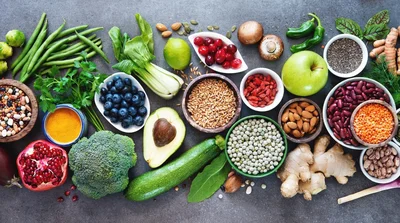
Fiber is found almost exclusively in plant foods—vegetables, fruits, legumes, nuts, grains, and seeds—and both Dr. Sohi and Dr. De Latour recommend consuming it in these forms.
Try to get your fiber from whole foods instead of powders and pills. Image: Adobe Stock
“When you incorporate foods that are meant to prolong shelf life, which is what basically [constitutes] a processed food, and then you also add a lot of sugar, it can defeat the whole purpose of that food,” Dr. De Latour says.
The doctors also advise consuming these plant foods in as wide a variety as possible.
“Just like you have your favorite foods, each of the bacteria in our GI tract have their favorite foods. So, if you feed your gut a diversity of plant fibers, your gut health flourishes,” Dr. Sohi says.
She advises aiming for 30 different types of plant sources each week.
“You hear terms like ‘eat the rainbow’ because if you’re eating a rainbow of foods, you’re getting a variety of different plant fibers,” Dr. Sohi adds.
3. Eat these high-fiber foods
If you’re at all confused about what to eat, Dr. De Latour concedes some collective culpability.
“It’s not always people’s fault, because the medical community hasn’t always been the best resource for nutritional information,” she says. “There’s always just been a general recommendation about, quote-unquote, ‘eating healthier.’”
So let’s get specific. Incorporate the following foods with the highest fiber content (per 100g) from each of the categories below for a total of 30 different fiber sources per week.
| | | | | | |
| --- | --- | --- | --- | --- | --- |
| Vegetables | Fruits | Legumes | Nuts | Seeds | Whole grains |
| Brussels sprouts | Passion fruit | Split peas | Almonds | Chia | Barley |
| Leafy greens | Avocado | Lentils | Pistacios | Flax | Quinoa |
| Broccoli | Prunes | Peanuts | Hazelnuts | Hemp (whole) | Oats |
| Carrots | Pear / apple | Common beans | Pecans | Pumpkin | Bulgur |
| Skin-on potato | Berries | Green peas | Macadamias | Sunflower | Wheat |
4. Increase water intake
Fiber absorbs water, so the more of it you consume, the more you should supplement with fluids. Experts already generally advise drinking half your body weight in ounces, so start there. If, after increasing your fiber intake, you notice uncomfortable gas, bloating, or constipation, drown it in water. Fiber and water are two consumables on which it’s hard to overindulge.
Of course, as Drs. Sohi and De Latour both note, most of us fail to get even the baseline amount of fiber recommended by the FDA, the USDA, the WHO, and any other qualified fiber influencer whom we used to just call a GI doctor.
“We have an issue in our country specifically where people under-ingest fiber in general,” Dr. De Latour says. “Most people are not having enough of it in a given day.”
So focus on the 38g floor for men and 25g threshold for women before “maxing” enters your lexicon. Because in this case, haste literally makes waste.
2025 PopSci Best of What’s New
The 50 most important innovations of the year