Wildland firefighters in Northern Ontario are still dealing with 159 blazes after extinguishing 80 in the past two weeks, provincial Natural Resources Minister Mike Harris said Thursday – while declining calls for a public inquiry into the government’s response to a record forest-fire season.
Thirty fires still remain out of control. That is down from 53 such blazes recorded on July 22, after an escalation of the conflagrations forced several First Nations communities to flee and blanketed major cities to the south in smoke.
The catastrophe has put Ontario’s wildfire response under a microscope, reviving long-standing questions about whether the province has dedicated enough staff and resources to battle these blazes, which experts warn are worsening because of climate change.
The fires have also prompted demands from First Nations leaders and opposition politicians, repeated Thursday at Queen’s Park, for a public inquiry.
Interim Liberal leader John Fraser told reporters that he had requested that the province’s Auditor-General examine Ontario’s wildfire response – and that her office responded by confirming that such a probe was in fact already under way and would be completed next year. Mr. Fraser said a public inquiry was still needed.
Speaking after a group of First Nations leaders addressed reporters, NDP Leader Marit Stiles said a public inquiry, with the power to compel witnesses to testify, would get to the bottom of what went wrong: “As one of the chiefs said here today, Ontario is burning and we are not receiving answers from the Premier or his ministers.”
On Thursday morning, Mr. Harris provided a wildfire update for reporters in a government building near Queen’s Park, in front of an array of big screens showing fire and weather maps brought in as a backdrop. Asked about the inquiry idea, Mr. Harris said his department conducts its own review after every fire season. But he would not commit to making that review public.
“I’m not sure how the review will all work out. We do a very deep dive internally and I think there’ll be lots of recommendations that will come forward,” Mr. Harris told reporters. “And at the time, we’ll see what makes sense to talk about.”
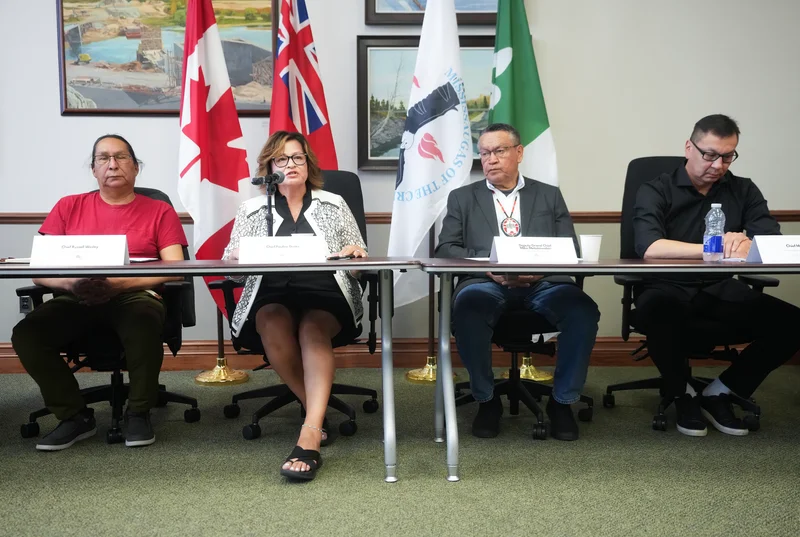
Later Thursday at Queen’s Park, Chief Pauline Drake of remote Whitewater Lake First Nation – a community forced to evacuate with almost no warning as the flames advanced – repeated her call for a public inquiry.
Alongside five other Indigenous leaders, she said her community was warned only hours before it needed to get out of the fire’s path: “It was just, okay, you need to evacuate. The fire’s coming in tonight.”
Ms. Drake said she has not yet been allowed to return and see the damage to her First Nation, which is 250 kilometres north of Thunder Bay and is accessible outside of winter only by float plane. But she said she has seen pictures of the devastation.
“It’s gone,” she said. “We’ll have to start from scratch.”
At his earlier press conference, Mr. Harris said 100 seasoned Mexican firefighters had arrived to help Ontario’s 156 crews, which consist of four-to-six firefighters each. Crews from Prince Edward Island have also arrived to help.
Recent rainy, cooler weather, Mr. Harris said, has allowed crews to make progress while keeping some of the worst fires in the province’s Northwest from growing quickly.
Among those blazes is the one known as Thunder Bay 36, which at more than 314,000 hectares (as of Wednesday) is one of Ontario’s largest wildfires in modern times. Mr. Harris said the break in the weather had allowed crews to construct fire guards and set up sprinklers for buildings and communities.
Jill Dunlop, Ontario’s Minister of Emergency Preparedness and Response, said Thursday that out of 14 communities that had to be evacuated in the face of the fires, five have since been able to return.
Ms. Dunlop has faced criticism from First Nations leaders who say her department did too little to help affected communities. Last week, an aide cut short a CBC Radio interview with her as she faced questions about those concerns.