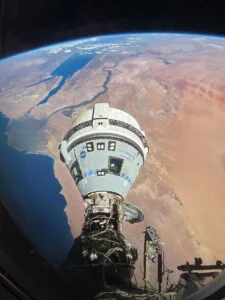
NASA declined again today to indicate when the next Starliner flight will take place. The agency and Boeing agreed after problems encountered with the 2024 Crewed Flight Test that the next mission, Starliner 1, will carry cargo only, but the question remains as to when. Boeing said earlier this week they are working with NASA to resolve uncertainties about the date and additional cost impacts are possible. Boeing must absorb any cost increases under this fixed price contract.
During a briefing today about three spacewalks coming up in August, ISS Operations Integration Manager Bill Spetch laid out the ISS schedule for the rest of the year: a Russian Progress cargo mission arriving in September, a NASA crew exchange later in September, a SpaceX cargo mission in the fall and a Northrop Grumman cargo mission towards the end of the year.
Asked whether Starliner might fly this year, Spetch reiterated NASA’s typical response that “we’ll fly it when we’re ready to go.”
“We continue to work very closely with Boeing on the Starliner upgrades. I would say the teams are working really well together to make good progress and that we will fly it when it’s ready to go and where we have a spot for a port for it on ISS.” — NASA’s Bill Spetch
In 2014, NASA signed contracts with Boeing and SpaceX to develop spacecraft to ferry crews to and from the ISS as fixed-price Public-Private Partnerships. Boeing received $4.2 billion, while SpaceX got $2.6 billion. SpaceX’s first flight of Crew Dragon was in 2020 and it now routinely flies people to orbit both for NASA and other customers.
Boeing’s Starliner, however, has encountered serious problems starting with the first uncrewed test flight in 2019. A second uncrewed test in 2022 was successful, but the 2024 Crew Flight Test carrying NASA astronauts Butch Wilmore and Suni Williams suffered propulsion failures during docking that led the agency to decide it was not safe enough to bring them home. It landed, empty, on September 7, 2024 EDT, experiencing another propulsion failure during reentry. Wilmore and Williams had to remain on the ISS for more than nine months instead of eight days, returning on a SpaceX Crew Dragon in March 2025. NASA later declared the mission a Type A mishap, the most serious category.
Boeing and NASA have been working on getting it ready to fly again ever since. In November 2025, the two agreed to reduce the total number of future flights from six to four and the first will carry cargo only to test the fixes now being made. The subsequent three flights are intended to carry crews. NASA and its ISS partners currently plan to deorbit the ISS in 2030. NASA launches two crew flights per year, so time is getting short for Boeing to get into the queue.
During Boeing’s second quarter 2026 financial results telecon two days ago, Boeing President and CEO Kelly Ortberg said “redesign of Starliner’s deficiencies is going quite well” but they have work to do with NASA to “align” on when both uncrewed and crewed flights will take place. He added that he doesn’t think it will create a cost problem, “but we do have some uncertainty here.”
Because it’s a fixed price contract, Boeing must absorb the cost increases — $2 billion as of February 2025. Ortberg didn’t disclose any additional cost impacts on Tuesday, but noted Starliner was one of two fixed-price programs in the Boeing Defense, Space and Security (BDS) segment where risks are being managed to stay within the estimate to complete (EAC). He said the other, the KC-46 tanker, was “well in hand,” but Starliner is “the one program we have work to do with the customer.”
“As NASA is re-planning their launch sequence, that will have some impact to when we’re actually doing the launch. The redesign of the Starliner deficiencies is going quite well, and we’re feeling pretty good about that. But we’ve got to work with NASA to align on how the launches are going to be, both the crewed and uncrewed launches going forward. I don’t at this time anticipate that’s going to create a cost problem for us, but we do have some uncertainty here that we’ve got to work with NASA to get that put to bed. And we are working with them right now.” — Boeing’s Kelly Ortberg
Boeing said in its associated 10-Q filing that they expect to complete the uncrewed flight “no earlier than the fourth quarter of 2026,” but the outcome of discussions with NASA “is uncertain.” As of June 30, 2026, they had $558 million of capitalized precontract costs and $19 million of potential termination liabilities to suppliers related to unauthorized future missions. “Risk remains that we may record additional losses in future periods.”