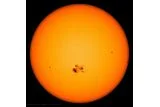
The sun’s activity has its ups and downs, going from chaotic to calm throughout the course of its 11-year solar cycle. It’s almost as if the sun takes a snooze, only for it to later rise from its slumber reenergized. But the critical point when it goes to “sleep,” scientists have found, may just be the key to understanding how space weather will pan out in the future.
As the solar cycle progresses, with sunspots rising and falling over the 11-year period, activity doesn’t exactly change gradually.
"The sun doesn't gently go to sleep and then gently wake up again,” said Sandra Chapman, a professor of physics and director of the Centre for Fusion, Space and Astrophysics at the University of Warwick, in a statement.
Chapman identified a specific point in the solar cycle when space weather “switches off." In other words, it suddenly ceases. The number of sunspots at this moment, Chapman proposes, could be used to predict the sun’s activity in the following solar cycle. This research — being presented at the Royal Astronomical Society's National Astronomy Meeting that is taking place from Monday, July 20 to Friday, July 24, 2026 — shows that the switch-off method may reveal a new way to follow the sun’s long-term behavior.
Read More: Charged Dust Near the Sun May Change How Its Outer Atmosphere Gets Hotter Than Its Surface
Space Weather Switching Off
During the approximately 11-year solar cycle, the sun’s magnetic poles switch places, with north becoming south and south becoming north, according to the European Space Agency. When the magnetic field reverses polarity, activity on the sun ramps up during a phase called the solar maximum. This results in extreme space weather entailing the release of charged particles and radiation.
Then, once the magnetic poles have flipped, space weather enters a lull that’s known as the solar minimum. This is when the switch-off happens.
Going from the solar maximum to the solar minimum causes “an abrupt transition between a more active sun when we see the most extreme space weather events at Earth, to a more quiet sun where we do get space weather, but more moderate events,” Chapman told Discover.
Counting Sunspots
The switch-off point is largely based on observations of sunspots, planet-sized areas on the sun’s surface that are produced by strong magnetic fields. These sunspots migrate in a “butterfly effect,” moving down to lower latitudes on the sun, which rotates at different speeds depending on the latitude, a phenomenon called differential rotation. When differential rotation twists up magnetic fields, Chapman said, it can generate huge coronal mass ejections (CMEs), leading to geomagnetic storms that often impact satellites and Earth’s electrical grid.
Chapman suggested that when sunspots move to within 15 degrees latitude — below which differential rotation weakens — the process driving CMEs switches off.
With information on the number of sunspots at the switch-off point, it may be possible to predict the strength of the next solar cycle around six to seven years before it reaches its maximum. This would greatly benefit solar cycle predictions, which are difficult to make because no two solar cycles are identical. Current prediction methods also need to wait until the solar minimum of each cycle.
“The idea is that the magnetic field of each cycle seeds that of the next … We have constructed a regular clock for the irregular solar cycle which may pinpoint when in the declining phase (the switch-off) we should look to see the seeds of the next cycle,” Chapman said to Discover.
Predicting the Sun's Activity
Using the switch-off method, Chapman has made a very early prediction for the next solar cycle (cycle 26), estimating a sunspot number of around 100 to 120, which would be similar to or weaker than the current solar cycle (cycle 25).
However, we are still two years away from this switch-off in the current solar cycle. Once the solar cycle reaches this point, a more accurate prediction could take shape, potentially redefining how we observe the sun and its weather.
Read More: Orbiter Observes Sun's Hot Spots for Record-Breaking 94 Days, Enhancing Solar Storm Forecasts
Article Sources
Our writers at Discovermagazine.com use peer-reviewed studies and high-quality sources for our articles, and our editors review for scientific accuracy and editorial standards. Review the sources used below for this article: