4 new MRT stations to be built for Cross Island Line; interchanges at Jurong Pier, Gul Circle
AI generated
SINGAPORE – The third and final phase of the Cross Island Line (CRL) will have four underground stations and help get commuters to the western region faster when it is completed in the late 2030s.
The latest stretch – about 10km when fully completed – will connect to other lines at two interchanges at Jurong Pier and Gul Circle and for now, are numbered CR20 to CR 24.
The CR20 station will serve residents in Taman Jurong, while CR21 will serve as a gateway to Jurong Island. It will also link to the upcoming Jurong Region Line (JRL).
CR22 will be located within Jurong Industrial Estate. The final station, CR23 or Gul Circle station, will link to the East-West Line (EWL).
Transport Minister Jeffrey Siow, speaking at the Singapore Rail Test Centre on July 31, said the stations will serve residents and workers across the western industrial estates and substantially improve connectivity to the rest of the island.
He added that the CRL will play a critical role in the rail network, with 11 interchange stations that connect to all existing MRT lines. This will strengthen the resilience of the MRT network as more commuters will be able to take alternative routes during a service disruption, he said.
In a joint statement on July 31, the Land Transport Authority (LTA) and Singapore Land Authority (SLA) said the last stage of the CRL will provide residents and workers in the western region with “more direct and convenient” travel options by MRT.
Work on the third phase is slated to begin in 2027. Noise and vibration impact studies will be carried out before work starts, the statement said.
To facilitate construction work, the authorities said seven industrial properties will be acquired, and eight other industrial properties with be partially acquired.
The partial acquisitions will touch on minor parts of the property, such as boundary fences. Affected businesses can continue operations, and the acquired parts will be restored to the original owners after the works are done.
In his speech, Siow said LTA is studying the feasibility of a Bus Rapid Transit system in Tuas South to shuttle workers between their workplaces and MRT stations.
The CRL is Singapore’s eighth MRT line and, when completed, will be the country’s longest fully underground rail line, spanning more than 65km from Changi in the east to Tuas in the west.
It is being built in three phases and will connect major residential and employment hubs, including Jurong Lake District and Punggol Digital District, as well as provide new interchange links with several existing MRT lines.
First announced in the 2013 Land Transport Master Plan, the target completion date for the entire line was about 2030. Construction delays were caused by the Covid-19 pandemic, and an environmental impact assessment in the planning stages because the line ran under the Central Catchment Nature Reserve.
The first phase of the CRL comprises 12 stations over 29km, from Aviation Park in Changi to Bright Hill, and is slated to be completed in 2030. A 7.3km four-station extension linking Pasir Ris and Punggol is expected to follow in 2032.
The 15km second phase, from Turf City to Jurong Lake District, is also expected to be completed in 2032 and includes stations at King Albert Park, Maju, Clementi and West Coast.
It will interchange with the Downtown Line at King Albert Park and the EWL at Clementi.
King Albert Park station on the CRL, at about 50m below ground, will be Singapore’s deepest underground MRT station.
When fully operational, the CRL is expected to serve at least 600,000 passenger trips daily, with ridership projected to grow to around one million in the longer term.
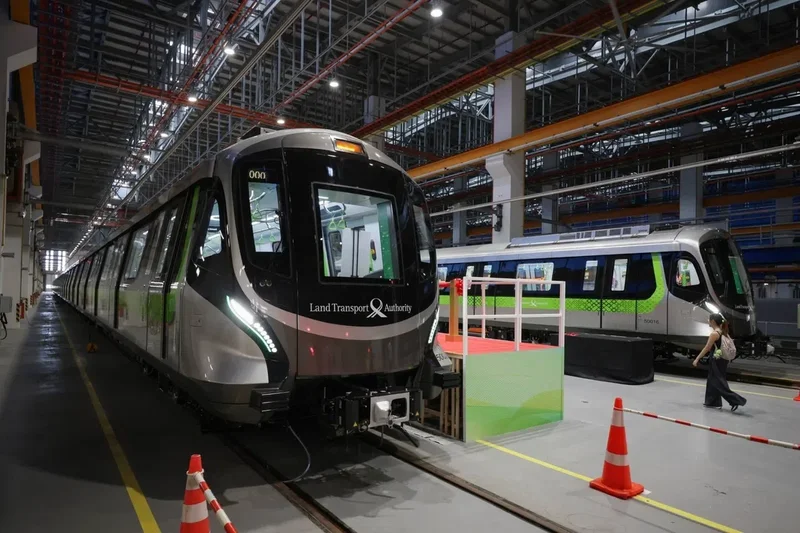
The first CRL train arrived in Singapore earlier in 2026, according to a Facebook post by LTA on May 31.
In its Facebook post, LTA said commuters can expect 44 fully automated six-car trains on the CRL, along with wider gangways (platforms connecting train cars) for smoother passenger movement and a more comfortable journey.
There will also be smart monitoring and diagnostic systems that help detect potential faults early and improve reliability, said LTA of the new line.