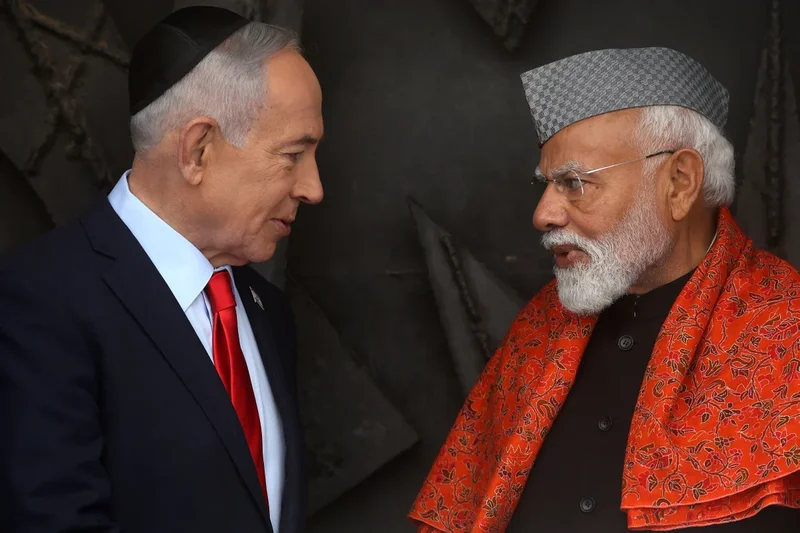
India has sold over 2500 shipments of weapons to Israel since the 7 October Hamas attacks despite risks that they could end up being used in genocide against Palestinians in Gaza, Amnesty International said in a new report.
India has become one of the strongest allies of Israel under prime minister Narendra Modi’s leadership, marking a significant shift in its foreign policy as the South Asian nation has historically supported the establishment of a Palestinian state.
India did not establish full diplomatic ties with Israel until 1992 and Mr Modi in 2017 became the first Indian prime minister to visit Israel.
The Amnesty International report said India has potentially exposed itself to complicity in violations of international law and human rights committed by Israel through the export during the period when Benjamin Netanyahu’s forces launched a major offensive in Gaza.
The Britain-based group on Thursday released a 42-page report, Made in India: The Supply of Weapons and Ammunition to Israel, that analysed shipment-level trade data between the two countries to find the extent of defence trade cooperation.
The report identified companies that are directly owned and controlled by the state of India as well as private players dealing with Israeli companies directly dealing with Israeli forces.
Amnesty said its investigators analysed 2,596 shipments of weapons, ammunition, parts and military components exported from India to Israel between 7 October 2023 and 30 November 2025.
Based on the data, the organisation said Indian companies supplied at least 390,516 small arms parts for military-grade weapons, 564,970 explosive ordnance parts, including drone warheads and artillery shell casings, and 298 military vehicle components to major Israeli defence companies.
The data excluded shipments that may have been intended for civilian use, as well as weapons and components likely destined for anti-missile defence systems used to protect civilians.
Israel has rejected as false and "grossly distorted" accusations brought by South Africa at the UN's top court that its military operation in Gaza is a state-led genocide campaign against Palestinians.
Amnesty found that the Indian government has forged "a close and profitable partnership" with Israel's defence sector and become a significant contributor to supply chains supporting the Israeli military.
Amnesty secretary general, Agnès Callamard, said India not only failed to regulate arms exports to Israel by private companies in line with international law and standards, but it has also deepened its defence partnership with Israel.
“Our research reveals India’s continuing support to the Israeli military and defence sector despite the genocide in Gaza, which has been broadcast worldwide on an almost daily basis for years.
“India manufactures and supplies arms transferred to Israel through its ownership and control over key supplier companies.
“In light of the International Court of Justice’s provisional measures orders recognising a plausible risk of genocide against Palestinians in Gaza, the Indian authorities cannot credibly argue that they did not know that continuing to authorise and facilitate arms transfers to Israel carries a substantial risk of contributing to serious violations of international law,” she added.
The report said that India's export control system contains "critical structural failures", including the absence of an explicit requirement for human rights due diligence before approving military exports and a lack of transparency in export decisions.
Amnesty also noted that India has neither signed nor acceded to the Arms Trade Treaty (ATT), urging the government to join the treaty and bring its export controls into line with international standards.
Among the equipment Amnesty said it identified were machine-gun components, 155mm high-explosive artillery shell components, explosive warheads for SkyStriker loitering munitions, and armoured vehicle components.
Ms Callamard said Indian companies profited by supplying weapons as the “Israeli military was inflicting widespread death, destruction and suffering on Palestinians in Gaza”.
Defence trade has remained one of the strongest pillars of India and Israel’s ties with New Delhi remaining Israel’s largest arms importer. India accounted for about 29 per cent of Israel's arms exports between 2020 and 2025, according to Stockholm International Peace Research Institute (SIPRI).
Mr Modi’s second visit in February 2026 further elevated the relationship to a “Special Strategic Partnership for Peace, Innovation and Prosperity,” with multiple agreements signed.
In his statement, Mr Modi “acknowledged the significant growth made in defence cooperation between their nations, both in scope and scale” and “provided a vision and a roadmap for future defence cooperation”.
The two leaders also signed a memorandum of understanding (MoU) on defence cooperation last year in November.
The shipments did not move in an anonymous marketplace, but many of them were shipped to three of Israel’s largest defence companies: Elbit Systems, Israel Aerospace Industries (IAI), and Rafael Advanced Defence Systems, it said.
The Independent has reached out to the Indian foreign ministry and Israeli Defence Forces for comment.
In May 2024, Spain’s Cartagena port refused to allow a ship carrying arms to Israel from India’s Chennai to call at its port. The ship carrying 20 tonnes of rocket engines, 12.5 tonnes of rockets fitted with explosive charges, as well as 1,500kgs of specialised explosives manufactured to dock at its port while it was on its way to Haifa.
“This is the first time we have done this because it is the first time we have detected a ship carrying a shipment of arms to Israel that wants to call at a Spanish port,” José Manuel Albares, the foreign minister, said in Brussels at that time.
“This will be a consistent policy with any ship carrying arms to Israel that wants to call at Spanish ports. The foreign ministry will systematically reject such stopovers for one obvious reason: the Middle East does not need more weapons, it needs more peace.”
A month later, residents of Gaza found debris marked with “Made in India” at a site where an Israeli airstrike killed 33 Palestinians inside a school serving as a shelter in Nuseirat refugee camp in central Gaza.
In September last year, the United Nations Independent International Commission of Inquiry concluded that Israel had “flagrantly disregarded” international law and “orchestrated a genocidal campaign for almost two years now”. It marked the first time a UN body reached such a conclusion.