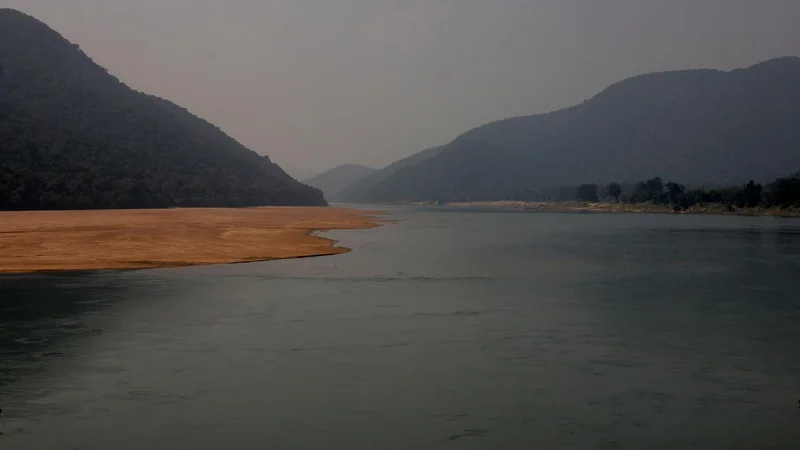
The story so far: After a high-level meeting in New Delhi on Thursday (July 30, 2026), chaired by Union Jal Shakti Minister C. R. Patil and attended by Chhattisgarh Chief Minister Bishnu Deo Sai, Odisha Chief Minister Mohan Charan Majhi expressed optimism about resolving the Mahanadi River water-sharing dispute within the next three months. In the absence of a formal interstate agreement, the two principal riparian States—Odisha and Chhattisgarh—have been locked in a prolonged legal and administrative battle for a decade now, each staking their right over India’s eighth-longest river.
Why was the meeting key?
After the Bharatiya Janata Party government came to power for the first time in Odisha in 2024, with the neighbouring Chhattisgarh government also ruled by the BJP, fresh attempts were made to find an amicable settlement to the river water dispute through negotiations.
It has been close to a decade since CMs of the two States formally met over the dispute. On September 17, 2016, then Odisha CM Naveen Patnaik and Chhattisgarh CM Raman Singh had discussed the issue in a meeting convened by then Union Jal Shakti Minister Uma Bharti. Mr. Patnaik had, however, expressed displeasure, accusing the Chhattisgarh government of being “non-cooperative”.
Also Read | Odisha, Chhattisgarh make headway towards resolving Mahanadi River water dispute
The political solution to the interstate water dispute was reinitiated when the Odisha CM, on July 25, 2025, wrote a letter to the Chhattisgarh CM proposing an amicable settlement of the Mahanadi Water Dispute. On August 1, 2025, the Chhattisgarh CM replied to the letter, stating that the matter of settling the dispute between the two states was under consideration. Accordingly, both States informed the Mahanadi Water Disputes Tribunal (MWDT), headed by former Supreme Court Justice Bela M. Trivedi. As per the plan, two CMs were scheduled to meet over the issue in December 2025.
Despite a consensus between the top political leadership of both States to pursue discussions outside the legal route, the Tribunal expressed strong displeasure over the absence of any concrete proposal from either side. The Tribunal observed that both Odisha and Chhattisgarh appeared to be merely buying time.
In its order dated April 20, 2026, the MWDT stated that it was granting one final opportunity to both States to arrive at a consensus and place it on record, failing which the tribunal would proceed to adjudicate the matter on its merits.
The order set the ball rolling with joint technical committees of both Odisha and Chhattisgarh meeting to accelerate the ongoing process for amicable settlement. They submitted the assessments of the annual water availability of the Mahanadi basin at various locations and State-wise water availability at various dependabilities and also average. These assessments were carried out independently by both the States considering the common period from 1980-81 to 2018-19. The pieces of information were tabulated in Common Format Information.
The July 30, 2026 meeting between two CMs in New Delhi was considered crucial for amicable settlement to the complex issues involving Mahanadi River water sharing.
The Dispute
Mahanadi, the eighth-longest river of the country, originates from the Amarkantak hills of the Bastar Plateau near Pharasiya village in Dhamtari district of Chhattisgarh. The total length of the river is 851 km. Mahanadi, which flows about 494 km in Odisha before discharging into Bay of Bengal, is the largest river of the eastern Indian State.
Around Independence, construction of Hirakud Dam, a massive structure, was initiated on Mahanadi in Odisha’s Sambalpur district with multiple objectives such as regulating flow of water in order to avoid flood in the downstream, produce hydroelectricity and creating irrigation networks. Odisha had never faced any crisis on account of water shortage in Mahanadi in its jurisdiction. The river system was fed by numerous tributaries. Branches and sub-branches of the river sustained human settlements, ecosystems, and various water-dependent needs.
Following its carving out as a separate State from Madhya Pradesh in 2000, Chhattisgarh charted its own development path. Mahanadi turned out to be crucial to meet its water needs for irrigation, drinking water and industrial purposes. Subsequently, Chhattisgarh started planning structures on the Mahanadi. There were no serious objections from Odisha over constructions by Chhattisgarh then.
When Odisha found out there was considerable decline in Mahanadi waters in its territory during non-monsoon season in early 2010, it noticed Chhattisgarh’s extensive upstream construction and increased water usage. According to the Odisha government, Chhattisgarh had by then built more than 500 anicuts and 30 barrages on Mahanadi. Then Naveen Patnaik Government demanded halting of upstream constructions and sought definitive water sharing formula as Odisha critically depends on the river. On the other hand, Chhattisgarh argued that 52.9% of the total catchment of Mahanadi and 89.9% of catchment up to Hirakud lies in their State and they had a right to use the water of Mahanadi.
And the settlement route
With Chhattisgarh allegedly not paying any heed to the request of Odisha regarding constructions on Mahanadi, the latter, on November 19, 2016, filed a complaint with the Centre on Mahanadi River Water Dispute under Section 3 of the Inter-State River Water Disputes (ISRWD) Act, 1956.
Acting on the request, the Centre constituted a Negotiation Committee comprising members from basin States and concerned ministries of central government, Central Water Commission (CWC), India Meteorological Department (IMD) and National Institute of Hydrology (NIH) for resolution of the Mahanadi River Water Dispute on January 19.01.2017. The committee had hardly met to resolve the dispute, when the government moved the Supreme Court seeking its intervention to restrain Chhattisgarh from construction and constitute a tribunal on sharing of Mahanadi water. The matter was heard by the apex on eight different dates in 2017 and 2018. Finally, the SC directed the Centre to constitute a tribunal for adjudication of the water dispute between States.
On February 20, 2018, the Union Cabinet, chaired by Prime Minister Narendra Modi, gave the go-ahead to a proposal for the constitution of MWDT to determine water sharing among basis States, which also include Maharashtra, Jharkhand and Madhya Pradesh apart from Odisha and Chhattisgarh. The tribunal headed by Supreme Court judge Justice A.M. Khanwilkar was required to submit its report and decision within 3 years, which can be extended to a further period not exceeding 2 years due to unavoidable reasons. The adjudication process got slowed down due to COVID-19. Following his resignation, Justice Trivedi was appointed as new chairperson in 2024. The tribunal has so far held more than 50 hearings.
Way-ahead
The July 30 meeting resolved to resolve the dispute through dialogue, technical cooperation and cooperative federalism. As per the official statement, both the CMs reaffirmed their commitment to continue the ongoing technical consultations in a constructive spirit. Mr. Patil said the objective was not merely to resolve the present dispute but to establish a long-term, equitable and sustainable framework for the management of the Mahanadi Basin. He expressed confidence that the continued constructive engagement between the two States would pave the way for a mutually acceptable and enduring settlement.
Published - July 31, 2026 10:32 am IST