New grant launches to help S’pore farms offset rising costs from the Middle East crisis
AI generated
SINGAPORE - The Singapore Food Agency will launch a new grant to help local agricultural producers offset rising operational expenses caused by the Middle East crisis to ensure uninterrupted local food production.
The one-off Farm Business Resilience Support Grant of an undisclosed amount aims to alleviate increased energy, and logistics and freight costs, SFA said on July 31.
The higher expenses have come on top of existing manpower challenges and a push to be more productive through greater use of farming technologies.
Announcing the new measures on July 31, Minister for Sustainability and the Environment Grace Fu said the new grant will alleviate cost pressures from fuel and fertiliser, among others.
“We’d like to support them so that the local capacity will continue to be sustained, and will help them tide over this crisis,” said Fu, who is also Minister-in-charge of Trade Relations.
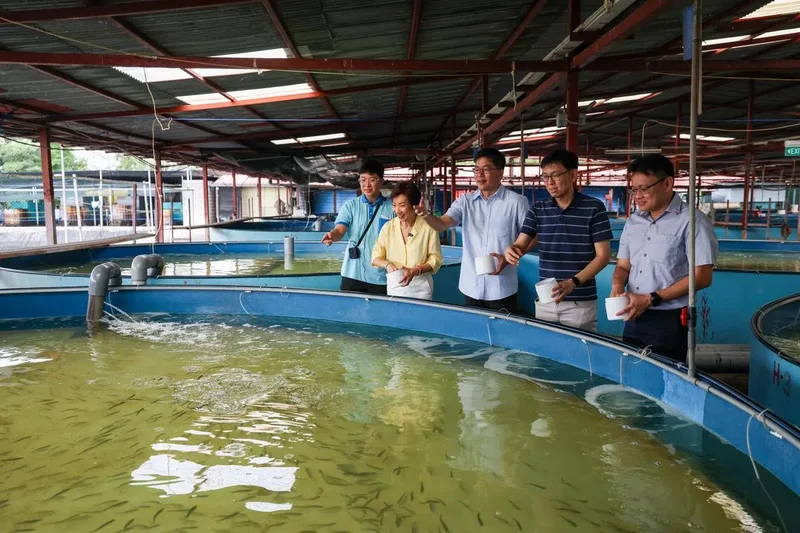
She was speaking during a visit to the Prime Aquaculture Hatchery on Pulau Ketam, off the coast of Pulau Ubin.
The Farm Business Resilience Support Grant will draw from the technology capability upgrading component of the Agri-Food Cluster Transformation Fund, launched in 2021 to the tune of $60 million. A second tranche of $70 million under the fund was announced in March.
All local farms that hold a valid farm licence as of Aug 1 and have contributed to local production of fibre or protein are eligible for the support.
These include farms producing leafy or fruited vegetables, mushrooms and beansprouts, as well as those producing hen-shell eggs and seafood. Such farms make up most of the 206 licenced farms here.
The support provided will differ depending on what the farms produce and how much they produce, the agency said, noting it would reach out to farms with more information in August.
SFA said the new grant is in addition to the recently announced one-off cash grant, which allows small and medium enterprises, including local farms, to receive $500 per local employee up to a total of $2,500 per company.
Prime Aquaculture head Tan Yong Yi said that since the war in the Middle East began earlier this year, the cost of feed had been increasing by about 5 per cent per month.
Noting that the hatchery was off the grid and dependent entirely on six diesel generators for its energy needs, Tan said that the amount spent on diesel had increased significantly, from about $50,000 per month last year to a six-digit amount currently.
To cut down on its energy expenses, the 7ha facility aims to transition fully to solar power for its energy needs, with the installation of a floating solar photovoltaic farm on a reservoir on the island.
Tan said he hoped the hatchery would be able to tap on the new grant to aid in its goal of becoming a zero emissions facility.
“We hope to be able to tap on the new grant because this will be a massive investment, upwards of $1 million,” he said.
Following a series of setbacks for local farms over the years, ranging from production declines to farm closures, in November 2025 the Republic dropped its “30 by 30” local production goal, which aimed to produce 30 per cent of the country’s nutritional needs locally by 2030.
The 2030 target was replaced with new objectives for local production to meet 20 per cent of Singapore’s fibre consumption and 30 per cent of its protein consumption by 2035.