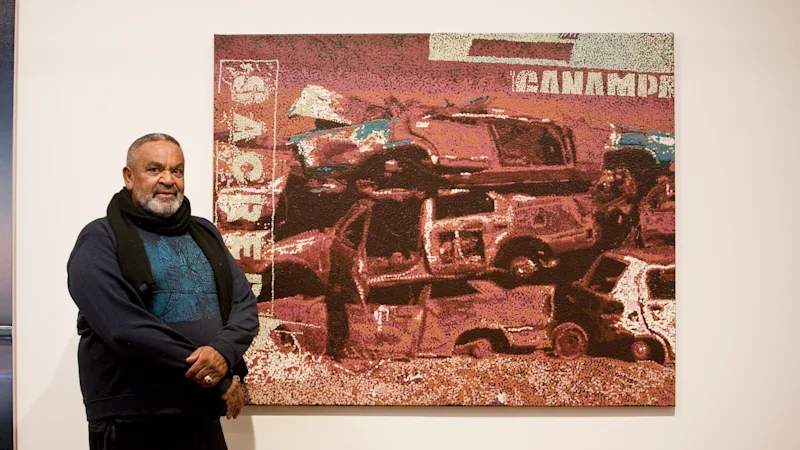
When Robert Fielding enters the room, he quietly takes in all the different artworks. His own is hung in one corner, but he walks straight up to another nearby – Minymaku Inma by Betty Campbell – then sits on the floor beneath it. He then makes his way across to Ngangkari Ngura (Healing Country) by Betty Muffler and does the same. Both artists, like Fielding, work in the APY Lands – and Campbell, like Fielding, works with Mimili Maku Arts.
Fielding’s work Landscape has been announced as the 2026 winner of the $100,000 Hadley’s Art Prize. He was first told the news over the phone, and now sitting in the gallery, his eyes start to fill with tears as recalls the moment he heard he had won.
“I cried with tears of joy,” he says. “I had no words – and the two people came into my mind: my mum and my dad. Because when you see my artwork, it’s all about stolen generations.”
It’s been a big year for the artist in an already soaring career. His portrait Tjintir-Tjintir was a finalist in this year’s Archibald, and Heritage impact assessment was a finalist in the Wynne prize.
Landscape is a scene that is mostly rendered in burnt red. Rundown cars are stacked on top of each other, tyres missing, doors open, windows gone. Down one side runs the word “Sacred”. Across the top reads “Nganampa” – ours.
For Fielding, whose work also spans printmaking and photography, abandoned cars are a recurring motif, as vessels that house memory.
“This is telling you a story of land … I’m very harsh with myself because when I paint, I paint for people,” he says. “I paint for movement. I paint for what was inside those relics. Who owned them? Who did they belong to?” he says. “They became heritage.”
Run through Hobart’s Hadley’s Orient Hotel, the prize is one of the country’s richest for visual arts. This year, it was judged by Abdul Abdullah, Judith Ryan and Sarah Wallace.
“It’s a very traditional mark-making process to tell a very contemporary and forward-looking story,” says Abdullah. “What drew me to it, even before we got into the room, was the way he wrote about it and his explanation.” Fielding’s work, Abdullah adds, “was interrogating landscape in a way that was unique in the prize”.
Wallace says: “It’s a familiar sight that you see in a lot of places across Australia. But for him, it wasn’t something ugly or a blight on the landscape; it held memory and stories of Country, and travelling across Country.”
The 26 finalist works on display at Hadley’s, in a pop-up downstairs gallery, offer a fascinating insight not only into the Australian landscape, but how it is perceived through different eyes.
Walking through the exhibition, curator Dr Amy Jackett highlights details of each work.
One of the few works on paper is watercolour and collage work Entanglement by Grace Gladdish. Emerald Coral by Ken Done is so vibrant it spills off the canvas and onto the frame. The winner of the prize’s residency award, Bunuru Nocturne, Derbal Yerrigan (High-Summer Night, Swan River) by Kelsey Ashe, is already unusual in that it depicts the landscape at night, then Jackett picks up a UV torch that makes the bioluminescent pigments glow wherever the light hits. Trill by Natasha Bieniek is so small and detailed it will be presented with a magnifying glass.
The climate emergency is a recurring theme across the exhibition. Joe Blundell’s Tormented Land shows a scene of fallen trees, with the dirt between them littered with tracks of heavy machinery. It’s an idea that also drove Alice Mannheim’s work Log It!, which was awarded the Packing Room Prize.
“I wanted to show that these environments are disappearing because people are destroying them through logging and deforestation,” Mannheim says. “I chose the Daintree rainforest because it’s very beautiful, but it’s also at risk of being destroyed.”
At 19, she is the prize’s youngest finalist, and this is the first time she has put her work forward for an award. She cites Harold Thornton’s portrait of Bob Brown, Dr Brown and Green Old Time Waltz, 1983, as an influence. She says that living in Canberra, “I’ve always been drawn to it.”
Her work is predominantly painted from memory, and she says: “I chose the title Log It! because it’s such a simple statement describing a simple action, but it has a very devastating impact.” The irony is deliberate – the beauty and detail of the rainforest versus the ease in which it can be eradicated.
All the works – with the exception of Fielding’s, which has been acquired by Hadley’s – are for sale. “The prize to me means many things,” says Fielding. “It means many opportunities. I’m already planning.”
For Fielding, this win is meaningful beyond a personal victory, and he emphasises the importance of paving the way for the next generation of artists and his work with Mimili Maku Arts in the APY Lands.
“We’re here as a team, Mimili Maku Arts [to show] that art centres are our hub, our heartbeat, our unison, our grief, our sorrow, our finance, our fighting dream,” he says. “But most of all, it’s about respect.”
The Hadley’s Art Prize exhibition is on at Hadley’s Orient Hotel, Hobart, from August 1-23.
Elizabeth Flux travelled to Hobart as a guest of Hadley’s Orient Hotel.
The Booklist is a weekly newsletter for book lovers from Jason Steger. Get it delivered every Friday.