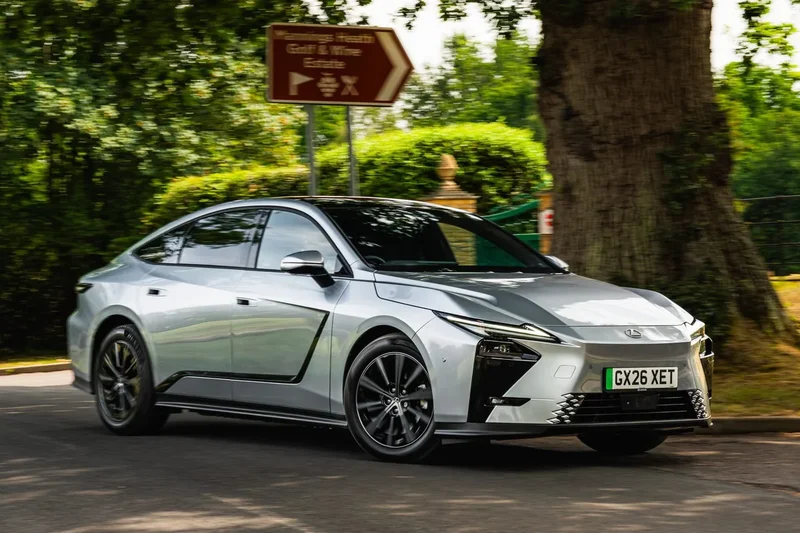
The Lexus ES has been part of the Japanese luxury brand’s story since the very beginning. It was launched alongside the LS limousine in 1989 and has since recorded more than three million sales worldwide, although British buyers had to wait until 2018 and the arrival of the seventh-generation hybrid before it officially joined the UK range.
Now there is an eighth-generation ES, and the change is far more significant than the usual new lights, fresh dashboard and updated tech. In the UK it’s available exclusively as the fully electric, front-wheel-drive ES 350e, making this both an all-new luxury saloon and another important step in Lexus’s move towards battery power.
It also arrives at an interesting time for the traditional executive saloon. SUVs dominate the sales charts, while electric rivals from BMW, Mercedes and Volvo are pushing claimed ranges towards 500 miles. Lexus has taken a different route, with a smaller battery and focusing on efficiency to go further. It fails to get anywhere near the long ranges offered by German marques – if you really need that range. And from our initial tests, at least the Lexus seems to get closer to its claimed range than many rivals.
The ES350e is a substantial car. At 5,145mm long, 1,920mm wide and 1,560mm tall, it’s larger in every direction than the model it replaces. Its 2,950mm wheelbase has grown by 80mm, helping create the sort of rear passenger space more usually associated with a larger luxury car. It also has some of the luxury tricks normally associated with a limousine, including an ottoman seat that will cool and massage your back, plus a front seat that creates even more room by folding itself away.
The styling takes its inspiration from the LF-ZC concept shown at the 2023 Japan Mobility Show. Lexus calls the theme Clean Tech x Elegance, which translates into a low-set nose, the latest version of the brand’s spindle-shaped front end, twin L-shaped lighting signatures and a smooth profile that tapers towards the rear. A full-width light bar at the back incorporates the Lexus name (the Lexus badge is only on the nose and not even on the steering wheel), while the door handles sit semi-flush with the body.
There are three versions at launch – Premium, Premium Plus and Takumi – all using the same 77kWh battery and 221bhp motor. Prices start at £59,345, rising to £72,545 for the most lavishly equipped model.
How we tested
I drove the Lexus ES 350e on a mixed route in the UK covering country roads, towns, villages and motorway. This provided the opportunity to assess its ride and refinement at different speeds, compare cars on both 19-inch and 21-inch wheels and try the various regenerative-braking settings.
I also tested the driving assistance systems on the motorway, including the automatic lane-change function, and spent time assessing the driving position, visibility, rear-seat space, boot, infotainment and Mark Levinson sound system. I even did an impromptu customer clinic with a Dutch guy who recognised the new car and wanted to know more.
Independent rating: 9/10
- Pros:Supremely comfortable, exceptional quality, spacious interior, easy-to-use technology, excellent real-world efficiency
- Cons:Modest performance, slow rapid charging, range trails key rivals, panoramic sunroof not very panoramic
Lexus ES350e specs
- Price from:£59,345
- Battery size:77kWh
- Maximum claimed range:361miles
- Miles per kWh:3.9
- Charging :up to 150kW DC - 10 to 80 per cent charge in 28 minutes
Battery, range, charging, performance and drive
Every Lexus ES 350e in the UK has the same powertrain: a single electric motor driving the front wheels, producing 221bhp and 269Nm of torque. The lithium-ion battery has a gross capacity of 77kWh and sits entirely beneath the cabin floor.
That battery location helps explain why the driving position feels slightly higher than expected in a saloon. It also contributes to a low centre of gravity, while passenger and luggage space are both uncompromised. The battery uses water cooling and can be pre-conditioned manually, automatically when a charging point is set as a navigation destination, or in advance for a scheduled journey.
The maximum official range is 361 miles for the Premium model, dropping slightly to 357 miles in Premium Plus form and more noticeably to 326 miles for the Takumi. The latter comes with 21-inch wheels as standard, and choosing those larger wheels on the Premium Plus version will also reduce the range by between 20 and 30 miles.
Those numbers are respectable rather than outstanding, especially when electric BMWs, Mercedes and Volvos are claiming figures closer to the 500-mile mark. The Lexus compensates to a degree with impressive efficiency. Across a mixed drive of country roads, towns, villages and motorway, it returned an excellent 4.3 miles/kWh – ahead of the official claim. That ability to make good use of its energy means Lexus can fit a smaller battery than some rivals, without leaving the ES with an impractical range.
The official consumption figures are 3.9 miles/kWh for the Premium and Premium Plus, and 3.8 miles/kWh for the Takumi. City range is quoted at up to 427 miles for Premium, 419 miles for Premium Plus and 413 miles for Takumi.
Charging is less impressive, though. The ES peaks at just 150kW on a DC rapid charger and takes 28 minutes to go from 10 to 80 per cent, even with the battery management and pre-conditioning systems working to maintain that performance in low temperatures. That certainly isn’t anything to write home about alongside the quickest-charging EVs. A standard 22kW onboard AC charger can take the battery from 10 to 100 per cent in four hours if you can find a 22kW AC charger.
Performance is similarly modest. The ES takes 8.0 seconds to reach 62mph and has a top speed of 99mph. It feels sprightlier from behind the wheel than the acceleration figure suggests, with the smooth and immediate response expected from an EV, but the number may disappoint buyers accustomed to far quicker electric cars. Sport mode (once you find out how to activate it through the menu system) doesn’t do much to sharpen responses or improve performance.
That 0-62mph figure was certainly a disappointment to the Dutch driver I met while I’d stopped to make notes at Ditchling Beacon. He knew what the ES 350e was and liked both the car and what I told him about it. He told me that he’d stopped short of buying an ES in the past because of its sluggish performance. The 8.0-second figure didn’t impress him, even with the reassurance that the car felt livelier on the road.
There is no full one-pedal driving mode, either. Paddles behind the steering wheel allow the driver to choose between different levels of regenerative braking, but even the strongest setting doesn’t feel quite strong enough and won’t bring the car to a complete stop. The electronically controlled brake system itself feels natural and easy to judge, though.
The ES is more comfort-oriented than sporty, which suits its character. On 19-inch wheels the ride is communicative without becoming uncomfortable. Body control is the trade-off, with more movement than in a firmly tied-down sports saloon, but that is an acceptable exchange in a car built around relaxation.
Thankfully, the ride is not ruined by the optional 21-inch wheels. If anything, that combination felt slightly better, probably because the 21-inch car wore Michelin tyres rather than the Dunlops fitted to the car on 19-inch wheels. The Dunlops also appeared to contribute to some road noise, with the larger Michelin wheel-and-tyre combination seeming quieter.
The ES remains pretty refined overall, although it is not quite as silent on the motorway as might be expected. There’s that small amount of road noise plus a tiny amount of wind noise, rather than the near-total isolation its shape and luxury positioning might suggest. Even so, the overriding impression is of an easy, relaxing car that is stable and reassuring at speed.
Interior, practicality and boot space
The ES is delightfully different inside as well as out. The cabin has the exceptional material and construction quality expected of Lexus, but it avoids simply copying the look and layout of its German rivals. The result feels distinctive, modern and refreshingly easy to understand.
The front windscreen is deep and is joined by similarly deep side glass and large door mirrors. Together they provide excellent forward visibility and good rearward visibility; despite the sweeping body shape and coupé-like tail combined with a relatively shallow rear screen, the view rearwards is okay. There’s a digital rear-view screen that can be switched on rather than rely on a traditional mirror, too.
The new-generation front seats are a highlight. They use a slim, split construction with separate modules mounted on a frame, which helps free additional space for passengers behind without compromising comfort.
The driver sits a little higher than expected because of the battery beneath the floor, but the position still feels natural and those seats are supremely comfortable. The Premium grade car gets eight-way power adjustment with the higher grades adding extra adjustment, four-way lumbar support and an extendable driver’s cushion. Seat heating and ventilation are standard throughout the range.
The steering wheel is smallish, a nice size to hold and covered in tactile synthetic leather. It is heated around its full circumference and offers 70mm more telescopic adjustment than before, helping a wider range of drivers get comfortable.
Rear space is genuinely impressive. Lexus says there’s 77mm more space than before, and the slim front seats help make the most of that room. Access has also been considered carefully, from the height of the seat and sill to the space around the centre pillar and the softer edge of the seat cushion.
Takumi trim turns the rear into something closer to a limousine. Its heated and ventilated rear seats recline from 28 to 38 degrees and include massage functions. The passenger-side rear seat has an extending ottoman footrest, while the front passenger seat and headrest fold themselves forwards to create even more legroom and a clearer view ahead. A centre armrest houses controls for the seats and three-zone climate system, along with space for two phones and twin 45W USB ports.
The sunroof is less impressive. Lexus describes it as panoramic, but the glazed opening is only a little larger than the kind of sunroof found in ES models from the 1980s and covers roughly half the cabin rather than stretching right to the back. In such an airy and spacious interior, that feels like a missed opportunity.
The bamboo trim fitted to Premium Plus and Takumi models is far more successful. It looks genuinely premium in daylight, while the ambient lighting shines through it after dark. The effect is smart and clever rather than showy, while the lighting system offers 14 themes and 64 colours, along with six dynamic patterns that gradually change tone.
Storage includes a tray ahead of the centre console with room for two smartphones and adjacent USB-C ports. Every model has wireless charging, with one pad in Premium and two in Premium Plus and Takumi. There are two USB-C ports in the front and another two in the rear.
The boot holds a decent 517 litres of luggage when its underfloor storage is included. Lexus says there is enough room for two 86-litre suitcases or four 9.5-inch golf bags. A powered boot lid is standard.
Technology, stereo and infotainment
The ES is the first Lexus to use the company’s new-generation LexusConnect multimedia platform, and it is a significant part of what makes the car so easy to live with. The 14-inch central touchscreen has four times the processing speed, eight times the storage capacity and 256GB of memory compared with the previous system.
The screen is impressive, with a clear layout and integrated climate controls. The user experience has been given considerable thought; important information and functions are available with a single press from the home screen (apart from changing the drive mode, it seems), while the quick-settings menu, notification centre and customisable widgets avoid unnecessary digging through layers of menus.
The 12.3-inch digital driver display is equally successful. Its cut-off sides keep it within the circumference of the steering wheel, speed is placed clearly in the centre, and six layouts allow the information to be arranged to suit the driver. Navigation can be mirrored from the central screen into the driver’s display, keeping directions closer to the line of sight.
Lexus’s new Hidden Switches also work well. The touch-sensitive controls sit beneath the dashboard trim and appear as illuminated icons when the car is switched on. They handle functions including temperature adjustment and the front and rear demisters. Touch controls are not always a recipe for ease of use, but the haptic response here is great, and the functions remain simple to understand.
Premium Plus and Takumi add a clear head-up display. Its projected image is tilted to create a sense of depth, and it can also show information from the driver-assistance systems. Individual settings are also linked to the driver’s seat memory.
Wireless Apple CarPlay and Android Auto are standard, while Lexus’s voice assistant can identify whether the driver or front passenger is speaking, understands more natural language and now occupies only the lower part of the screen when in use. A more capable Intelligent Agent, able to answer a broader range of questions, is offered as a subscription service.
The LexusLink+ app handles functions including finding the car, monitoring its range and battery, scheduling charging, setting a charge limit and remotely heating or cooling the cabin. The navigation can plan routes around charging stops and revise them as the battery level and driving conditions change. Standard connected services have a 10-year pan-European trial period, while other bundles will be offered with shorter trials before moving to subscriptions.
The standard sound system uses 10 speakers. Premium Plus and Takumi models get a 17-speaker Mark Levinson surround-sound system, a brand whose systems usually impress.
This one is good rather than great. It majors on clarity, detail and separation, but lacks some punch and bass. The surround presentation is heavily focused on the centre speaker, making it sound more like a home-cinema system than a conventional in-car audio system, and there’s no sign of Dolby Atmos.
The latest Lexus Safety System+ package comes as standard. Its upgraded sensors have a 115 per cent wider horizontal viewing angle and 170 per cent greater detection distance than before. The system includes adaptive cruise control, lane tracing and lane-change assistance, front and rear cross-traffic alerts, blind-spot monitoring, Safe Exit Assist and an emergency system that can stop the car in its lane if the driver becomes unable to respond.
On the motorway, the assistance technology worked well. With the adaptive cruise and lane tracing active, indicating for a lane change prompts the system to check that the manoeuvre is safe before controlling the steering, acceleration and deceleration to move across.
Not every intervention is as polished. The speed-limit warning sounds like another driver tooting because you are going too fast, while the driver-monitoring camera also sometimes struggled to locate my eyes. I could see it, but it could not see me, resulting in repeated instructions to look at the road while I was already doing exactly that!
Prices and running costs
The Lexus ES 350e range starts at £59,345 for Premium, moves to £68,245 for Premium Plus and tops out at £72,545 for Takumi. All three use the same 221bhp front-wheel-drive powertrain and 77kWh battery, so the differences concern equipment, materials and rear-seat luxury rather than performance.
Premium is generously equipped. Its standard specification includes 19-inch wheels, that no-so panoramic opening roof, powered boot lid, 12.3-inch driver display, 14-inch touchscreen with embedded navigation, wireless Apple CarPlay and Android Auto, a wireless phone charger and a 10-speaker sound system.
The powered front seats are heated and ventilated, while the heated windscreen, fully heated steering wheel, heat pump and dual-zone Lexus Climate Concierge should all make cold-weather journeys more comfortable. Tahara synthetic leather upholstery, 64-colour ambient lighting, acoustic front and rear side glass and the full Lexus Safety System+ package are also included.
Premium Plus costs £8,900 more. It brings semi-aniline leather, a head-up display, panoramic-view monitor, digital rear-view mirror, high-resolution adaptive headlights, extra front-seat adjustment, easy-closing doors, remote automatic parking, twin wireless phone chargers and the illuminated bamboo trim. It also replaces the standard audio system with the 17-speaker Mark Levinson setup.
Takumi adds another £4,300 and concentrates on rear-seat comfort. Its equipment includes reclining, massaging, heated and ventilated rear seats, the passenger-side ottoman with power-folding front passenger seat, rear climate controls, side-window and rear-screen sunshades and 21-inch wheels. Those wheels are available as an option on the other grades, but their effect on range is worth remembering.
The ES’s efficiency is a useful running-cost advantage. The official combined figures equate to about 3.9 miles/kWh, while the 4.3 miles/kWh achieved on my varied test route suggests the car can make particularly good use of its relatively modest battery.
Rapid charging remains the weak point. A 150kW maximum and 28-minute 10-to-80 per cent time are merely adequate for long journeys, but neither figure stands out in a class containing EVs with substantially faster charging and longer claimed ranges.
The verdict: Lexus ES350e
The Lexus ES 350e is something delightfully different: comfortable, stylish, brilliantly built and unusually easy to use and live with. Its high-set saloon shape creates superb passenger space, the seats are supremely comfortable and the cabin combines exceptional quality with technology that has been designed around the people using it.
It is one of the best mainstream Lexus models yet. The relaxed ride, excellent real-world efficiency and thoughtful controls matter more here than sharp handling or dramatic acceleration, although an 8.0-second 0-62mph time is disappointing for an EV at this price.
Its 150kW charging speed and 361-mile best-case range also trail the strongest electric rivals, and the lack of genuine one-pedal driving is a missed opportunity. Even so, the ES’s distinctive character, comfort, craftsmanship and everyday ease make a persuasive and refreshingly individual package.
Lexus ES350e rivals
FAQs
How long does it take to charge?
The Lexus ES 350e can charge from 10 to 80 per cent in 28 minutes using a suitable 150kW DC rapid charger. With its standard 22kW AC onboard charger, a 10 to 100 per cent charge takes four hours.
How much does the Lexus ES350e cost - is it worth it?
The Lexus ES 350e starts at £59,345 for Premium, rising to £68,245 for Premium Plus and £72,545 for Takumi. All versions combine exceptional quality, generous equipment and impressive passenger space, while higher grades add more luxury technology and, in Takumi, limousine-style rear seating.
Does Lexus replace batteries for free?
Yes, Lexus promises impressive cover for up to ten years or a million miles, promising at least 70 per cent of the battery’s original capacity. There’s also ten year’s cover on the rest of the car assuming you have the car serviced by Lexus over that time.
Why trust us
Our team of motoring experts have decades of experience driving, reviewing and reporting on the latest EV cars, and our verdicts are reached with every kind of driver in mind. We thoroughly test drive every car we recommend, so you can be sure our verdicts are honest, unbiased and authentic.