Gaza City - At about 11 o'clock each night, inside the small apartment that has, so far, survived the Israeli bombardment that has swept through much of northern Gaza, Eman Lulu gets out of bed.
The living room is unusually dim, lit only by a handful of lights powered by the family's solar panels, installed by her father Hussam, 58, during the first months of the war, before they became almost impossible to find.
Beside the central battery on the balcony, where the family charges all their devices, Eman unplugs her phone. Charging from a wall socket has become a luxury in Gaza; like thousands of other families, the Lulus now depend on whatever electricity they can generate themselves.
Still dressed in the white cotton shirt and denim skirt she'd worn all day, Eman, 18, crosses the black-speckled marble tiles of the living room, the worn brown carpet softening the centre of the floor and steps into her mother Beirut's room. She places the phone in her hands, says goodnight and returns to bed.
Beirut, 43, lays the phone beside her pillow, switches it to silent, and a few minutes later, the family shuts down the battery for the night. The apartment sinks into near-total darkness. Messages still arriving, comments gathering beneath Eman's latest video, will all have to wait until morning. For a few hours before dawn, one of the world's most-watched windows into Gaza goes dark.
Seen in isolation, the ritual feels almost universal. A mother takes away her teenager's phone before bed. Across the world, families negotiate similar rules every night, with varying degrees of success. Governments have joined the argument too. Australia already bars under-16s from holding accounts on many major social media platforms, while Britain has announced a similar ban and additional restrictions aimed at older teenagers. In the United States and Europe, lawmakers continue to debate where childhood should end and the algorithm should begin.
For years, Beirut would have found herself instinctively on their side.
"A hundred percent right," she says. "It's like I'd advise any mother whose kids are still young — even if she's 18, 16 ... you still need to keep an eye on things.
"I was completely against it, absolutely against it ... I was against sharing her picture on Facebook, period."
The dangers, as she understood them, lay inside the phone itself. "All these things I don't know about ... you hear so many stories of blackmail, someone provoking [a girl] over photos, people talking about her. Even adults get affected ... how about teenagers, who are even younger?"
Until recently, her daughter accepted the rule: no personal phone before finishing secondary school, no social media. If Eman needed WhatsApp for school, YouTube for homework, or to speak to friends during the COVID pandemic, she borrowed her mother's device. Everything passed through Beirut first before it reached Eman.
The arrangement was not born of blind obedience. Eman describes herself as stubborn, and arguments over phones, curfews and going out were hardly uncommon. But, as her parents' only daughter, she also trusted that the limits they set came from a desire to protect her rather than control her.
Beirut's rules were strict, but they were far from unusual. In Gaza, relatively few teenagers aged below 16 own smartphones, and even among wealthier families, whether a child has a phone often depends as much on parental approval as financial means. In Eman's class, only a handful of girls had phones of their own. Most borrowed a parent's device, and owning one before finishing school was considered a matter of luck rather than expectation.
Eman wanted one all the same. Her close friend, Hanaa, had her own phone throughout their school years, and Eman remembers pleading with her mother for one too. The arguments were frequent, but Beirut never relented. The family rule was simple: no personal phone until she had finished school and turned 18.
At the time, the wait felt impossibly long. Looking back now, Eman can scarcely imagine what finally receiving that long-awaited phone would come to mean.
During the genocide, though, the phone became something else entirely.
She would carry Beirut’s old iPhone 11 Pro Max as her family fled their home under Israeli bombardment, climbed onto rooftops during communications blackouts that lasted for months, and uploaded videos capturing these moments that would eventually reach millions.
The phone became a torch when there was no light, a camera, a witness, a notebook, a map, an archive, a classroom, a newsroom and, increasingly, a responsibility.
It transformed Beirut, too. The mother who had once refused to let her daughter have a phone now became the one urging her to use it.
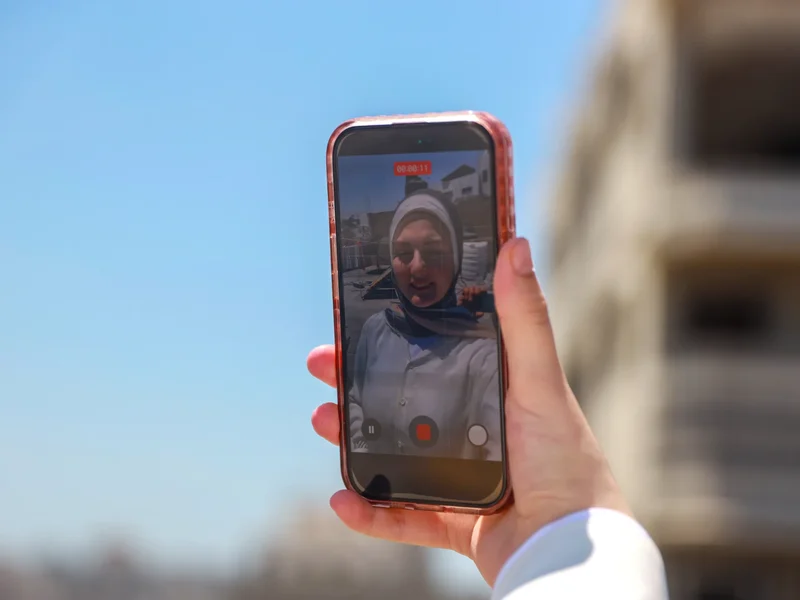
The device Eman now hands back to her mother each night is different. For her 18th birthday, her parents spent 6,000 shekels ($1,950) and bought her a brand-new iPhone 16 — a bright pink handset tucked inside a plastic case decorated with roses and butterflies, its lock screen a smiling selfie.
In the weeks that followed October 7, 2023, the family's 300-year-old home in Gaza's Old City was destroyed. Their current apartment sits barely 100 metres away, in eastern Gaza City. Scarred by bullet holes and shattered windows, it survived the surrounding bombardment, though the family has still been forced to flee it repeatedly during military operations.
"I wanted the world to see what was happening to us," Beirut says.
Small in stature, Beirut sits beside her husband and daughter on the sofa, her soft, delicate features making her look more like Eman’s sister than mother and daughter. She speaks with unguarded emotion, hands rarely still, her eyes widening as she recalls that morning.
"Our house was bombed while we were inside it ... we ran out barefoot, took nothing, the house burning behind us ... we survived by a miracle ... it was five in the morning ... at that moment I wished the whole world could see what was happening."
The first videos Eman posted were simple records of daily life. Images of destruction. Memories of her childhood home before it was damaged. Fragments of ordinary existence interrupted by war. They attracted little attention.
Then the audience changed. As Israel barred international journalists from entering Gaza, millions searching for a glimpse of life inside the Strip increasingly found it on social media. A handful of viewers became a few thousand. Thousands slowly became tens of thousands.
Eman smiles, shaking her head. "There was no clear plan behind the content. The ideas were already there, because it was just our life," she says.
"I was taking the ideas from the everyday things we were living and doing under the war ... open the camera and say, this happened to us, or that happened."
Then one afternoon a video took off.
Eman and her parents riding through Gaza on a donkey cart, known locally as a karra. With vehicles destroyed and diesel and petrol no longer entering the Strip, donkey carts had become one of the only ways to get around. She filmed the journey exactly as it was: her, her father and her mother passing between the rubble of destroyed neighbourhoods.
"Me, dad and mom," she captioned it.
"The clip got a huge amount of engagement," Eman says, her eyes widening as she gestures animatedly with both hands, a broad smile spreading across her face as she relives the moment. "I started gaining 100,000 followers every day. Within about a week I'd reached 500,000."
The numbers kept climbing. Roughly two weeks later, she woke to find her audience had passed two million. Eventually, it would reach five million.
Elsewhere, becoming an influencer is often viewed as the reward for years of careful work: learning the algorithm, refining an aesthetic, studying audiences and chasing visibility.
"For all this to happen to me all at once ... I couldn't have imagined it in my life before that. It was honestly shocking."
Eman's audience arrived because the world was searching for another kind of visibility altogether.
Around the world, debates over social media increasingly centre on what teenagers should be protected from: addictive algorithms and harmful content. Eman's experience posed a different question entirely. What happens when a teenager becomes responsible for documenting a war and millions of strangers begin depending on her to do it?
As Israel's genocidal war on Gaza divided the territory, many people displaced to the south could no longer see what had become of neighbourhoods in the north. Eman's family were among those who stayed, surviving repeated military incursions, displacement within the city and the collapse of electricity, water and communications.
Overnight, Eman found herself transformed from a girl filming her daily life into one of the few people documenting life in northern Gaza.
"I'd get so many messages from people in the south," she says. "'Please film this street. We want to see whether our house is still standing.' Or they'd ask me to pass a particular landmark, just so they could see what had become of it."
Journalists wrote to her, and news organisations started to follow. Every time her phone vibrated, someone, somewhere, was asking her to bear witness.
She tried whenever she could. But she could only film the places she and her family could safely reach. Sometimes she explained that to her followers. They understood; they were living the same war.
Social media has become a form of release during the war ... but the sudden exposure it brings can also overwhelm young people who are not prepared for the pressures of public attention.
Gaza-based psychologist Faten Abu Odeh says that in Gaza, social media has shifted from a space where adolescents build their identities into one where they document survival. With schools, sports and other spaces for growing up disrupted by war, online platforms have become one of the few places young people can still express themselves.
"Social media has become a form of release during the war," she says, "but the sudden exposure it brings can also overwhelm young people who are not prepared for the pressures of public attention."
This shift, from a beginner content creator to a news source by force of circumstance, was not just a numerical achievement for Eman. It came with a weight she was not prepared for.
The moment she became "the girl from the north" known to millions, she could no longer film with the same spontaneity she had in those first weeks.
"After that whole thing, I entered a kind of second phase, in the posting, in the engagement," she says.
The ideas that once came organically from daily life were no longer enough on their own; she had to "think of other ideas" and reshoot a clip more than once instead of posting it as it was.
Then, after the "ceasefire" was announced in October last year, “people stopped engaging, and Instagram, I mean the algorithm, started restricting my content's reach", Eman says, describing how her follower count dropped from five million to about 4.7 million.
The changing pace of the genocidal war was reflected in the rise and fall of her audience.
"I realised the war was the content," she says. "When there was a ceasefire, people stopped caring about what life in Gaza looked like afterwards."
Ahmed Jamal, a Gaza-based digital media specialist, says conflict-related content often follows a distinctive pattern on social media: it surges during major events as engagement spikes, before later becoming less visible as platforms' recommendation systems prioritise newer or different content.
"We saw many trends related to Gaza and Palestine begin in a very explosive way," he says, "with tens of thousands or even hundreds of thousands of accounts engaging with them, but after hours or days they would disappear from visibility."
Eman adapted instead. If the emergency no longer held people's attention in the same way, she tried to find new ways of showing everyday life in Gaza, searching for the small, overlooked details that might keep people looking.
Despite the "ceasefire", the genocidal war continues into its third year, and Eman began to notice dimensions that had not been clear to her in the first months of her sudden fame.
The dark humour and spontaneity that had defined her content at the start suddenly became something her followers put "under the microscope", as she puts it.
In the beginning, Eman's videos carried a tone that surprised many people who expected only grief from Gaza. She laughed. She joked with her parents. She found moments of levity in ordinary conversations because, she says, that was how her family had learned to endure.
"I used to film in a spontaneous way, with dark humour, and I was trying to convey the details of my life and the hard details of the war around me — blood, killing, massacres ... there are people out there suffering."
By "dark humour", Eman does not mean making light of the war itself. She means the small moments of levity her family clung to in order to survive it: laughing together on camera, teasing one another, finding reasons to smile despite everything around them.
In one video, they celebrated drinking tea with sugar for the first time in eight months, after sugar had disappeared entirely during the famine that gripped Gaza.
Faced with all this pressure, Eman kept asking herself whether she had the right to smile and speak lightly on camera, or whether she was expected to act as a strict chronicler of events.
By then, Eman's audience had grown well beyond the viral donkey-cart video. When her page passed one million followers for the first time, she wanted to mark the moment in her own way.
She bought a small tray of baklava fingers, rolls of crisp filo pastry filled with pistachios or walnuts and soaked in syrup, from a sweet shop in Gaza City's Old City, not far from where her family now lived.
It cost about 400 shekels ($130), a remarkable expense at a time when sugar had become scarce, and prices had soared under the blockade. She took the pastries to the paramedics at al-Ahli Hospital, she says, because they had "worked so hard alongside us" throughout the war.
She filmed the moment and posted it.
That same day, an Israeli strike hit a displacement camp in Rafah and many people were killed and burned alive, in the south of the Strip, where tents burned down entirely.
"The timing of the video's release coincided, to the hour, with the timing of the massacre," Eman says.
"The video shows me happy, handing out sweets, and then in the comments everyone attacked me for handing out sweets while people were dying, as if the timing had been deliberate."
The clash between her personal happiness and a tragedy of this scale on the same day opened a floodgate of criticism she was not prepared for.
That, in her words, was a "huge moment of realisation” that the number of followers she had came with a responsibility she had not consciously signed up for, and that she now had to "shine a light" on a particular cause.
But even that attempt did not spare her. "It didn't let up. People said I was benefitting from this fame, that I was just filming people's suffering for my own gain," she says.
"I no longer knew whether to post my usual spontaneous content about my daily life, or show the details of the war, or what."
Abu Odeh says the burden is especially acute for adolescents, who are still developing emotionally while living through trauma themselves. Becoming witnesses for millions of strangers, she says, can leave them carrying responsibilities they are not equipped to bear.
"This kind of change requires time and support," she says, "so that teenagers can gradually accept the new reality they are living."
Feeling suffocated, Eman has tried to stop documenting the suffering, even temporarily.
“I've noticed that Eman is going through an emotional decline," Beirut says. "Her feelings aren't stable. Maybe that's natural, given the psychological pressure that comes with the fame and the followers. At the same time, I want her to be stronger, to face her reality. This is simply the reality we're in, in the end, and we have to accept it and live with it, not run from it."
Sometimes, Eman says, "I tell my family: I don't want to film anything in Gaza any more, because I'm exhausted, and people are exhausted too.
"Other times I say, I've filmed all the suffering there is, I want to live my life, I want to film the things I want to actually live."
Eman’s sanctuary remains inside the apartment, where every evening ends with the same return of the phone.
The apartment itself bears the marks of a family navigating war and displacement. In Beirut's room, an old refrigerator, useless without electricity, has become a cupboard for plates and cups.
Before the genocide, Eman’s father, Hussam, ran a wholesale business supplying cleaning products and detergents to hospitals and other institutions across Gaza. Today, with his business destroyed, the family survives on what remains of his savings.
Hussam sits beside Beirut, his arms folded, listening more than he speaks. His features are calm, answering questions in an even voice that rarely rises, even when describing the upheaval of the past three years. If Beirut wears her emotions openly, Hussam seems to absorb them instead.
His work also allowed the family to travel. Business trips took him to Egypt, Turkiye, China, Malaysia and the United Arab Emirates, and whenever they could, his wife and daughter would join him, turning work into family holidays. "For fun," he says. "To try new things, wander around, enjoy ourselves."
Eman is Hussam's only child with Beirut. He has three older children from an earlier marriage, all now grown up and living separately. One was killed during the war.
Despite all the pressure Eman has lived through publicly, she describes her relationship with her parents as “having remained stable”.
"To this day I'm fine with them, and they're fine with me; there have never been any problems."
Before the war, Beirut had worried about strangers online. Now, she worries about strangers recognising her daughter in the street.
"That danger got a lot bigger ... people wanting to film with her, people wanting to talk to her. I became afraid to let her go out on her own."
The boundaries on phone use have also now changed. Decisions about interviews and collaborations have become family conversations. Videos are viewed together before being published. Sometimes mother and daughter disagree over what should be posted, but the discussion itself reflects something neither had anticipated: the teenager once denied a phone has become the person teaching her parents how the digital world works.
"I'm the one mostly who'd guide my family on this," she says, explaining a quiet reversal of roles.
And when the comments turned into attacks, the family's reaction was strikingly calm, almost the opposite in intensity to the attacks themselves.
"They were very cool about it ... they'd tell me it's fine." Their advice stayed consistent: "Do what you want, film what you like, film what you feel is right."
For a while, Eman adopted the same attitude, ignoring the negative comments. But as the pressure accumulated, her strategy changed. "Now I've started deleting the negative comments. I'm not indifferent; honestly, it affects me psychologically, so I delete any comment I see like that."
As her audience expanded, her father Hussam’s role evolved into something resembling an editor. He listened to conversations in markets and among neighbours, collecting reactions before bringing them home.
"I'd hear people talking in the market ... 'You're Eman's father, your daughter did this' ... I'd tell her, be careful, there's some criticism here, some feedback there."
It was an analogue version of moderating the comments section.
The family's decision to appear together in videos, he says, was partly instinctive and partly protective. In a conservative society, the visible presence of mother and father offered reassurance about the circumstances in which their daughter was filming. It also revealed something else: these videos were never really about a lone creator. They were about a family navigating catastrophe together.
Internet access has been "the thing that exhausted me the most", says Eman.
She has relied entirely on eSIMs. To get an eSIM signal strong enough to upload a video, she would climb to the communal roof of the family's four-storey building, where the four solar panels Hussam bought during the early months of the war now sit. Around them, walls pocked with bullet holes and shrapnel scars from the fighting.
"I climbed up so much that after a while, from climbing so much, I'd just stay standing ... standing on the chair, aiming it at the water barrel," says Eman. "Many times it was very risky to do so because of the ongoing bombing around."
When repeated climbs left Eman standing for hours in the summer heat, searching for enough signal to upload a video, Hussam built her a shaded corner from a brown-and-white fabric curtain. There, seated on a worn, fraying chair, she would angle her phone eastwards, waiting for an eSIM signal strong enough to reach the outside world.
"I didn't want Eman to be uncomfortable," he says. "I wanted her to live her life with peace of mind, despite the war all around us."
Around her, laundry hung from washing lines strung across the roof. To one side lay the remains of Gaza City; to the other, the ruins of the family's old home. Above it all, the constant buzz of Israeli drones.
The audience saw a phone balanced carefully towards the sky. They rarely saw the father climbing the stairs with a teapot and whatever he had managed to find that week: Lipton tea scented with sage or mint, poured into small glasses to share, a handful of salted nuts, raisins, dry bread rusks, or, when fortune allowed, a little chocolate.
The phone that Eman’s mother once feared would steal her daughter's childhood has ended up preserving what fragments of it remain. Every night, though, the ritual remains unchanged.
"The phone is absolutely not allowed to sleep in her room," says Beirut. "No way."
Around 11 o'clock, Eman unplugs the charger. She walks to her mother's room and hands over the phone. For a few hours before dawn, the device that has served as a witness, burden, companion and lifeline goes dark.
In another life, it would simply have been a phone.