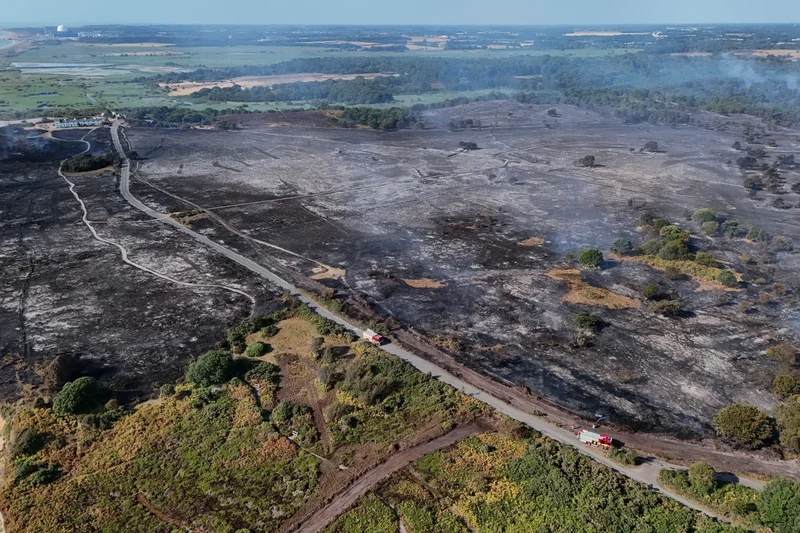
Firefighters are tackling a blaze at a nature reserve in North Essex as crews continue to battle the “unpredictable” wildfire in Suffolk.
Around 30 crew responded to a fire on Middlewick Ranges nature reserve in Colchester, Essex, urging people to avoid the area. It is the latest wildfire as England and Wales experience tinderbox conditions and swathes of the country remain in drought.
Multiple fire brigades remain on site for a third day fighting a blaze in Suffolk after it spread to cover an area the size of 210 football pitches on Thursday. Firefighters identified and mapped trigger points on Thursday evening.
The Sizewell B nuclear power plant a few miles away is on alert as flames and smoke tear through Dunwich Heath, where at least 90 firefighters are battling the blaze.
Nuclear chiefs at EDF, who are understood to be monitoring the situation, said there was currently no risk to the power station.
Authorities have declared a major incident and residents in about 200 coastal properties and caravans were forced to leave. Local wildlife habitats, protected as a Site of Special Scientific Interest, have been left devastated by the flames.
Prime minister Andy Burnham promised that firefighters in Suffolk would have all the resources they needed. Green Party leader Zack Polanski called for Mr Burnham to hold an emergency Cobra meeting.
Have you been affected by the wildfire in Suffolk? We’d like to hear from you. Please email bryony.gooch.ind@independent.co.uk
Breaking: North Essex grassland set alight as firefighters rush to the nature reserve
Firefighters are tackling a blaze on grassland in Colchester.
Essex Fire Service said around 30 crew were tacking a blaze on Middlewick Ranges nature reserve south of the city.
They urged people to avoid the area.
In pictures: A drone view shows the scorched landscape left by ongoing Dunwich Heath wildfire
Wildlife habitats in Dunwich Heath could take 25 years to recover - report
Habitats devastated by the wildfire in Dunwich Heath could take up to 25 years to recover, a wildlife expert has reportedly said.
Adam Rowlands, from the RSPB, said the blaze had been "hugely consequential" for the wildlife.
"Most of them have finished breeding so they'll be able to escape the fire, and last night we could see nightjars flying above the fireball up on the heath," he told the BBC.
"But the problem is it will look like a scene of devastation afterwards. All the vegetation will go and the majority of those birds will lose the places where they nest.
"Some of that habitat will take five, 10, 25 years to come back to what it looked like before the fire broke out yesterday afternoon."
‘All of Europe could catch fire this weekend’: Where is most at risk?
As an EU agency warns that more of the continent could be ablaze at the beginning of August, Helen Coffey looks into where is most likely to be affected and when, in what is already being dubbed the biggest fire season in European history.
Read more here:
Fire crew thanks national effort as brigades across the country lend a hand
Suffolk Fire and Rescue has thanked fire brigades from across the country for sending crews, specialist equipment and resources as a wildfire rages on in Dunwich Heath.
They particularly thanked:
- Essex County Fire and Rescue Service
- Norfolk Fire & Rescue Service
- London Fire Brigade
- West Yorkshire Fire and Rescue Service
- East Sussex Fire & Rescue Service (ESFRS)
- Surrey Fire and Rescue Service
- Northamptonshire Fire and Rescue Service
“We would also like to thank the many local businesses, farmers, volunteers, community groups and partner agencies who have stepped forward to help. Whether it's been donating food and drinks, lending equipment, providing practical support, or helping to look after those affected by the incident, everyone has gone above and beyond.”
Disposable BBQs currently not under review, minister says
Athena Stavrou, political reporter:
A government minister has said the banning of disposable BBQs is currently not under review, despite concerns amid ongoing UK wildfires.Firefighters have spent 24 hours tackling a “fast-moving” wildfire in Suffolk after the blaze spread to cover an area the size of 210 football pitches on Thursday.
There have been calls to ban disposable BBQs in order to prevent further wildfires, but asked if the government had considered the move, first secretary of state Louise Haigh said it was not currently under review.
“We've got specialist drone technology in the area to monitor the situation and they are containing the fires, but we are keeping a very close eye on it,” she told BBC Breakfast. “The advice is very clear about behaviour in this weather. I hear the National Trusts' perspective.
“It's not something that is currently under review, but we will continue to monitor the situation very closely.”
In pictures: Firefighters tackle blaze in Dunwich Heath as smoke rises from the scorched earth
National trust calls on government to look into climate change adaption as she reflects on devastated 'Dunwich' Heath ecosystem
Dr Hilary McGrady, the National Trust's director general, has said that the ecosystem on Dunwich Heath has been devastated.
"It's just been absolutely devastating," she told BBC Radio 4's Today Programme. "The impact has been enormous. I mean, the loss of this extraordinary landscape that so many people love, but of course the nature itself there, loss of nightjars of Dartford warblers, otters, lizards.
"The list is just so extensive. It's got every designation you could imagine," she said of the "incredibly important site."
The National Trust boss has called on the government to look into climate change adaption as she reflected on this being one of many large scale fires this summer.
"Climate change is here. This isn't something that we're waiting to happen. We are in the middle of it. We're feeling the impacts. I think everyone does recognise that now, but what we aren't yet seeing is that climate adaption, climate, thinking and planning isn't embedded across all parts of government.
"This is not just an environmental issue. This is an economic, a social issue that needs embedded. So we're calling for a plan that is cross-departmental, ideally led by a climate commissioner. We're looking for a planning system that really embeds climate adaption in everything that we do, houses that we build, landscapes that we look after. In our urban spaces, we need trees that will keep us cool. We need areas that will soak up the water when we, when we deal with flooding.
"Fundamentally though, we need to keep our fossil fuels in the ground."
She added: "This is a long term thing. We prepare for war, we prepare for pandemics. We need to prepare for climate change, and that's what we need to see."