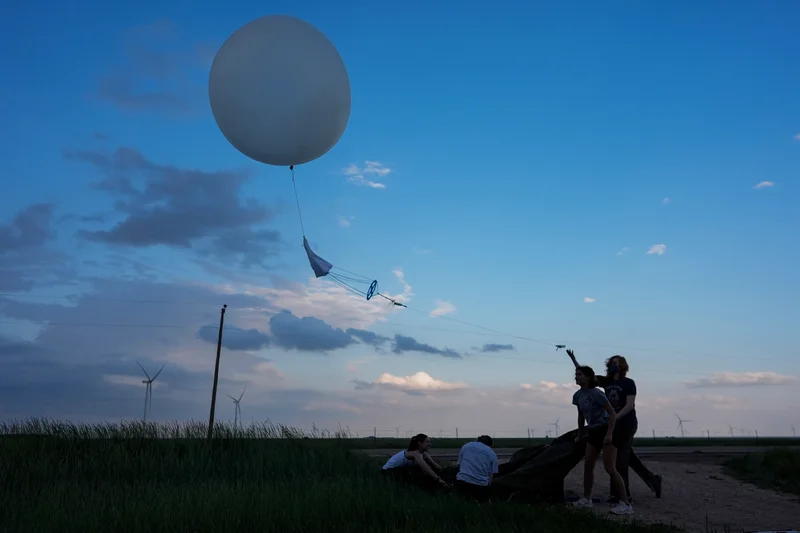
Twice a day, a delicate dance takes place in the Earth’s stratosphere: At noon and midnight Greenwich Mean Time, around 1,000 sensor-laden weather balloons slice their way through the sky, collecting readings crucial to global forecasting systems.
In the 1950s, members of the World Meteorological Organization, a United Nations agency, agreed to launch weather balloons as part of a co-ordinated data-collection effort. But now, one country is not following that pattern, which experts say is affecting Canada’s ability to predict the weather.
For more than a year, weather stations in the United States have strayed from their noon and midnight GMT balloon launches, according to data and multiple experts interviewed by The Globe and Mail. In many cases, these launches – or “soundings,” as meteorologists call them – are delayed by several hours, falling out of sync with the rest of the world. In others, balloons are no longer being launched at all.
The number of American stations reliably launching weather balloons at the WMO-designated times decreased substantially over the past year-and-a-half, a Globe and Mail analysis found. Just 51 per cent of stations that were regularly launching at noon and midnight GMT at the start of 2025 were still on that schedule earlier this summer.
Canada also saw a decline, but it was much smaller: A full 92 per cent of its stations were still launching during WMO times.
While the impact of the change is difficult to quantify, several meteorologists, scientists and forecasting experts said that Canada will have less information or forewarning ahead of severe weather events, and that the country must reduce its reliance on American data for its modelling.
“In the short term, a lot of meteorologists in North America are suddenly lacking confidence in the data,” said David Sills, a severe storm scientist and the director of the Northern Tornadoes Project at Western University in London, Ont.
“I’m just looking at the balloon launches from this morning, and there are no launches between Albuquerque, New Mexico and Saskatoon,” Dr. Sills said.
“There’s just nothing. It’s a void.”
Many morning soundings in the American west have been delayed by six hours, the data show, from 12 p.m. to. 6 p.m. GMT, leading to an 18-hour gap in the observations used by Canadian forecasters.
“We’re seeing a degradation of higher-resolution models,” Dr. Sills said. “Talking to meteorologists this year, we’re all going, ‘What the heck is going on?’”
While it is difficult to trace the impact of these changes on specific predictions or subsequent weather warnings, severe storm forecasters in Southern Ontario and Quebec will have less data they can rely on, he said.
Despite repeated efforts to replace balloons with satellite observations or other approaches, the cheap, battle-tested contraptions – which rise so high they eventually burst and fall back to Earth – have remained essential to global weather models.
“If you withhold weather balloons and run the same simulation, it’s not going to be anywhere near as accurate,” Dr. Sills said. “These are the models that generate our daily forecasts, assess whether a severe storm or an extreme storm is going to happen, these kinds of things.”
Changes to soundings in states such as Montana, Idaho, Utah and the Dakotas have a direct impact on Canadian forecasting, Dr. Sills said. Since weather tends to move from west to east, measurements collected by the U.S. provide critical data for meteorologists in Ontario and the Prairies.
John Bateman, a spokesperson for the U.S. National Weather Service, said that agency policy allows for launches at midnight, 6 a.m., noon and 6 p.m. GMT, and that a majority of the agency’s weather balloon stations are operating on a normal schedule.
“Any sites conducting fewer launches are due to temporary resource or equipment constraints,” Mr. Bateman said.
American news outlets have previously tied the changes to the wide-ranging spending cuts brought forth by U.S. President Donald Trump over the past year-and-a-half.
Matthew Bunkers, a consultant and meteorologist in South Dakota who retired from the U.S. National Weather Service last year, said that some government staff were happy with the agency’s change to its launch schedules, since it gives them data closer to the late afternoon, when thunderstorms are more likely to develop.
“I’ve talked to forecasters from a central U.S. office who like having the middle-of-the day sounding,” he said.
Dr. Bunkers said that the shift in launch times wouldn’t necessarily imperil forecasting models, either. Thirty years ago, models used to be run twice a day, but are now run continuously, fed by satellites, radar and other data sources aside from balloons. “As meteorologists, we have a lot of tools in the toolkit,” he said.
While the U.S.’s changes may benefit some of its own meteorologists, Canada is left to contend with a patchy weather balloon system.
“There are fairly big gaps in the Canadian network,” said Patrick McCarthy, a storm chaser and retired Environment and Climate Change Canada severe weather meteorologist who follows the weather “religiously.”
There are no regular soundings near Saskatoon, Regina, Calgary or Winnipeg, for instance, all major urban centres in one of Canada’s tornado hot spots. “There’s nothing. It’s very frustrating.”
Over time, Canada has become too reliant on U.S. measurements, said Mr. McCarthy, who is also president of the Canadian Meteorological and Oceanographic Society.
“The logic has been that there’s so many stations upstream” – that is, in the United States – “that that should be enough,” he said. “We’ve abdicated some of our responsibilities because we rely so much on American data. If they’re not going to do that for us, our network of upper air stations is no longer effective.”
Instead, Mr. McCarthy would like to see renewed investment in the national weather balloon network. A start, he said, would be to add at least one or two permanent stations in the Prairies – though he warns that’s unlikely.
“I can’t remember hearing of a new weather station in Canada. But I’ve heard of ones being closed,” he said. Earlier this year, Environment Canada disbanded a research team which had been working to improve the quality of data from the country’s new weather radars, which use pulsed energy to detect precipitation.
In an e-mailed statement, Environment and Climate Change Canada spokesperson Samantha Bayard said that the department had “observed a reduction” in U.S. morning soundings.
“ECCC is working to ensure that it has access to upper air data coverage from across Canada,” she said, and the government’s national atmospheric monitoring network is “robust and responsive to Canada’s unique climate and population distribution.”
Given the severe weather in the Prairies this summer – the provinces of Alberta, Saskatchewan and Manitoba have already seen more than 70 tornadoes in 2026, according to the Northern Tornadoes Project – the department has temporarily deployed a “mobile upper air station” in Saskatoon, which will launch a balloon each weekday, Ms. Bayard said.
So far, day-to-day forecasts in the U.S. and Canada haven’t seen a statistically significant decrease in accuracy, according to Eric Floehr, the founder of ForecastWatch, a U.S.-based service that has tracked and measured the quality of weather forecasts for more than two decades.
That doesn’t mean the dearth of balloon launches hasn’t had an impact, however.
“It’s in those unusual events that the weather balloons really make a difference,” Mr. Floehr said.
Take the case of Ottawa, Kansas, where several tornadoes touched down in April, including an EF2 – a rating for tornadoes that can inflict “considerable damage” – with wind speeds reaching 200 km/h, leading to three injuries. Ottawans received little advance warning, according to Mr. Floehr.
“If a balloon had gone up in one of the places nearby,” he said, “it is very likely that they would have caught that.”
To Mr. Floehr, the compounding effects of climate change will make the detailed atmospheric data collected by weather balloons increasingly important.
“In this era where we are absolutely, 100 per cent seeing more extreme weather, the more data you have and the better able you’re able to predict it, the more lives you save,” he said.