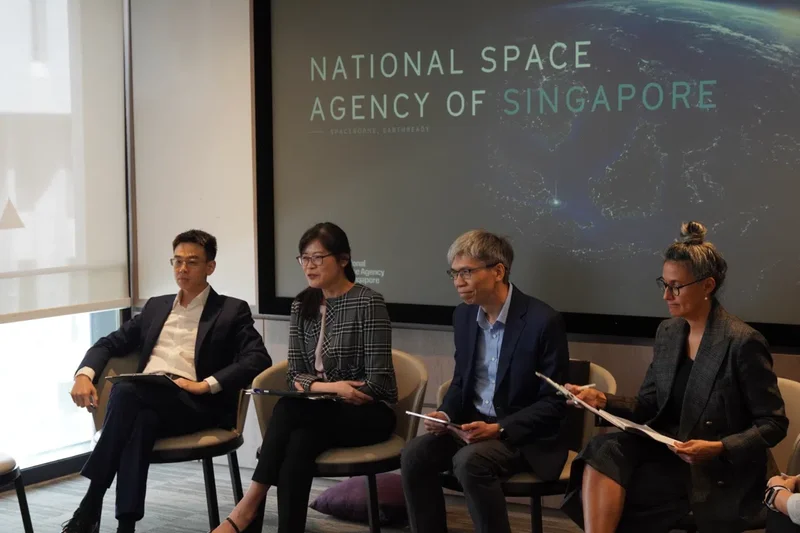
S’pore space agency to launch new satellite operations centre in 2027, plans new hires
AI generated
SINGAPORE - Over the next few years, Singapore’s newly-minted national space agency plans to triple its current 30 people-strong workforce to staff its new satellite operations centre and support plans to protect the sustainable use of outer space.
The National Space Agency of Singapore (NSAS) said it will be looking for talent across disciplines including legal, engineering, industry development and international relations.
Speaking to the media for the first time since NSAS’ launch on April 1, chief executive Ngiam Le Na said: “Today, NSAS is about 30-plus strong. We will probably be doubling and then tripling in the next few years.”
The additional manpower will also staff its new multi-agency operations centre, which is being built.
The centre aims to be a one-stop shop supporting government agencies with their needs, such as satellite images of a specific location for environmental monitoring, urban planning, port operations or food security.
Currently, NSAS and satellite operators obtain information on space traffic and potential collisions from third parties. There is also no coordination among government agencies to avoid duplicating efforts.
** The new centre will also operate** satellites and monitor them to avoid collisions in space.
“There are about 11,000 satellites (in space), but it is projected to grow significantly, possibly a tenfold increase by 2035. So we expect that collisions between satellites and space debris are going to increase significantly along the way,” said Ngiam.
This centre will sit in NSAS’ new headquarters which is slated to open in the middle of 2027.
NSAS, a department in the Ministry of Trade and Industry, has built on the functions of the then Office for Space Technology and Industry, set up in 2013 under the Singapore Economic Development Board (EDB) to drive the development of small satellite capabilities and new sensor technologies. The new agency is currently housed in EDB’s Raffles City Tower office.
In Singapore, satellites are used to detect oil spills, track ships and planes, and enable cellular communications, among other things.
Over the past two decades, more than 30 satellites have been launched by the Singapore Government, academic researchers and firms here for maritime surveillance, disaster management and communications.
There are currently around 20 active and inactive Singaporean satellites in orbit. Singapore’s three national satellites – co-owned by ST Engineering and the Government – weigh between 300kg and 740kg, while most of the rest are shoebox-sized research satellites from universities and companies.
NSAS’ new operations centre will be monitoring these space assets using state-of-the-art equipment, including control systems to protect them from sudden solar flares and extreme space weather, said Ngiam.
Staff from other government agencies could also be stationed at the centre to obtain and analyse images.
NSAS deputy chief executive and chief technology officer Desmond Lim said: “The first order of business is to work with agencies to define requirement, suss out use cases, and build a good working model for the multi-agency operations.”
The other focus areas for the agency includes building up Singapore’s space industry, advancing research and development, strengthening international partnerships, and tabling national space laws in a few years.
NSAS will continue maintaining a fleet of national satellites, but their numbers and functions will evolve over the years. The trio of national satellites that were launched in 2022 and 2023 will reach the end of their lifespan by the late 2020s, said Ngiam.
The agency is planning to replace the fleet, possibly with advanced capabilities to monitor land sinking as sea levels rise, and track forest health and crop growth.
“As satellites are much smaller and more compact now, we could go for a few more as compared to one single big one for the same cost,” said Ngiam.