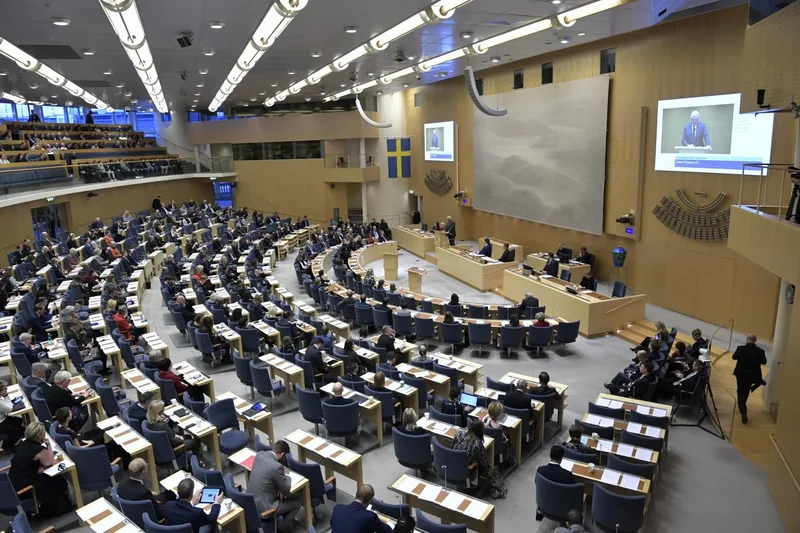
The bill, which will go before parliament during a special summer session on August 12th and 13th, increases the maintenance requirement for foreigners wishing to bring family members to Sweden, imposes a new maintenance requirement for permit extensions, and introduces a two year waiting period for bringing family members to Sweden.
It also aims to solve the problem of teen deportations by raising the age of dependency from 18 to 21 for all permits.
In an opposition motion approved last week and filed by Green Party parliamentary leader Annika Hirvonen, the party called for almost every proposal in the law to be rejected - with the notable exception of the teen deportation reforms.
"The government's proposal is a family separation law. It is a deliberate dismantling of the right to family life," she wrote in the motion.
The proposals, she said, would make it harder for immigrants to integrate by making it significantly more difficult for them to bring their loved ones to Sweden.
"On point after point, the government is erecting new barriers between parents and children, between spouses and cohabitants, and between young people and the countries they grew up in," she concluded. "It is a shame for Sweden."
READ ALSO: Swedish government announces stricter requirements for family immigration
Only united on one point
Hirvonen in April managed to unite the opposition parties to vote on a motion to add transitional rules to the stricter citizenship bill. The opposition proposal also won the backing of two former Sweden Democrat MPs and was in the end only defeated because the Sweden Democrats sent in two MPs to vote they had agreed to hold back under the parliament's pairing agreement.
But there are fewer points of agreement on family reunion, with the largest opposition party, the Social Democrats, supporting almost all of the government's proposed reforms.
The only point where it is in agreement is in calling to reject the proposal to require the maintenance and housing requirement to also apply when a family member is extending their residence permit, which is not currently the case.
In a motion to the parliament submitted by the party's immigration spokesperson Ida Karkiainen, the Social Democrats, like the Green Party, Left Party and Centre Party, are calling for the parliament to reject this clause in the bill.
The party, Karkiainen wrote, "sees a risk that the government's proposal will build family separation into the legislation and lead to more deportations of family members" if this part of the bill enters the law.
Other possible points of agreement
The Social Democrats want to soften some of the government's other proposals.
In their motion, they propose reducing the proposed higher maintenance requirement from 1.30 times the so-called normalbeloppet to 1.10 times (from 8,116 kronor to 6,867 kronor at 2026 rates).
The Centre Party and Left Party want the maintenance requirement to remain at the current 1.0 times the normal amount (6,243 kronor), while the Green Party want it abolished altogether.
If the other opposition parties united behind the Social Democrats' proposal, there is a chance of defeating the government.
The Social Democrats also want to halve the waiting time for family reunion introduced in the bill from two years to one.
"'It is unthinkable for most people to live for more than two years without their children or parents," the party argues.
If the Green Party, Left Party and Centre Party, who all oppose bringing in a waiting period, unite behind the Social Democrat's compromise proposal, there will again be a chance of a government defeat.
**What will need to happen for the opposition to change the bill? **
The opposition parties on the Social Insurance Committee would need to unite behind a joint proposal on one or more of these points when it meets on August 10th to prepare the final text of the bill to be put before parliament.
The joint proposals would then have to be raised formally during the debate on August 12th, before a vote on August 13th.
For the opposition proposals to pass, the opposition would then need at least two Liberal MPs to vote for their proposal.
This is not too far-fetched, given that four Liberal MPs are not standing for reelection because of their opposition to the party leadership's decision to open up to sharing a government with the far-right Sweden Democrats.
In a comment to the Local, Hirvonen said she expects the opposition parties to reach a common position on several issues, but did not specify which ones.
The Local has contacted representatives for all the opposition parties to ask about their expectations for the bill and will add to this article when others respond.