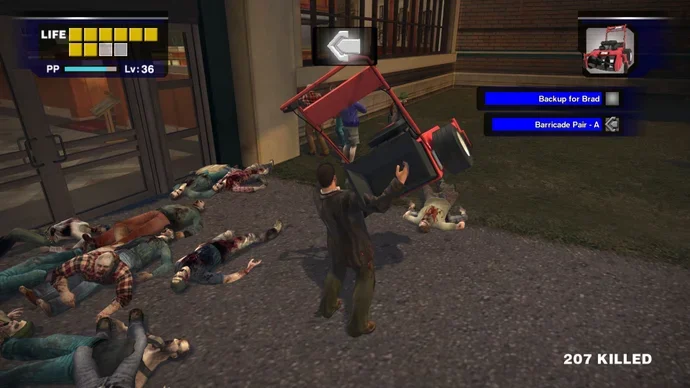
Photojournalist Frank West is heli-dropped into the Willamette Parkview mall, following a tip-off that there’s something sinister going down in the sleepy Colorado town. Impressively undeterred by the sight of people eating each other by a school bus during his fly-by, he instructs his pilot to drop him off on the mall roof and return for him in exactly three days.
The rest, more or less, is up to you. If you decide to do absolutely nothing but lounge around in the security room for 72 in-game hours, Dead Rising doesn’t care. The chopper turns up on schedule, you get in and leave. Thanks for the £40, here’s the credits.
But Frank’s here for more than food court leftovers and nap time. There are zombies in this town. In this mall, in fact, thanks to the actions of one extremely hard-to-forgive senior citizen and her toy poodle. There’s also an open-shirted, long-haired man hanging around who seems equally likely to reveal crucial information or release an absolutely banging Latin pop single. Intrigue’s in every crevice of this shopping centre and Frank’s keen to seek it out. Sure, his life’s in danger, but the guy is basically nonplussed. He’s covered wars, you know.
You, on the other hand, are (probably) not a photojournalist on an assignment to uncover a riot in a sleepy Colorado town, but a player of videogames. You have a totally different agenda to Frank, one that involves far more playing dress-up and performing wrestling moves on the recently reanimated. And while most open world games ignore that incongruity between what the player wants and what the protagonist wants, Dead Rising leans into it with its uncommonly pliable structure.
Here are, for example, some ways to spend your limited time in the mall: complete missions which piece together the story of the dead rising in Dead Rising. Hunt down the Psychopaths who’ve been mentally broken by the event and have turned into videogame bosses in response. Rescue survivors dotted around the mall. Go looting for cruel and unusual weapons to use against those who refuse to rest in peace. Take photographs of gory, funny, or sexy scenes you see around the mall. Wander round killing the zombs indiscriminately. Read a book. Try on outfits.
Dead Rising cares not one jot which of these endeavours you choose. Like a great improv comedian, it steps back and just lets you get on with it, interjecting only with a suggestion, never a directive. Hey, a new survivor's been spotted over at Paradise Plaza. That jarringly sexy Central American stranger might have new info about the infection. A bunch of cultists have turned up. That sort of thing.
In the space this game gives you in between those time-triggered events, you absorb the atmosphere of the place. A shopping mall is an obvious place to set a zombie game, but Dead Rising does it with an equally keen eye for Dawn of the Dead’s social satire, and the massive gameplay potential a great big building full of shops and stock has in this setting.
You feel a bit of a buzz, strolling through the shops and picking up whatever you like. And you internalise the logic of where certain item types can be found: sporting goods and DIY stores for weapons, food court for health-replenishing snacks, kids area for ludicrous costume items. It makes its own kind of sense, and it gets to have a jab at your innate consumerist tendencies in the process.
It feels like such a dense space for 2006, too. The world map’s scale isn’t impressive by modern standards, but the level of detail, variety and interactivity certainly is. If you’ve wondered if you could visit that castle/mountain/volcano/dystopian tower on the horizon in countless open worlds since and then felt deflated when you got there because the journey was across so much empty space, Dead Rising’s environment feels like the antidote to that modern malady.
Characters are broadly written, and their performances are often so scenery-chewingly pantomime that even Divinity: Original Sin-era Larian would tell them to dial it back a bit. In truth Dead Rising's cast isn't an element that’s aged particularly well, but it is nonetheless possible to feel a fondness for the likes of Otis the janitor, jockish photojournalist Kent Swanson, and timid DHS agent Jessie, a trope whom Capcom has rolled out in numerous names and guises over the years.
There are 54 survivors in total dotted around the mall, and you can engage with their stories as much or as little as you choose. Or leave them all to die, without any particular punishment other than the massive karmic weight of such an act. If you do choose to engage with their stories, though, you generally find a surprising amount of thought and detail: Cheryl, having been captured by cultists while in the movie theater and subsequently rescued by Frank, tells him she can’t stand the idea of just disappearing. So she asks him to take her picture. She’s an incidental character, but someone’s thought about her and decided she was in the movie theater because she’s obsessed with stars, with being known.
It’s good at something else most open worlds are rubbish at: ramping up its challenge as you become more powerful. Too often game worlds feel swept clean by the time you’ve got the best weapons and the coolest abilities, but this one ramps up in tandem with Frank. The zombies get angrier and more proactive at nightfall, and as the days tick by, the human antagonists of Willamette make themselves known too, throwing curveballs deep into your run without funnelling the gameplay into linear territory.
The only aspect it doesn’t leave up to the player is when certain events take place. To really deepen the sense that time is passing, and that you’ve got a limited window to explore this mall, Frank’s ‘Case’ missions trigger at set times, and both Survivors and Psychopaths spawn on specific time cues too.
Play the game through a few times and you begin to feel like a bloodier Bill Murray in Groundhog Day, planning in advance for rescue missions and tricky fights you know are coming up in a few hours’ time. During the first playthough, though, the way time passes is quite alarming. It’s a real FOMO driver, and the fact that even important Cases will simply expire and lock all further progress in the main storyline makes you feel unusually responsible for the decisions you make.
Over in Western RPG land during the same year, Bethesda Softworks had released a very different vision for what to do with all the space that gaming hardware allowed. Oblivion’s open world is vast and, in a way, frozen in time.
Its denizens stand and wait indefinitely for you to help them rescue their cousin from a haunted painting, or harvest Nirnroot, or close a bunch of gates that daedra are absolutely pissing out of. There’s a pinch of reactivity to quests – kill an NPC and you’ll soft-lock yourself out of the quests they had to dispense, likewise when you hit major primary quest plot beats without having cleaned up certain side quests – but BGS’s design ethos in Oblivion is that time passes according to the player’s actions, not independently of them.
That ethos is very well-suited to the kind of power fantasy that most players want from an epic RPG, and it’s proven such a popular way to organise the activities in open-world games that in 2026 it’s basically rote. It’s like explaining that when you pick up items from the game world, they enter your inventory. Of course the world is frozen in time until you move the plot forward.
By contrast, almost nobody picked up where Keiji Inafune and Yoshinori Kawano’s Capcom team left off in Dead Rising. Truly dynamic open worlds that tick along regardless of your actions have remained a rarity since Frank’s mall misadventures. There were, of course, the Dead Rising sequels themselves, but they never seemed to capture the same magic as the original. Their settings seemed too broad and their vastness at odds with the limited time concept. And as for the 2024 remaster, well – we don’t like to talk about that.
No, the time-sensitive open worlds have been rare. So much so that even deeply flawed projects like Deadly Premonition, Swery’s 2010 tragi-comic retelling of Twin Peaks, feels like it has something to offer when you notice that Greenvale’s NPCs each have their own daily routines and mill about living their lives regardless of what you’re doing.
Persona is the current title-holder for compelling passage of time. It knows that making you decide how to spend the minutiae of even your most uneventful school days makes it hit that much harder when the strange inner psyche dungeon-crawling arrives, and that agency gives an extra dimension to your accomplishments.
More recently, titles like Outer Wilds and Deathloop have found more gamefied, knotty ways to bring the passing of time into open worlds (or interconnected sandbox spaces, in Arkane’s case) by making time cyclical and having you rearrange the parts of their repeating sequences to progress. On the Horizon, The Blood of Dawnwalker extends the duality of its vampire protagonist to a day-night cycle, transforming who you are and how you interact with the world when the sun rises and sets. Your actions cost time, and as it passes, your multiple potential narrative branches lessen. They prove what an untapped vein of creativity there is in the way time passes in our open worlds.
But Dead Rising’s simple three-day limit (spoilers: plus overtime, depending on your in-game actions), scheduled global events and aversion to fail states feels curiously under-borrowed in the last 20 years, given how predominant open worlds have become in that time.
Perhaps the biggest deterrent to devs is that Dead Rising’s structure has an end point. As games have evolved to become live service destinations, it feels increasingly unintuitive to put a full stop on the experience after you’ve spent such a lot of resources on building a great big world. You only had to play Fallout 3 without the Broken Steel DLC and feel the cruel sting of its end credits to understand why persistent open worlds are almost mandatory today.
On the other hand, Dead Rising seems to get more fascinating each time you start a new game. You’re technically replaying content you’ve seen before, but since you can only be in one place at one time and you’re always making small decisions about how to spend that finite resource, it never actually feels like you’re doing the same thing again. This time last playthrough you were dicking about with a Lego head in the Paradise Plaza. Now you’re shepherding four survivors to the safe room, stocked up on orange juice and extra health points carried over from the last playthrough.
Capcom’s New Game+ system does a lot of the groundwork. Being able to start a new run with the extra unlocked combat moves and health upgrades means that you can take on activities that you daren’t before. You’re the version of Bill Murray who plays piano like a virtuoso and knows how to chat up Andie MacDowell. The mall’s the same, the weapons are in the same location, and the same events trigger at the same times. But your increased stats and knowledge mean that your experience of them is always a bit different in the next playthrough.
Maybe it’s how the events unfold. As your first day turns to night, a double-stab of nu-metal guitar fills the night air to herald the arrival of some of gaming’s biggest jerks: the Convicts. This trio of escaped prisoners in a jeep with a mounted turret have decided to drive around the central Leisure Park mowing down zombies and civilians indiscriminately, and the first time you encounter them they feel almost insurmountable. You’re a guy in a big leather coat carrying (probably) a dumbbell and a carton of orange juice, against three lunatics with a high-caliber mounted gun. It’s unwinnable.
Unless you prep for it, like any Dead Rising player does after their first playthrough. You stock up on ranged weapons, bait the jeep into driving into a tree, and take your potshots at the driver until the other two are left immobile. And you apply the same principle to the other major developments, like the glowing-eyed, angrier zombies, the cultists, and the soldiers.
It makes you wonder which is the preferable late-game state in an open world. An environment you swapped up the main quest in, but where stragglers of questlines remain in endless supply, or an environment that’s been reset, every indication of player agency wiped away from it except for a few extra blocks on a health bar. The genre may have voted with its feet towards the former, but limited-time open worlds are a fertile ground for innovators to share some fresh ideas in.