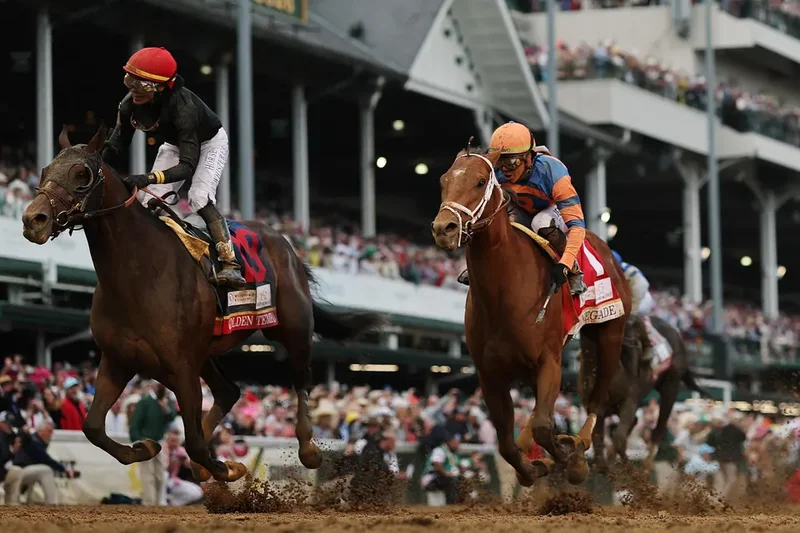
This fine Michael Reaves shot, top, of Golden Tempo edging Renegade at the Churchill finish line is a grand rendering of two airborne Thoroughbreds thundering down on victory, or something very close to it. But it only hints at the ferocious mile-and-a-quarter gauntlet each horse had to run to get to that exalted precipice in America’s, and the racing world’s, most famous race.
Within spittin’ distance of the 5:44 post time for the $500,000 Jim Dandy at Saratoga tomorrow, what follows is a study of the two biggest races in Renegade’s life to date, and the anatomy of his finish in them.
The first and biggest race was the Derby, pictured top, and the second was the Belmont, pictured below. It’s fair to say that, as a bright, fine leading colt nationally and as a decorated Triple Crown veteran, Renegade’s runs in those races have been bandied about to a fare-thee-well. But it’s equally fair to observe that Renegade’s results within the two Triple Crown runnings have been misunderstood by a very great number of people in handicapping the Jim Dandy and by extension, in assessing contenders in what upstate New Yorkers and many others consider a shadow, sort-of-widowmaker Triple Crown race, namely, the Travers, infamous for bringing even the godly Secretariat to a rare defeat.
What we’re after here is the answer to a two-fold question: Why is Renegade the second-favorite in the Jim Dandy morning line by such a skinny margin, and the corollary, why does the handicapping mindset that Renegade may wind up in the money (but almost certainly not as the victor) exist? Some notables among the gods of picking, the NYRA’s hilariously, fearsomely sharp Andy Serling among them, seem near to tossing the inescapable Ortiz Jr. and his talented mount, not to mention the brainy Texan trainer Todd Pletcher, over an – ahem – Ohio Derby winner. Rare and curious, that, no?
But before we dive into the minutia of those battles, here’s a refresher on the Jim Dandy field and its morning line.
(Post Position, Trainer, Jockey, Morning Line Odds)
-
Chip Honcho, Steve Asmussen, Jose Ortiz, 3-1
-
Asked and Answered, Antonio Arriaga, Jaime Rodriguez, 30-1
-
Renegade, Todd Pletcher, Irad Ortiz Jr., 7-5
-
Silent Tactic, Mark Casse, Luis Saez, 6-1
-
Commandment, Brad Cox, Flavien Prat, 6-5
(Source: New York Racing Association, 7/30/2026)
A look back is required: Renegade got to Churchill by winning the Arkansas Derby, a big, celebrated prep in which he easily hammered into place the speedy Silent Tactic, whom he will meet again bristling beside him at post time in the Saratoga gate on Saturday. But the Arkansas victory absolutely pales beside the sheer madness and gargantuan size of the Churchill Downs extravaganza – its field, its audience, its gate, its paddock, its ambient decibel level, and not least, the length of its race at its precise debut point in the athletic lives of its three-year-old contenders.
All that spectacle is unmatched in American and in global Thoroughbred racing on dirt, and to varying degrees all of it freaks out each and every horse that runs in it. The Derby’s question is quite often decided by whichever colt or filly has the racing focus and the strength not to succumb to his or her ambient freak-out.
Because the Kentucky Derby fields are so huge – this year, at eighteen horses, it was double the nine-horse field of the other Triple Crown bookend, the Belmont – the Churchill start traditionally resembles more of a rugby scrum than any other contest among Thoroughbreds.
The reason is this: For a mile-and-a-quarter race, the “new” Churchill gate is positioned at the top of the stretch, where the track broadens with a little kick-out bulge to accommodate the 20-stall monstrosity. From that break, there remains just over a quarter-mile to the first turn – 480 yards and change – which means that the athletes who have drawn inside post positions have anywhere from a few to sixteen or seventeen – or even nineteen – rivals coming down hard upon them to save ground before they hit that first turn.
The rugby scrum isn’t relegated to the break. Bluntly put, if you enter an athlete or a couple of them in the Kentucky Derby, God help you and him or her, because jostling, bumping and outright fouls are the status quo. Getting through sixteen to ninteteen horses to the finish is a tight physical battle no matter at which point of call the athletes are in the race. It’s a rare Kentucky Derby when the stewards do not have to take second looks.
Which is exactly the feature that makes the Derby such a highly demanding, tactical race. Winning it is a ragingly swift chess game of finding the slot to dance away from the competition. It’s at once a jockey’s race, and a monumental challenge for these adolescents, running the longest and certainly the most baffling, aggressive span of their lives. The more lightly raced contenders don’t even yet know how to “listen” to their jocks’ tactical suggestions, which of course begs all sorts of disaster.
As we know, Renegade was the 2026 favorite, and he famously drew the most dreaded post position in the entire Derby tumble , the No. 1 “hole,” smack on the rail. At the break, during which he got slammed by a triumvirate of horses themselves moving to escaped being slammed by a neighbor, Renegade and Ortiz had the entire field coming down on them in the run to the turn.
Which brings us to the point: He literally had to re-start his run, which is, at the tender age of three, strong evidence of tactical prowess, and even stronger evidence – if any were needed – that Hall of Fame jock Irad Ortiz is a tactical genius. That Renegade not only brought a huge run, wove through the peloton and came within a neck of taking the victory is nothing short of an heroic deed. Said another way, he beat sixteen of his nationally-ranked peers, including his slightly more-favored rival on Saturday, Commandment.
Four weeks later, Renegade’s rough Derby ride continued, and can even be said to have been worse, in the Belmont. The terse Equibase paragraph on his adventurous Belmont run reads like the film script from One Battle After Another.
Here it is:
“RENEGADE bobbled at the break, raced just off the inside through the first turn before heading three paths off the rail down the backstretch, continued three wide through the far turn coming under urging with five-sixteenths to go, angled six wide into upper stretch, dug in rallying with the top pair to the furlong grounds, then couldn’t keep pace late and was shaken off by those rivals while keeping on to be clear for the show honors.
To get around traffic in the backstretch, Ortiz took him three lanes wide, then had to go six wide at the top of the stretch – effectively having to ask Renegade to start another run before they could get around most of the peloton. Renegade led Golden Tempo and Commandment for a few seconds in the stretch as they squeezed him toward the rail, and that caused his rally to falter ever so slightly, allowing the victor and the place horse to put him in show. But: He was with them until the very last strides.
The point about both those big races is: traffic. Although the Belmont break was smooth, Renegade and Ortiz took to the back alongside Golden Tempo and Commandment and had more to do winding his way through the pack than either of them. There won’t be that kind of traffic in this five-horse field, and Renegade has beaten Commandment when it mattered most, and arguably, when his traffic problems were at their most acute, at Churchill.
Essentially, that fact alone deepens the mystery of Renegade’s second-favorite status in the morning line. What were they thinking up there in the Adirondacks? What did he do wrong except fight the traffic that confronted him?
We shall see what the track money will opine on the narrow favorite Commandment as the clock ticks toward 5:44 p.m. Eastern in Saratoga tomorrow, but his residency as the favorite looks parlous at best. Chip Honcho seems unlikely to be enormously loved by the track money, but weirder things have happened. For a close second-favorite at the moment, Renegade’s connections have no choice but to celebrate their status as a highly decorated, but oddly-unloved, outlier.
And that may be the best reason of all to put some money on his nose.