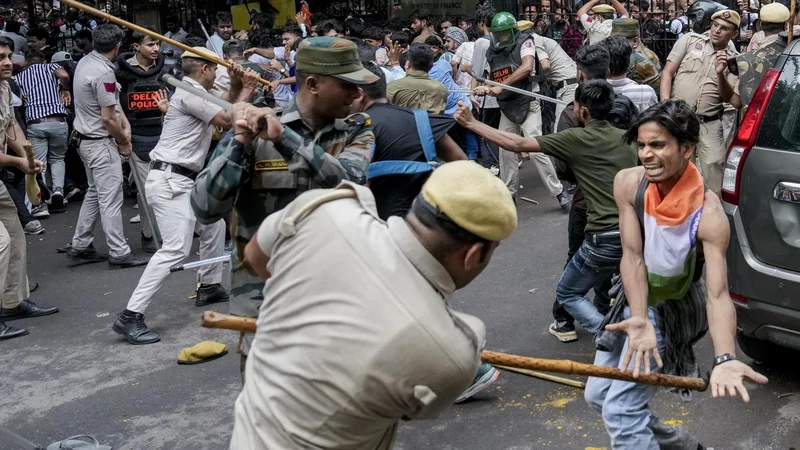
The Cockroach Janta Party’s (CJP) “Chalo Sansad” march in Delhi, which came to an end on Saturday led to the resignation of of Union Minister of Education Dharmendra Pradhan, as protestors demanded accountability over paper leaks in the National Eligibility-cum-Entrance Test (NEET). Among the many conversations it started, the power of the police stood out due to videos of tear gas, pellet guns, and lathi charges circulating.
While reports and news coverage over the years have revealed a pattern of violence resulting in injured civilians, and in some cases, deaths, the National Crime Record Bureau’s (NCRB) data barely reflects the extent of it. Further, the data show that cases filed against police personnel are far less likely to end up in conviction when compared to overall crimes.
The past few editions of the NCRB’s ‘Crime in India’ report have shown a declining number of civilians injured during police operations despite the occurrence of many widely reported incidents.
For instance, NCRB says only 76 civilians were injured during police operations throughout India in 2020 despite the beginning of the year witnessing widespread protests against the Citizenship Amendment Act, particularly in north-east Delhi. A report by the United Nations High Commissioner for Human Rights states that over 200 were injured in Delhi alone.
The NCRB also shows that 18 civilians were injured in such instances in 2023, despite reports from PTI stating that more than 30 students, mostly women, were injured in Manipur’s Imphal Valley as the police fired tear gas shells and baton-charged a crowd protesting against the killing of two youths.
Another striking case of underreporting was in 2024, when only two civilians were injured across India during police operations as per NCRB. The ‘Dilli Chalo’ protests organised by farmers took place throughout the year, resulting in police resorting to use of force on many occasions. Hundreds were injured after clashing with the Haryana Police on the Shambhu and Khanauri borders in February 2024 alone.
NCRB data also show that over the past five years, less than 1% of cases filed against police personnel, involving crimes such as illegal detention, deaths in custody, torture, and extortion, have ended in convictions in court.
To put this figure in perspective, all crimes coming under the Indian Penal Code or the Bharatiya Nagarik Suraksha Sanhita, such as murder, rape, and offences against women and children, have had a conviction rate of around 50% in the same time period.
Additionally, about 80% of criminal offenses created by specific statutes outside of general penal codes, or Special and Local Laws (SLL), end in conviction. The Narcotics Drugs and Psychotropic Substances Act and the Unlawful Activities (Prevention) Act come under the SLL category.
(With inputs from Gandla Sneha, who is interning with The Hindu’s Data Team.)
Published - July 31, 2026 07:00 am IST