Space Snapshot
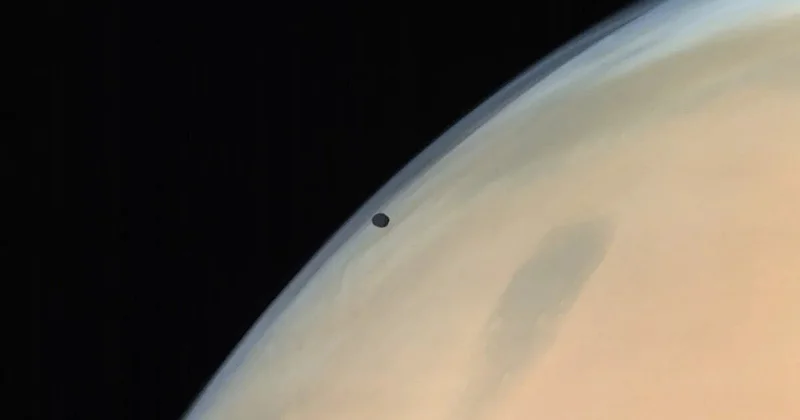
Marsâ two moons are small. In this 2014 image from Indiaâs Mars Orbiter Mission, you can see Phobos, the larger of the two, which is only about the length of a major city on Earth. Still, this tiny world may hold important clues about the history of the Solar System â thatâs why Japanâs MMX spacecraft is going to retrieve a sample from its surface. Learn more in our guide to Phobos and Deimos. Image credit: ISRO/ISSDC/Emily Lakdawalla.
Fact Worth Sharing
Phobos orbits closer to its planet than any other moon in the Solar System, and gets closer every year. In roughly 30 to 50 million years, Phobos will get close enough for Marsâ gravity to rip it apart, causing debris from the moon to land on Mars and possibly form a ring around the planet.
Mission Briefings
Starshipâs latest test flight was a success. The SpaceX megarocket launched on July 24, sending its vehicle on a suborbital test flight and deploying 20 Starlink satellites. A human landing system variant of the Starship spacecraft is one of two lunar landing systems being developed for NASAâs Artemis program. Pictured: The Ship vehicle seen from the Starship rocket. Image credit: SpaceX.
Wildfires in Spain forced the evacuation of a NASA Deep Space Network (DSN) facility. The Madrid DSN station is one of three around the world that communicate with spacecraft traveling throughout the Solar System. Wildfires in Spain and France have also forced more than 300,000 people to evacuate their homes. As of the time of writing, the fires stopped before reaching the DSN station complex.
The U.K. is cutting funding to several space exploration activities. The budget cuts affect funding for the Jodrell Bank Observatory, which hosts a network of radio telescopes, as well as U.K. participation in the Vera C. Rubin Observatory and the Next-Generation Transit Survey.
From The Planetary Society
This tiny CubeSat will be a big achievement. A team of students at the University of Maryland is building their own spacecraft to join the missions observing asteroid Apophis as it passes close to Earth on April 13, 2029. Members of the team joined this weekâs Planetary Radio to talk about how a class project turned into a real mission. Pictured: A rendering of the TERP RAPTOR CubeSat spacecraft. Image credit: TERP RAPTOR/University of Maryland.
NASA may send an engineering test of the Perseverance rover to the Moon, but at what price? Planetary Society Chief of Space Policy Casey Dreier has analyzed historical analogs, public data, and current NASA procedural requirements to determine just what the mission would cost, and what it might deliver.
Next in the Book Club: âAlien Oceans.â On Aug. 5, JPL researcher and explorer Kevin Hand will join Planetary Society members in a virtual book club meeting to discuss his book, âAlien Oceans: The Search for Life in the Depths of Space.â Join us with your questions and thoughts about whether we may finally discover extraterrestrial life in the warm, salty oceans of other worlds. Not yet a member? Join today.
What's Up
Super bright Venus is stunning in the early evening west. In the pre-dawn, Mercury is very low in the west, with reddish Mars above it, and yellowish Saturn high in the sky. Find out what to look forward to in our guide to Augustâs night skies.
Help save space missions. Join today!
If you are not already a member, we need your help! Funding for space science is not guaranteed. It requires the voice of passionate advocates like YOU.
NASA funding must grow, not shrink, if the agency is to succeed in returning to the Moon, exploring the Solar System, and seeking out life beyond Earth.
We must prevent future budget cuts. When you become a member of The Planetary Society, you join the worldâs largest and most influential space advocacy nonprofit. Will you join us and support a future full of space exploration?
Wow of the Week
Legendary space artist Don Davis painted this imagined view of Mars from the perspective of Deimos in 1978. He based the piece on maps of Mars made from Mariner 9 and Viking orbiter photos. âThe distinctive albedo markings which telescope observers have long observed dominate the overall appearance of the planet,â said Davis, âbut the details of the topography are revealed with close examination. Deimos was based on initial mapping, which was in progress at the time. The star background portrays a real area of the sky, my usual practice.â
This painting is included among the archived items in The Planetary Societyâs âVisions of Marsâ DVD, which was brought to Mars on the Phoenix lander in 2008. *Image credit: Don Davis. *
Send us your artwork!
We love to feature space artwork in the Downlink. If you create any kind of space-related art, we invite you to send it to us by replying to any Downlink email or writing to [email protected]. Please let us know in your email if youâre a Planetary Society member!