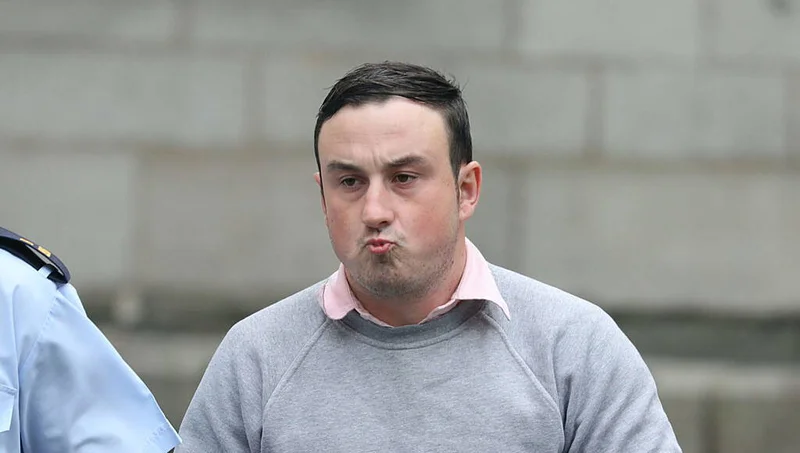
Garda killer Aaron Brady, who showed "contempt" for his capital murder trial by secretly recording a garda interview with a potentially key witness, has had his three-year sentence increased following a successful appeal by the State.
Lawyers for the Director of Public Prosecutions had argued that the case raised an important issue of “principle” rather than one of practical consequence, as Brady (35) is already serving a life sentence for the murder of Detective Garda Adrian Donohoe.
However, they said there are “very few, if any cases where deterrence would be more important”.
Quashing Brady’s original three-year prison term and resentencing him to five years imprisonment today, Judge Isobel Kennedy said the offending was an “affront to the administration of justice”.
What occurred was “pre-meditated”, “insidious” and “menacing”, the Court of Appeal judge said, and was aggravated by the fact that it occurred in the context of a capital murder trial.
In August 2020, Brady, formerly of New Road, Crossmaglen, Co Armagh was convicted by a jury of the murder of Det Gda Adrian Donohoe during a credit union robbery at Lordship, Bellurgan, Co Louth on January 25, 2013.
In 2024, he pleaded guilty to a charge that on a date between February 20 and May 7, 2020, within the State, he video-recorded the playing of a witness interview between Ronan Flynn and members of An Garda Siochana, thus embarking on a course of conduct intended to pervert the course of justice.
A further count of conspiring with Dean Byrne to persuade prosecution witness Daniel Cahill not to give evidence with the intention of perverting the course of justice between April 8, 2020 and June 22, 2020 was taken into account.
Brady was sentenced to three years in prison by the three-judge, non-jury Special Criminal Court.
As Brady is already serving a life sentence for murdering Det Gda Adrian Donohoe, his sentence for perverting the course of justice will make no difference to the time he serves.
Brady accepted that he was responsible for recording footage of an interview between gardaí and Ronan Flynn, a witness who told gardaí he had heard Brady admit to shooting Adrian Donohoe three times.
The video was later posted on social media accusing Flynn of "touting" and calling him a "rat".
Flynn did not give evidence at Brady's trial and Judge Michael White, who oversaw the murder trial, described the release of the footage as "the most outrageous contempt of court" and a clear attempt to intimidate Flynn and other witnesses.
Brady also sent photographs of portions of Daniel Cahill’s statement to Dean Byrne (33), a violent criminal housed on the same wing of Mountjoy Prison.
Byrne passed the statements on to at least two people in what the State argued was an attempt to get Cahill's family members to persuade him not to give evidence.
Cahill did give evidence at Brady's trial, telling the jury that Brady admitted to shooting a garda on three occasions while Brady was living in New York, having fled from Ireland in the aftermath of the murder.
Flynn, who did not give evidence at Brady's trial, spoke to gardaí in October 2017 while he was living in New York.
He told gardaí that while he was sharing an apartment with Brady, he often heard the defendant admit to shooting Det Gda Donohoe. Flynn said that when Brady was drunk, he would listen to the Wolfe Tones and get "angry and frustrated with himself" and say things like: "Sure f**k it, I shot a guard".
Brady is currently serving a life sentence with a minimum time served of 40 years for that murder. He was also jailed for 14 years for the robbery of the credit union.
Delivering judgment today, Judge Kennedy said the video recording of Flynn was “insidious” and “menacing” and the hazard of circulation must have been known to the respondent. She said the offending was pre-meditated and was an abuse of the privilege afforded to Brady of having a laptop whilst incarcerated.
The court found the offences were primarily aggravated by the fact that they occurred in connection with the prosecution for capital murder and were committed during the trial for that offence.
She said the offending showed “contempt for the trial process”, noting that the public consequences of an unsuccessful prosecution, because of the absence of witnesses, in a case of such gravity is more significant than it would be for a more minor offence.
She said the principle of general deterrence must be “a major factor” influencing sentencing in cases of this kind because the offences are “intrinsically serious, premeditated and are an affront to the administration of justice”.
Kennedy said the sentence imposed was a substantial departure from the norm, justifying intervention by the court.
The court identified two errors: an excessive emphasis on the lack of violence and the failure to attach sufficient weight to the principle of general deterrence.
Kennedy set a new headline sentence of nine years for the perverting the course of justice charge, taking the second offence into consideration.
She reduced this to six and a half years after mitigation before further reducing it by 18 months after applying the totality principle, leaving a final term of five years.
In seeking a review of Brady’s original sentence on the grounds that it was unduly lenient, Lorcan Staines, for the DPP, said the appeal was primarily “an issue of principle”.
Staines said the danger was that if this sentence was to stand, it would be held up as the “high water mark” for this type of offending.
He argued the sentencing court placed too much emphasis on the fact that no violence or threats of violence were used.
The barrister emphasised that Brady was on trial for capital murder at the time and was alleged to have shot a detective garda at point-blank range.
While no violence occurred in the witness interference itself, the offence was particularly serious given the gravity of the underlying charge and the importance of the witnesses involved, he said.
“A very clear line needs to be laid out pointing out that any attempt to interfere with the administration of justice will be punished extremely heavily,” said Staines.
He noted that, had the case been halted or the witness not given evidence, there may not have been another trial for capital murder.
Dean Byrne, last of Cabra Park, Phibsborough, Dublin was found guilty by the Special Criminal Court of conspiring with Brady in Mountjoy Prison between April 8, 2020 and June 22, 2020 to persuade prosecution witness Daniel Cahill not to give evidence at Brady's murder trial, a course of conduct which had a tendency to and which was intended to pervert the course of justice.
Byrne, who has over 120 convictions, was sentenced to two years for the offence. However, the Supreme Court is to hear his challenge against the Court of Appeal's decision to uphold his conviction.
The Supreme Court found that Byrne's case raised a question of public importance as to whether "it can ever be lawful to seek to persuade a witness not to give evidence".