Dark matter is already one of the strangest substances in the universe, but a new study suggests this elusive material could be even weirder than we thought.
Scientists suggest that dark matter could be spreading through a hidden 'fifth dimension,' beyond the normal four dimensions of space and time.
Even stranger still, scientists say that the shape of this extra dimension causes dark matter particles to 'resonate'.
Researchers suggest that the geometry of the fifth dimension causes masses of dark matter particles to line up in a precise arrangement.
This extremely specific structure creates a phenomenon known as 'dark matter resonance'.
Just as the string of a violin vibrates intensely when played at just the right pitch, dark matter has been 'tuned' throughout the evolution of the universe.
This could explain why dark matter seemed to have played a huge role in shaping the universe right after the Big Bang, and why it is proving so hard to find today.
Co–author Dr Yu–Dai Tsai, of the University of Sheffield, says: 'Dark matter resonance is already known to be a powerful idea, with the potential to change our understanding of how dark matter was produced in the early universe and how we search for it today.'
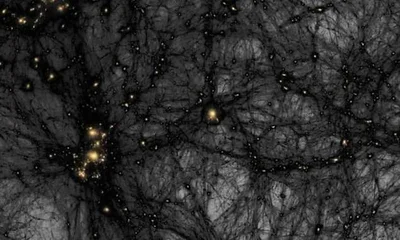
Scientists say that dark matter, the mysterious substance which makes up 27 per cent of the universe, could exist in a hidden fifth dimension. Pictured: NASA's map of dark matter structures in the early universe
Scientists believe that the normal matter which makes up your body, planets, stars, and galaxies only represents about five per cent of all the mass in the universe.
The rest is made up of the mysterious substances known as dark matter and dark energy, which make up 27 per cent and 68 per cent of the universe, respectively.
Dark matter is a particularly important puzzle for scientists to solve because it plays a major role in shaping the formation and evolution of galaxies like our own Milky Way.
Although it doesn't interact with normal matter directly and doesn't show up in our telescopes, scientists can see how its gravitational pull has shaped the universe.
Scientists now believe that dark matter acts like an invisible glue, holding individual galaxies and the great threads of the cosmic web together with its gravitational pull.
However, despite decades of research, scientists aren't really any closer to figuring out what dark matter really is.
Some theories, known as 'thermal dark matter' theories, suggest that dark matter is a type of weakly–interacting particle that was abundant in the early universe but eventually thinned out as the cosmos expanded and cooled.
In contrast, Dr Tsai and her co–author propose something called a 'resonant' dark matter model.
Scientists propose that dark matter (left) interacts with normal matter (right) by resonating with a mediator particle called a dark photon
Lead author Dr Taegyu Lee, of Indiana University, told the Daily Mail: 'In our model, the particles that we can observe, including ourselves, reside in four–dimensional space, which includes one time dimension and three spatial dimensions.
'However, dark matter can move freely in four dimensions plus an extra spatial dimension, which is very small and curled up.'
This extra dimension isn't something that we can see into or enter, but it would leave a distinctive fingerprint in the structure of reality.
Most importantly, from our four–dimensional perspective, movement in the fifth dimension would appear as a series of related particles with different masses – one of which would be dark matter.
The big difference between this view and other theories is how these dark matter particles interact with normal matter that moves in four dimensions.
Dr Tsai adds: 'In our model, dark matter can still interact with ordinary matter, but only very faintly, through a particle called the dark photon. This is a heavier, hypothetical cousin of the ordinary photon.'
When the mass of the dark photon is close to twice the mass of the dark matter particle, this creates something called 'resonance'.
This is a bit like pushing someone on a swing; lots of random pushes won't do anything, but a push delivered at just the right time will send them flying.
This theory would explain why dark matter interacted with normal matter more actively in the early universe but remains extremely difficult to detect today. Pictured: A timeline of the evolution of the universe over time
When dark matter 'resonates' with the mediator, it's like pushing the swing at the perfect moment, meaning that dark matter interacts with normal matter a lot more strongly.
Dr Tsai explains: 'It makes dark–matter interactions much more effective in the early universe.
'Because of this boost, the correct amount of dark matter could have been produced even if its connection to ordinary matter is extraordinarily faint.'
However, dark matter's precise tuning isn't a coincidence, but arises naturally from the mathematical structure of the hidden dimension itself.
If true, this provides a neat explanation for how dark matter has affected the shape of the universe and points the way towards improved ways of detecting it.
Dr Tsai says: 'Scientists could look for this pattern in two main ways. Underground dark–matter detectors could search for tiny kicks given to electrons when dark matter passes through.
'Particle accelerators could try to produce the dark photon and look for missing energy, which would suggest that invisible dark particles escaped the detector. Finding several of these signals with the predicted mass pattern would provide indirect evidence for an extra dimension.'