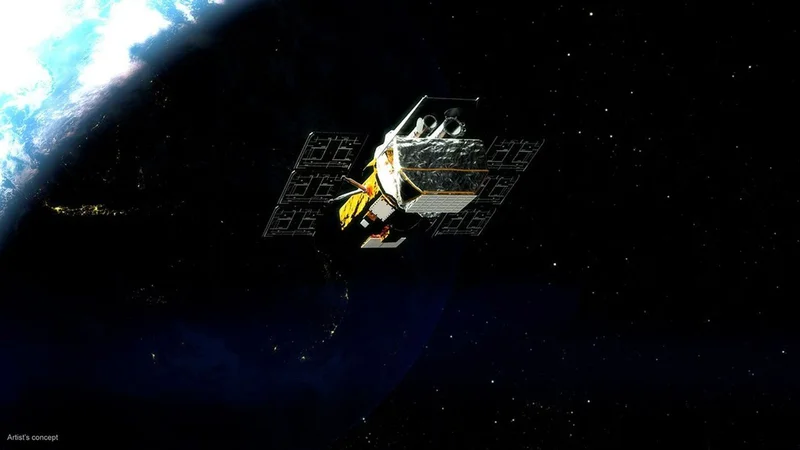
A private mission to rescue an ailing NASA space telescope may now need a rescue of its own. The LINK spacecraft — designed by private company Katalyst Space to boost the orbit of NASA’s ageing Swift Observatory — is reportedly spinning unexpectedly in the weeks after its launch, so much so that stabilizing the spacecraft will likely delay the telescope rescue.
Katalyst’s LINK spacecraft launched July 3 from a mid-air Northrop Grumman Pegasus XL rocket mounted aboard a modified Lockheed Martin L-1011 airliner. The spacecraft lifted off after less than a year of development, on a mission to catch NASA's nearly 22-year-old Neil Gehrels Swift Observatory before the telescope falls back to Earth.
While teams at NASA and Katalyst are working hard to stabilize the new LINK spacecraft, the next few weeks will be a delicate balance of getting LINK ready before Swift falls back to Earth (which is expected to occur this autumn), while not putting Swift at undue risk.
NASA administrator Jared Isaacman said there’s still time. "We are not giving up yet," he wrote late Thursday (July 30) on X. "This remains a very cool, very low-cost, high-potential, high-reward mission, and another step toward a more autonomous future where missions like this routinely upgrade, repair, service, and boost satellites."
LINK was supposed to rendezvous with Swift about a month after its early-July launch, but now it looks like late August is the earliest possible date, according to the latest update. That’s because the $30-million LINK began spinning in recent days after electrical power issues affected two of the devices that control the spacecraft’s orientation, known as reaction control system (RCS) wheels. Only one of the three RCS is working properly.
As of Thursday (July 30), Katalyst’s mission blog said engineers reduced the rotation with engine fires from the spacecraft, and that work is ongoing to stabilize the spacecraft. LINK is now spinning at four degrees a second, instead of the previous nine.
"Over the last 48 hours, the Katalyst team has worked to reduce LINK’s rotation while assessing current spacecraft functionality and its control system," Katalyst representatives wrote.
Get the world’s most fascinating discoveries delivered straight to your inbox.
All the troubleshooting has delayed LINK’s expected arrival near NASA's Swift Observatory — a legacy telescope designed to detect gamma-ray outbursts — into late August. Time is of the essence, as Swift is expected to fall too far for help by autumn. The observatory has already reduced its science work to stay as streamlined as possible, so that drag doesn’t pull it into the atmosphere this summer.
Swift must stay above a minimum rescue altitude of 185 miles (298 kilometers) for the mission to succeed, agency models suggest. For comparison, the International Space Station typically operates at about 250 miles (400 kilometers) in altitude.
NASA has noted that other systems on LINK are working well. "The spacecraft remains power positive and in communication with the Katalyst team," NASA officials wrote in a Tuesday (July 28) update. Assuming LINK’s attitude stabilizes and the spacecraft is healthy enough, teams "will then evaluate revised plans to approach and capture Swift," NASA stated.
Related stories
Katalyst’s ultimate goal is to refuel and reboost Swift so that the observatory, worth roughly $450 million today when accounting for inflation, will be able to continue its mission. (The mission cost $250 million in 2004, which is much cheaper than the $10 billion James Webb Space Telescope that launched almost five years ago.)
Swift was initially mainly tasked with looking at gamma-ray bursts, which are huge explosions that happen after a dying and massive star collapses into a black hole. Swift has gathered many observations of these bursts, but it also looks at other stellar changes (like supernovas or X-ray flares) as well as moving objects like comets and asteroids.
Its science remains valuable, a recent NASA statement noted. "Swift is NASA's multitool when it comes to studying the cosmos," S. Bradley Cenko, Swift's principal investigator and an astrophysicist at NASA's Goddard Space Flight Center, said in the statement. "It observes the sky using a wide range of light, and rapidly points at short-lived outbursts, alerting other facilities in space and on the ground to help coordinate follow-up observations."
If successful, the rescue mission could give Swift many more years — potentially decades — to continue surveying the cosmos, as long as its science instruments continue to function.
Elizabeth Howell was staff reporter at Space.com between 2022 and 2024 and a regular contributor to Live Science and Space.com between 2012 and 2022. Elizabeth's reporting includes multiple exclusives with the White House, speaking several times with the International Space Station, witnessing five human spaceflight launches on two continents, flying parabolic, working inside a spacesuit, and participating in a simulated Mars mission. Her latest book, "Why Am I Taller?" (ECW Press, 2022) is co-written with astronaut Dave Williams.