The Venezuelan government and a segment of the opposition are to kick off United States-backed talks aimed at paving the way for eventual elections.
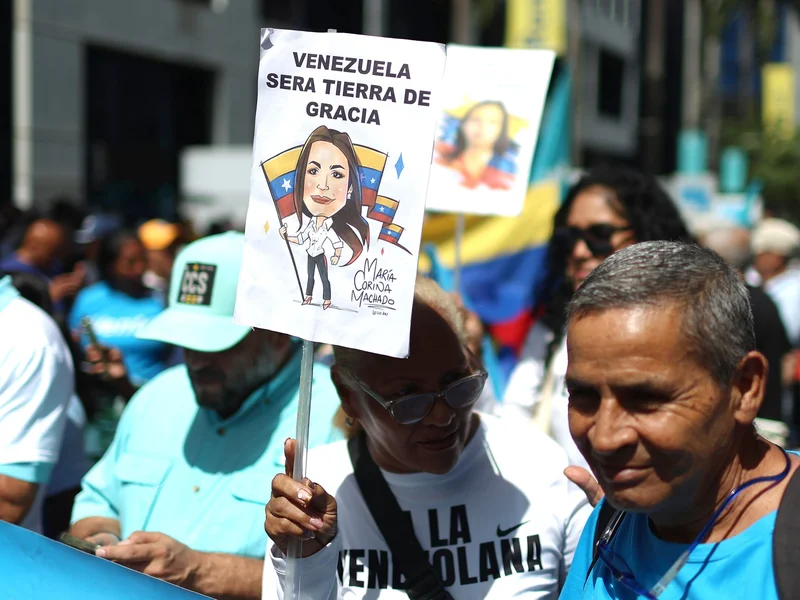
Noticeably absent from the negotiations will be one of the country’s most prominent opposition figures, Nobel Peace Prize winner Maria Corina Machado, who has not been invited to attend.
Recommended Stories
list of 3 items- list 1 of 3US imposes new sanctions on Cuba tourism ministry, state-owned companies
- list 2 of 3Searching for closure: Venezuela families refuse to give up after quakes
- list 3 of 3US judge sets 2027 trial date for Venezuela’s Maduro
The proceedings, which are scheduled to begin on Saturday, come nearly seven months after the US military’s abduction of Venezuelan President Nicolas Maduro. The talks have riled both conservative supporters of Machado and opposition leftists alike.
The talks also underscore Washington’s continued influence over the government of interim President Delcy Rodriguez, Maduro’s former vice president who has already overseen several key concessions to the administration of US President Donald Trump, including opening the state-owned oil industry to foreign companies.
The opposition delegation in Caracas will be led by Dinorah Figuera, who oversaw an opposition bloc in the National Assembly elected in 2015. Sources told the Reuters news agency that Figuera has been chosen by the US because she hails from what Washington considers the last democratically elected legislature in the country.
Leading the government side will be Delcy Rodriguez’s brother, Jorge Rodriguez, the president of the National Assembly, who has headed previous talks with the opposition.
In June, Figuera returned from exile in Spain. She is set to push for overhauling the electoral council and top court, long filled with Maduro loyalists, to ensure free and fair elections.
Jorge Rodriguez has said he will use the talks to push for more US sanctions relief.
For her part, Machado, who had been living in hiding in Venezuela before resurfacing in Oslo, Norway, in December to receive the Nobel Peace Prize, said last week that she would not obstruct any “real progress” at the talks.
She said she would judge their success based on whether democratic institutions are restored, political prisoners are freed and elections are scheduled.
Machado’s popularity had surged before Venezuela’s presidential election in 2024, but she was blocked by the Supreme Court from standing in the race. She decried the move as government suppression.
Her ally, Edmundo Gonzalez Urrutia, ultimately ran as the top opposition candidate. Both opposition leaders and independent election observers have rejected Maduro’s claim of victory in that vote.
Still, the Trump administration has kept Machado, who gave her Nobel prize to the US president, at arm’s length. US officials have questioned whether Machado has enough support to lead the country. Trump, meanwhile, has denied reports the administration advised Machado not to return to her homeland.
Earlier this week, about 300 pro-Machado protesters gathered in Caracas, calling for the country to hold elections.
“The people are hopeful that … we will arrive at free and democratic elections,” former political prisoner and ex-lawmaker Williams Davila, 74, told the AFP news agency.
“They cannot exclude Maria Corina Machado because she is a fundamental leader for all of us,” he said.
In a post on X, socialist lawmaker Francisco Arias criticised the holding of talks “approved only by those who run the US government”.
“It must be a negotiation that is then submitted to the country, to the people of Venezuela,” Arias said.
Saturday’s talks will be the second time Figuera and Jorge Rodriguez have met publicly since Maduro’s abduction.
The pair held their first meeting just days before twin magnitude 7.2 and 7.5 earthquakes struck Venezuela on June 24.