Topline
President Donald Trump declared the sudden influx of migrants to Ceuta, Spain, this week a “talking point for the midterms,” alleging the U.S. would see illegal immigration at levels “much worse” if Democrats were to take power—but the situation in Ceuta is driven by a combination of geographical and policy factors incomparable with anything that could happen in the U.S.
Key Facts
Trump called the situation a “catastrophe,” alleging “if we’re not in office our country will be invaded at levels that will make Spain look small time,” he said during a cabinet meeting Friday.
Officials in Ceuta and Madrid have attributed the sudden surge in migration to a recent decision by Spain’s Supreme Court prohibiting authorities from immediately deporting people who swim there—the ruling, authorities have said, has been misinterpreted by migrants to mean they could stay there permanently, though they can still be returned to their home countries via a formal legal process.
Spain’s Prime Minister Pedro Sánchez blamed human smugglers for the surge, alleging “it appears that this interpretation of the Supreme Court’s ruling spread like wildfire over the past few hours through the networks of human trafficking organizations, triggering the kind of mass surge we witnessed yesterday.”
Ceuta is a small Spanish territory on the north coast of Africa, about 8 square miles, with a population of around 85,000, making it far more vulnerable to a large influx of people than the U.S., which has 1,954 miles of border it shares with Mexico across multiple states and has a robust immigration processing system to absorb people crossing the border.
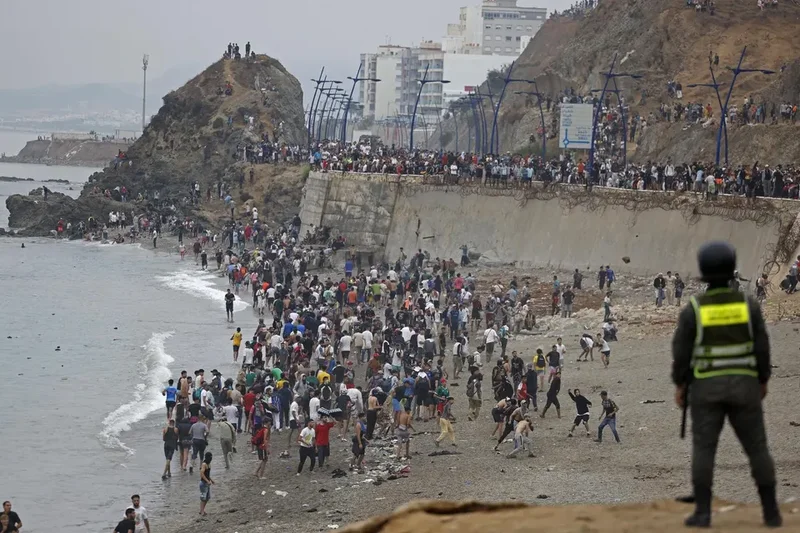
Many of the people crossing into Ceuta are swimming from the Moroccan town of Fnideq, which is three miles from the Spanish territory.
People often travel thousands of miles to reach the U.S. border from southern Mexico and Central America—the journey from Venezuela to Texas, for example, is more than 2,000 miles through several countries, a physically demanding trip that many migrants make on foot.
What else have Trump and others on the far right said about the situation in Ceuta?
White House Deputy Chief of Staff Stephen Miller, a driving force behind Trump’s hardline immigration policies, reposted a video of migrants breaching the shoreline into Ceuta, writing on X, “The Democrats did this to America every single day for 4 years under Biden and will do it again instantaneously, but orders of magnitude greater, if they are given any form of national power,” without providing evidence of any proposed Democratic policies that would create a similar situation. The White House also posted images of people gathered at the border Eagle Pass, Texas, in 2023, when there was a surge in migration driven by a combination of factors, including an end to pandemic-era deportation policy that allowed for immediate denial of migrants at the border combined with political instability in Venezuela, where many of the migrants traveled from. In Eagle Pass, migrants typically surrendered themselves to federal agents to seek asylum after crossing the border, rather than rushing the shoreline as they have in Ceuta. The Trump administration also blamed “far-left globalist policies” for “enabling mass migration,” referring to a policy announced earlier this year by Sánchez’s Socialist-led government that’s allowed more than 1 million undocumented people in the country to apply for legal status in an effort to shore up Spain’s workforce. Sánchez has condemned the mass influx to Ceuta, calling it “a violation of Spain’s territorial sovereignty.”
Big Number
29%. That’s the percentage of voters who said the economy is the issue they would most like to hear congressional candidates talk about, compared to 7% who said immigration, according to a recent Pew Research survey. Thirty-nine percent of respondents to a CNN/SSRS poll this month said they approve of Trump’s handling of immigration, compared to 37% who approved of his handling of the issue at this point in his first term.
Key Background
The crisis appeared to be subsiding somewhat Friday as Spanish authorities said a majority of the 60,000 people who crossed into Ceuta from Morocco over the past several days had returned home. At least 57 people have been found dead in the Spanish territory, Spain’s government said, after many were crushed or drowned trying to enter.