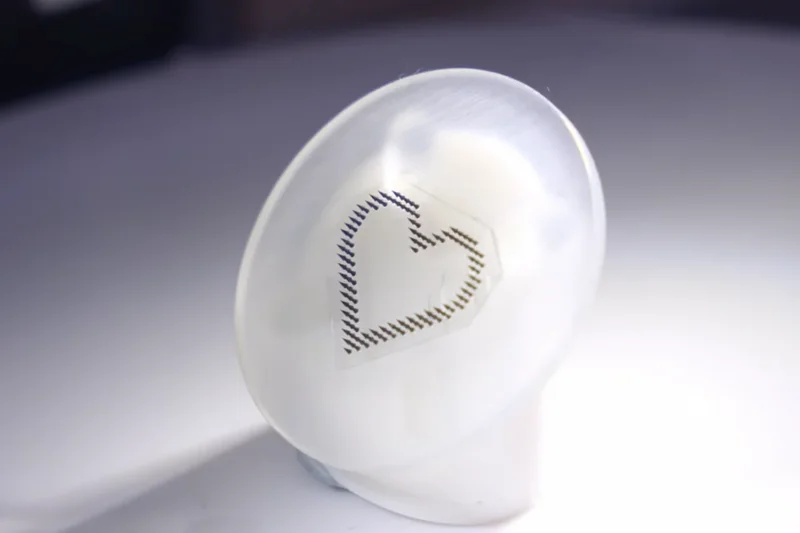
Todayâs entry to the ranks of âtechnologies that are cool in a technical sense but also donât seem like a particularly great ideaâ comes from London-based startup CipherX, which describes itself as âa biotech start-up pioneering the next generation of microneedle technology for high-impact products across lifestyle, cosmetic, and pharmaceutical markets.â If youâre wondering exactly what that means, it translates as follows: theyâre selling permanent stick-on tattoos!
The tattoos use the companyâs proprietary âMicroDot Technology⢠platformâ and come in the form of little patches that are pressed onto your skin for 15 minutes. The application process seems not unlike those temporary tattoos that you apply by pressing them onto your skin and then wetting them with a washcloth, except that in this case, instead of a washcloth, you use an applicator that pushes the patch against your skin, thus forcing the âultra-fine, microscopic structures (smaller than 1 mm) ⦠to penetrate the upper layers of the skin and deposit pigment.â
The phrase âultra-fine, microscopic structuresâ seems to be a nice way of saying âtiny needles,â but apparently theyâre basically painless: The Vergeâs Jess Weatherbed took one for the team by actually getting one of these things, reporting that the application process âfelt more like someone had lightly touched my arm with their finger.â Clearly this is excellent news for people with needle phobias and others who have wanted a tattoo but have been unable or unwilling to subject themselves to traditional tattooing.
It’s worth pointing out, however, that options are currently pretty limited, both in quantity and in complexity. All the tattoos available so far are basically laid out on a grid, with each filled square corresponding to a single dotâor microdot, I guessâof ink. This means that the results look like very precise stick-and-pokes. The designs available on the CX website lean into this aesthetic, including simple geometric designs (stars, hearts, lines) along with some Wingdings-y items (a musical note, a butterfly, a skull andâfor our raver friendsâa smiley face). As far as colors, you, well, you can have any color you like, so long as itâs black. All this means that actual tattoo artists shouldn’t worry too much about this technology, despite founder Ferdinand Kohle’s proclamation in a London Tech Week video that “the skill level to apply these tattoos is extremely low… so anyone essentially can be a tattoo artist.”
Kohle’s blog on the CipherX site is pretty wild reading, by the way. If you thought that this was just a new way to deliver stick-and-pokes, think again: “Conceptually, a microneedle tattoo reframes tattooing from symbolic inscription to technological embedding,” Kohle writes. “In that sense, a microneedle tattoo isnât just body art or medical techâitâs a proto-interface, hinting at futures where interaction, sensing, and expression are literally under the skin.” The blog is big on phrases like “interaction paradigms on skin”âa topic that seems to envisage a future wherein one could get “localized haptic cues” and “thermal feedback” from touching someone’s tattoo, which… the mind bogglesâbut small on mentions of the artists who have created and applied tattoos for, y’know, ever. In this sense, it embodies a trend that seems endemic in tech people, which is the combination of apparent respect for a given art form (in this case, tattoos) with complete disregard for the people who actually create that art form.
In any case, the demographic that’s currently most likely to be worried about CipherX’s offerings is parents of impulsive teens/pre-teens. Perhaps in deference to such concerns, while the company’s tattoos can be ordered online, they can only be applied in person at the companyâs London store or one of its roving events âso we can offer a guided experience.â The company is pretty clear on its website that you need ID to prove youâre over 18 before theyâll tattoo you. The site is also clear that staff won’t apply tattoos to the “head, face, neck, hands, wrists, genitalia, elbows, anus, ankles [or] feet”âdevastating news for anyone who wanted a smiley face on their asshole.
Anyway, CipherXâs desire to keep these out of the hands of lovestruck kids, drunken frat boys, and men experiencing mid-life crises is laudable, but it also feels ultimately futile. This feels like one of those technologies that, sooner or later, will surface in budget, imperfectly imitated forms, resulting in a lot of chastised teens with face tattoos and a lot of very angry parents. The fact that CipherXâs FAQ says that it doesnât ship tattoos âat the momentâ suggests that perhaps they know this as well as anyone, and its representative apparently told The Verge that âitâs planning to sell kits that let you apply the tattoo yourself at home.â All together now: what could possibly go wrong?