S’pore nurses: Setting aside personal fatigue and emotional distress to focus on patients
AI generated
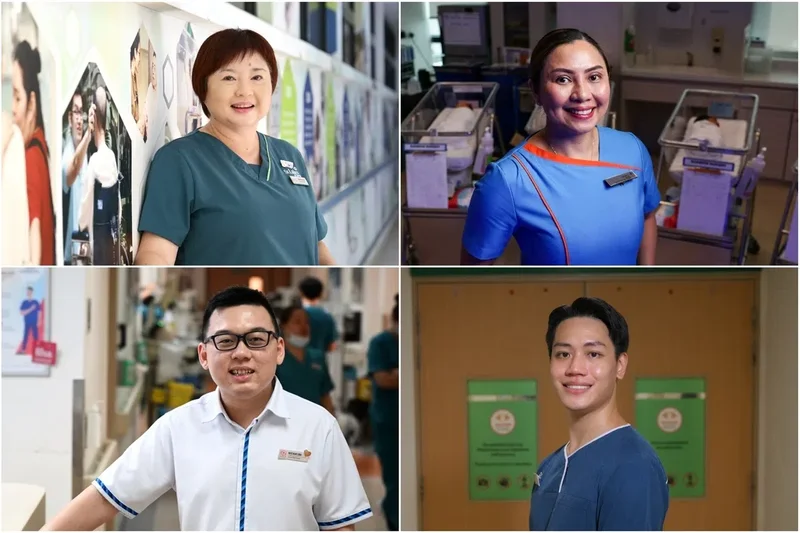
SINGAPORE – Different paths, same purpose – four individuals share a commitment to caring for others.
Jasmine Tan had a brush with death when she was diagnosed with Stage 3 colorectal cancer. That was when the former engineer decided to make a mid-career switch. Twenty years on, she leads a wound care team.
As the eldest child, Cheryl O. Pia Mandadero places others before herself – her parents, her patients and her son. She left her home in the Philippines 18 years ago to eke out a better life for her family. Today, she has taken on greater clinical responsibilities.
Service comes first for Tan Min Kai. He enlisted as a combat medic to serve his country before becoming a flight steward seven years later. But when the Covid-19 pandemic hit, Tan found himself volunteering as a care ambassador at a public hospital. He never left.
Neo Kok Ern’s mother has schizophrenia, which relapses every two to three years.
To better understand the condition and its management, he became a nurse.
These nurses exemplify the compassion and hard work the profession demands.
For them, nursing is more than a job – it is a calling and a passion.
Singapore marks Nurses’ Day on Aug 1, an annual occasion to recognise the contributions of nurses to the healthcare system.
According to the Ministry of Health (MOH), there were 50,389 nurses and registered midwives in Singapore in 2024. This includes those employed in the public sector and in private practice, as well as those not in active practice.
Jasmine Tan: Healing beyond the wound
A persistent pain in her abdomen and irregular bowel movements prompted Tan to see a doctor in 2001.
“The X-ray the doctor sent me for showed some blockages. I underwent surgery, and that was when I was diagnosed with Stage 3 (colorectal) cancer. I had to have the cancerous parts and 15 lymph nodes removed,” the 58-year-old said.
She underwent six months of chemotherapy, during which she decided she wanted to make a difference.
“I saw an MOH advertisement in The Straits Times calling for people to make a mid-career switch to nursing. Inspired by the nurses who took care of me, I wanted to make the switch.”
Tan waited until she was given the all-clear after five years before applying to Nanyang Polytechnic (NYP) in 2006. She was accepted into its accelerated diploma in nursing.
She graduated two years later and joined St Luke’s Hospital, where she was promoted every two years and also went on to earn an advanced diploma and a degree in nursing.
Tan, who is now a nurse manager, is particularly interested in wound management. Over the past 20 years, she has tended to patients with wounds caused by pressure sores or resulting from diabetes.
“Caring for a patient’s wound is not just about treating the condition, but caring for the person. They need to be comfortable and, as nurses, we need to be mindful of their dignity and overall well-being,” she said.
Her most memorable case was that of 56-year-old Tan Lay Kiot, whose pimple-like patch with a black spot on her upper back developed into a large infected carbuncle – a red, swollen and painful cluster of connected skin boils.
“She had surgery to remove the infected tissue but developed septic shock. Being newly diagnosed with Type 2 diabetes, she also developed complications,” Tan said.
The patient was transferred to St Luke’s Hospital in March 2025 and came under the care of Tan and her team.
Although the wound took longer to heal (compared with surgery), Tan said: “We managed to reduce her extensive wound, which measured 31.1cm by 39.5cm, to just 1.2cm by 2.1cm with no signs of infection in just six months.”
Cheryl O. Pia Mandadero: Putting others first
At work, assistant nurse clinician Mandadero, 43, was all smiles.
“I keep a happy demeanour because working in the obstetrics and gynaecology ward, witnessing life beginning as women gave birth, is supposed to be a happy occasion,” she said.
“I let my emotions take over only when I am back home alone in my room. That’s when I cry,” she told ST, recounting how her relationship with her son’s father broke down seven years ago after she returned to the Philippines to give birth.
Like many nurses, Mandadero of National University Hospital (NUH) keeps her private life separate from her profession.
She came to Singapore from Iloilo 18 years ago as an enrolled nurse to support her family financially. It was a big decision, as her father was still recovering from a serious accident that fractured his spine in 2006, while her mother had just undergone cataract surgery.
“I am the eldest daughter and a trained nurse, and that made it difficult – whether I should stay to take care of them or leave to provide financial stability and better long-term care, especially for my father,” Mandadero said, her eyes brimming.
The decision to come to Singapore was one she said she had never regretted.
Professionally, she advanced from enrolled nurse to staff nurse within two years and then progressed to assistant nurse clinician, providing specialised care for complex cases and leading teams of junior nurses.
She also helps with quality improvement in the department and conducts clinical training in the wards.
Mandadero became a single mother in 2020 after returning home to give birth because she did not have the support to raise her baby in Singapore. While she was there, her relationship with her son’s father fell apart.
“It was hard after coming back because it was during the Covid-19 pandemic and I could not return to see my family or visit my son. I missed out on his milestones and birthdays,” she said.
“Being an introvert, I found it hard to confide in my nurse managers and supervisors, so I put up a brave front and carried out my work,” she added.
It was after her nursing leaders found out about her situation that they gradually coaxed Mandadero to open up and ask for help.
“I am glad they did,” she beamed.
“I was applying for permanent residency here for myself and my son, and because of their help and that of higher management, my application came through.
“I am now able to enrol my son in a Singapore school so he would have a better future.”
Tan Min Kai: From serving country to serving people
In his career, Tan, 37, has worn three different uniforms.
“I enlisted in the Singapore Armed Forces as a full-time combat medic before becoming a steward with Singapore Airlines,” he said.
“Now I am a staff nurse at Khoo Teck Puat Hospital.”
Interestingly, Tan had always wanted to work in healthcare.
“I wanted to become a paramedic after watching the TV series Ghost Whisperer,” he said. “The husband of the lead character was a paramedic who saved lives and that inspired me.
“That was when I thought I could do my national service with SCDF (Singapore Civil Defence Force) but I did not qualify, so I went into the army.”
He enlisted in 2009 as a combat medic and was trained in pre-hospital emergency trauma care, battlefield triage and providing medical coverage during training exercises and operations.
Tan left the service in 2016 after seven years to fly with Singapore Airlines, providing service at 35,000 feet.
Not long after, the Covid-19 pandemic hit and he was grounded as commercial flights to destinations around the world came to a halt.
“There was a critical manpower shortage at the hospitals, and we were encouraged to volunteer as care ambassadors,” Tan said.
“I did, and that reignited my passion to join healthcare.”
His wings were clipped then, and while his former colleagues returned to the skies, he went back to school.
“I enrolled in the Alice Lee Centre for Nursing Studies (at the National University of Singapore),” he recalled, “and did a two-year degree before joining KTPH full time.”
Today, Tan brings what he learnt in the Singapore Armed Forces and Singapore Airlines to caring for his patients with compassion and dignity.
“I am very invested in the next generation, just as my seniors were with me,” he said.
“I will do my best to mentor my younger colleagues and help build the confidence that will carry them forward in the profession.”
Neo Kok Ern: Escaping poverty with parents in tow
Having grown up in one-room rental flats in Redhill with a mother who suffers from schizophrenia, Neo Kok Ern, 36, was determined to “get a job with a steady income to break away from childhood poverty”.
“I also wanted to learn how to care for my mother. Her schizophrenia relapsed every two to three years, sometimes so bad that she would make noises at night, which affected my sleep,” he said.
That was when he found out that nursing was “quite an iron rice bowl” and would help him understand illness management and prevention, so his family could avoid frequent hospital visits and save on medical expenses.
Unsure that he would pass the course, Neo skipped sponsorship. Instead, he worked at a tea shop to earn his keep.
But he could not earn enough for his second year of tuition. So he bit the bullet and applied for a National Heart Centre Singapore sponsorship. The move paid off.
Neo graduated from NYP without having to retake any exam, something he said he had never dreamed of achieving.
Life took a positive turn after he graduated. Today, the senior staff nurse supervises his juniors and helps manage the ward.
Being able to speak several Chinese dialects, such as Hokkien and Cantonese, has also put Neo in good stead.
“Many of the patients in the ward are elderly and have heart disease. Some were even struggling to breathe. To be able to help them communicate with the doctors was what made me feel proud,” Neo said.
Still living with his parents in their rental flat, Neo said his salary had increased the family’s household income so much that they no longer qualify for rental flats and would have to move.
“I never travelled when I was a child and spent my holidays at the playground. I could travel now with my pay, but because I want to give my parents a good home, I am putting the money into a kitty and saving up for my BTO (Build-To-Order) flat,” he said.