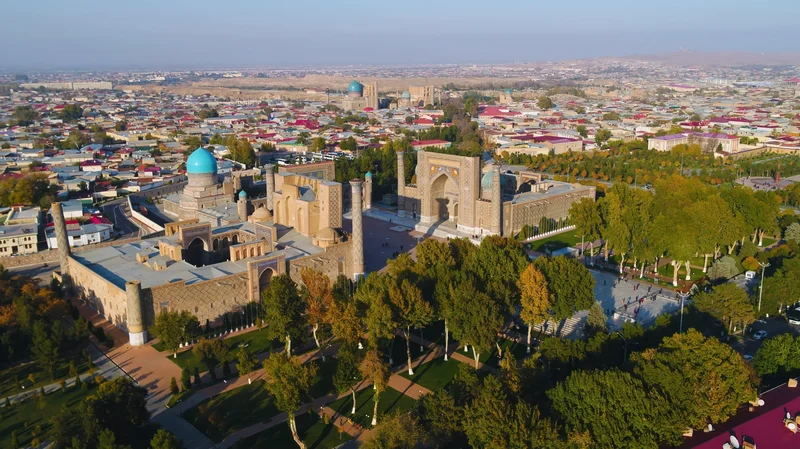
In his Turkish-language book whose title could be translated as "Deep Structure: The Conceptual Framework of the History of Islamic-Turkish Philosophy and Science," prominent Turkish scholar Ihsan Fazlıoğlu devotes the substantial first section of the book to "the Samarkand School of Mathematics and Astronomy," a 15th-century scientific center in modern Uzbekistan. He provides a comprehensive analysis of the intellectual continuity established across different regions through the network of scholarly centers that both influenced and were influenced by this school, demonstrating that such continuity transcended changing political structures. Particularly significant is the fact that the regions of Transoxiana and Khorasan already contained numerous madrassas during the 10th century – approximately 165 years before the establishment of the Niẓamiyya madrassas.
This early institutional infrastructure is essential for understanding both the development of intellectual production in the region and the channels through which its scholarly legacy spread to other parts of the Islamic world. From the late 14th century until the beginning of the 16th century, this region constituted the most productive center of scientific and intellectual activity in the Islamic world. Moreover, while inheriting the legacy of the Maragha School of Mathematics and Astronomy, founded in 1259, particularly through the mathematical-philosophical tradition of Nasir al-Din al-Tusi and Qutb al-Din al-Shirazi, it also absorbed the philosophical heritage of Ibn Sina (commonly known in the West as Avicenna) and the theological legacy of Fakhr al-Din al-Razi.
While Timur, the first ruler of the Timurid dynasty in the 14th century, established his empire, with Samarkand as its capital, upon a synthesis of Turkic, Mongol and Persian elements, his son Shah Rukh chose Herat as his capital and transformed the city into a major center of the Sunni religious sciences, much as Nizam al-Mulk had done centuries earlier. This mission was pursued through two complementary channels: Sunni scholars operating within the madrassa system and the Naqshbandi order shaping the broader social sphere. Given Herat’s deliberate commitment to strengthening the Sunni tradition in response to Shiism, it is hardly surprising that al-Taftazani, a Muslim Persian polymath whose works occupied a central place in the linguistic and religious sciences, emerged as one of its most influential intellectual figures. Nor is it coincidental that the al-Taftazani tradition adopted a critical stance toward the school of Ibn Arabi and, in this context, promoted the Naqshbandi path, which distanced itself from speculative mystical metaphysics. Meanwhile, under the patronage of Shah Rukh's son Baysunghur, Herat also developed into a distinguished center of literature and the arts. Within this vibrant cultural environment, the city produced not only scholars who would shape Herat itself, but also a remarkable generation of intellectuals, artists, poets, calligraphers and musicians whose influence extended across the Muslim world and played a decisive role in ensuring the continuity of its intellectual tradition.
While Shah Rukh and his son Baysunghur fostered an intensive program of intellectual and cultural production in Herat along the lines described above, Shah Rukh’s other son, Ulugh Beg, established in Samarkand a scholarly school that, although maintaining an educational tradition comparable to that of Herat, placed particular emphasis on the mathematical and instructional sciences. As a child, Ulugh Beg had visited the Maragha School of Mathematics and Astronomy and its observatory, founded by Nasir al-Din al-Tusi, an experience that would profoundly shape his later scientific vision. At the Samarkand School, leading scholars such as Qadi Zada al-Rumi, Ulugh Beg himself, Jamshid al-Kashi, Ali Qushji and Sayyid Munajjim served as full-time members of the institution. In addition, a number of distinguished scholars – including Mansur Kashani, Fatḥullah al-Shirwani, Abd al-Ali al-Birjandi, Muin al-Din al-Kashani and Abd al-Raḥman Jami – were associated with the school for shorter periods, either as teachers or students, contributing to its vibrant intellectual life.
During this period, the movement of scholars between different intellectual centers not only enriched the institutions they visited but also enabled the knowledge and scholarly traditions they acquired to be carried back to their places of origin, where they took root, developed further, and ensured the continuity of intellectual production. For example, Qadi Zada al-Rumi of Bursa traveled to Samarkand upon the recommendation of his teacher, Molla Fenari, after completing his education in Bursa. As a result, each major center was able to remain closely connected with, and informed by, the intellectual achievements of other scholarly schools. In this context, the Samarkand School of Mathematics and Astronomy inherited an exceptionally rich scientific tradition. As Fazlıoğlu notes: “According to the information provided by Jamshid al-Kashi, Euclid’s "Elements" and Ptolemy’s "Almagest," together with Nasir al-Din al-Tusi's "Tahrirs" of these two works; the Zij-i Ilkhani, the collective achievement of the Maragha School of Mathematics and Astronomy; the important commentaries written by Nizam al-Din al-Nisaburi and Sayyid Sharif on Nasir al-Din al-Tusi’s celebrated "al-Tadhkira fi Ilm al-Haya"; Quṭb al-Din al-Shirazi’s "al-Tuḥfa" together with his "Nihayat al-Idrak fi Dirayat al-Aflak"; and, quite remarkably, "Abu Rayḥan al-Biruni’s al-Qanun al-Masudi" were all studied at the Samarkand Madrasa."
The most significant collective achievement of the Samarkand School of Mathematics and Astronomy was the Zij-i Ulugh Beg, a comprehensive astronomical handbook consisting of four major sections: calendars and chronology, timekeeping, the positions of the stars, and astrology. The principal contributors to this monumental work were Ulugh Beg, Qadi Zada al-Rumi, Jamshid al-Kashi and Ali Qushji. The Zij exerted a profound influence not only within the Ottoman Empire but also across India, China and Europe. The intellectual legacy of the Samarkand School was likewise transmitted beyond Central Asia through the migration of its scholars. Its scientific and philosophical heritage spread primarily to the Ottoman Empire, as well as to India and Egypt, where it continued to shape scholarly traditions and exert influence even within the philosophical and scientific circles of Western Europe and the Indian subcontinent. The transmission of this tradition into Ottoman lands was accomplished chiefly through the efforts of Ali Qushji, Fatḥullah al-Shirwani, and Abd al-Ali al-Birjandi.
In the classical philosophical and scientific tradition, the sciences were classified into three categories according to the ontological level of the realities they investigated: the lower sciences, the middle sciences and the higher sciences. The natural sciences, which deal with the sublunary world, were regarded as the lower sciences; the mathematical sciences, concerned with the superlunary realm extending from the sphere of the moon to the outermost celestial sphere, constituted the middle sciences; while the theological or metaphysical sciences, which investigate realities beyond the cosmos, were considered the higher sciences. Accordingly, whereas Herat became a center for the higher sciences, Samarkand emerged as the leading center for the middle sciences. The two schools thus developed distinct yet complementary intellectual orientations.
Two important observations follow from this classification. First, because the sublunary world was understood to be governed by the influences of the superlunary realm, a proper understanding of the natural world necessarily required knowledge of the higher levels of reality. In other words, the study of nature depended upon mastery of both the middle sciences, which explained the mathematical order of the heavens, and the higher sciences, which provided the ultimate metaphysical framework of existence. Second, the interaction among these three levels of knowledge – whether proceeding from the higher to the middle and then to the lower sciences or in the reverse direction – required a high degree of conceptual continuity, intellectual permeability and linguistic fluency across disciplinary boundaries. The sciences were therefore not conceived as isolated fields of inquiry but as interconnected domains whose methods, concepts and explanatory languages mutually informed one another.
In the Herat intellectual milieu, al-Taftazani – who followed the Ḥanafi school in jurisprudence and the Maturidi school in theology – emerged as the dominant scholarly figure, whereas in Samarkand this role was assumed by Qadi Zada al-Rumi of Bursa, the chief professor of the Samarkand Madrassa. Timur himself, however, favored Sayyid Sharif al-Jurjani, who sought to integrate within a higher intellectual framework the distinct scholarly languages that would later characterize Herat and Samarkand. This preference stemmed from the fact that al-Jurjani was regarded as the foremost scholar of his age, possessing equal mastery of both the rational and transmitted sciences. The range of works on which he wrote commentaries reflects the extraordinary breadth of his scholarship. By contrast, al-Taftazani distinguished himself primarily in the linguistic sciences, while Qadi Zada al-Rumi excelled in the mathematical, geometrical and astronomical sciences.
Significantly, Qadi Zada al-Rumi was also a student of Sayyid Sharif al-Jurjani. Consequently, al-Jurjani served not only as an intellectual bridge between the Maragha School of Mathematics and Astronomy and the Samarkand School, thereby ensuring the continuity of the Islamic scientific and philosophical tradition across the Muslim world, but also made a decisive contribution to the formation of a shared conceptual language and intellectual framework that united the lower, middle and higher sciences discussed above.
The enduring influence of Sayyid Sharif al-Jurjani can also be traced through the intellectual developments that took place in Istanbul. As noted above, the legacy of the Samarkand School of Mathematics and Astronomy was transmitted to the Ottoman capital primarily through Ali Qushji, Fatḥullah al-Shirwani and other scholars. In Istanbul, the scholarly traditions represented by al-Taftazani in Herat and Qadi Zada al-Rumi in Samarkand were brought together in a new intellectual synthesis forged by Ali Qushji. At the heart of this synthesis stood Sayyid Sharif al-Jurjani and, in particular, his celebrated Sharḥ al-Mawaqif fi Ilm al-Kalam, which became the principal reference point for integrating these diverse traditions. Accordingly, just as the Samarkand School of Mathematics and Astronomy inherited and further developed the scientific legacy of the Maragha School, its own intellectual heritage was subsequently carried to Istanbul – most notably through Ali Qushji – where it underwent further refinement and expansion. By being rearticulated within an intellectual framework centered on Sayyid Sharif al-Jurjani, this legacy evolved into a richer and more comprehensive scholarly language, one capable of integrating diverse disciplines and sustaining the continuity of the Islamic philosophical and scientific tradition.