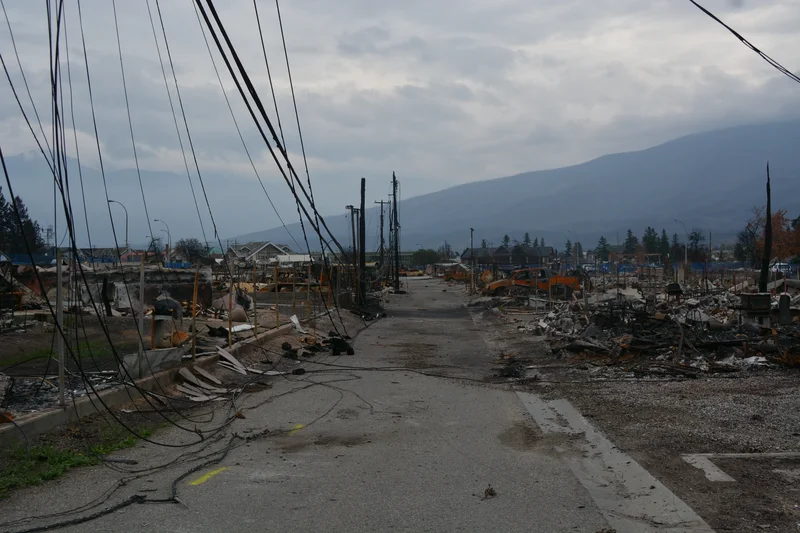
Canada’s electricity grid is connected through a vast network of mostly wooden poles that criss-cross a densely forested landscape. Every summer, that wooden network stands in the path of wildfires.
Over a thousand utility poles were damaged by wildfires across Canada last year, causing outages in remote communities, according to figures compiled from several provincial and territorial utility providers.
Their destruction disproportionately affects rural and remote communities, disrupting power and prompting utility companies to search for a solution.
Jasper, Alta., had been connected to the provincial power grid through a new transmission line in 2019. Only three years later, the Chetamon wildfire burned roughly 6,000 hectares in Jasper National Park, damaging those power lines to the townsite and causing a week-and-a-half outage.
In 2024, an even more ferocious wildfire, which devastated the townsite, left residents whose homes weren’t damaged without power for up to 16 days. For areas in the process of being rebuilt, the utility provider ATCO Electric has replaced powerlines by burying them and using non-flammable material for the lines that remain above ground.
“One long [power] arm reaches into Jasper, and when that gets affected, then we are simply without power,” Jasper Mayor Richard Ireland said in a recent interview.
“It is not really a grid. We are a tentacle.”
During the 2022 Chetamon wildfire, Jasper needed to institute rolling blackouts and use backup power generation to fulfill the town’s needs, which Mr. Ireland said had a “devastating impact” on the tourist town.
An enormous amount of infrastructure needs to be protected to save just one town, he said, often beyond the capacity of remote communities and the utility company.
“Most remote or relatively remote communities are in a similar situation, and so the vulnerability just gets that much greater,” said Mr. Ireland.
“We are not unique.”
Near Clinton, B.C., when the Kelly Lake substation was consumed by a massive wildfire in July, customers hundreds of kilometres away saw their lights flicker and experienced power interruptions. One of the main sources of power for the Lower Mainland and Vancouver Island passes through the Kelly Lake substation.
Last year, B.C. Hydro lost 115 distribution poles and two transmission structures because of wildfire damage, said Susie Rieder, spokesperson for BC Hydro, in an e-mailed statement.
On July 4, wildfires damaged utility poles leading to O-Pipon-Na-Piwin Cree Nation, or OPCN, located on South Indian Lake in northern Manitoba, causing a three-week-long outage.
When power lines go down, the community is dependent on generators and a twice-weekly fuel delivery, said OPCN councillor Rita Thomas.
“It’s discouraging, especially with our people with health issues,” Ms. Thomas said. She said members who require dialysis, feeding tubes and breathing machines are the priority in case of a power outage.
Manitoba Hydro – the Crown corporation providing electricity and gas in the province – restored power to OPCN on July 26.
Crews initially could not enter the area because of the active wildfire, Peter Chura, a spokesperson for Manitoba Hydro, said in an e-mailed statement.
They had to navigate difficult terrain, with replacement poles needing to be set in rock and tracked vehicles required to reach poles in muskeg, a type of wetland terrain.
Last year, OPCN was forced to evacuate because of a wildfire, but the several-month-long power outage that resulted kept at-risk community members and families from returning to their homes.
In 2025, more than 1,000 utility poles in Manitoba were damaged or destroyed and power generating stations were evacuated because of wildfires, said Mr. Chura.
Kevin Hanna, director at the Centre for Environmental Assessment Research at the University of British Columbia, said systemic risks to remote communities come in a few different ways: In some cases, there may only be one route for power supply with no alternative. In others, the power may be shut off before a wildfire as a safety measure and everything from natural gas supply lines, roadways and electricity may fail at once.
Power disruptions from wildfires “disproportionately affects rural and remote communities,” Dr. Hanna said.
As a result, provincial utility providers are having to come up with strategies and new technologies to mitigate wildfire risk.
“The effect of more frequent, bigger, prolonged wildfire events is pushing a lot of innovation and rethinking of systems,” said Dr. Hanna.
In B.C., wooden poles are treated with fire retardant when at risk from nearby active wildfires, said BC Hydro’s Ms. Rieder.
In high-risk areas, poles are replaced with fibreglass-reinforced polymer or steel. Wooden utility poles can also be wrapped with wildfire-resistant mesh which swells and expands to insulate the pole when exposed to heat.
The wildfire-resistant pole mesh has been installed on thousands of poles in high-risk areas, Ms. Rieder said.
Utility provider ATCO started using wildfire-resistant pole mesh in a proactive way after the 2016 Fort McMurray wildfire.
About 10 per cent of ATCO’s distribution network is currently protected with the mesh, said Gurb Hari, vice-president of engineering and construction. The provider also uses steel cross arms, which reduce the chance of falling embers catching fire, while being more reliable and having a lower life cycle cost than wooden cross arms.
But there is only so much the utility can reasonably do, Mr. Hari said.
“We are balancing the performance of the system, public safety, reliability and affordability when we’re managing wildfire risk,” he said.
Eliminating wildfire risk would be disruptive to rates, so the provider has been using cost-effective solutions to mitigate risk, such as the mesh.
“There are ways you can reduce 99 per cent of the risk to losing power on an overhead system,” Mr. Hari said. “That is to bury all of your lines.”