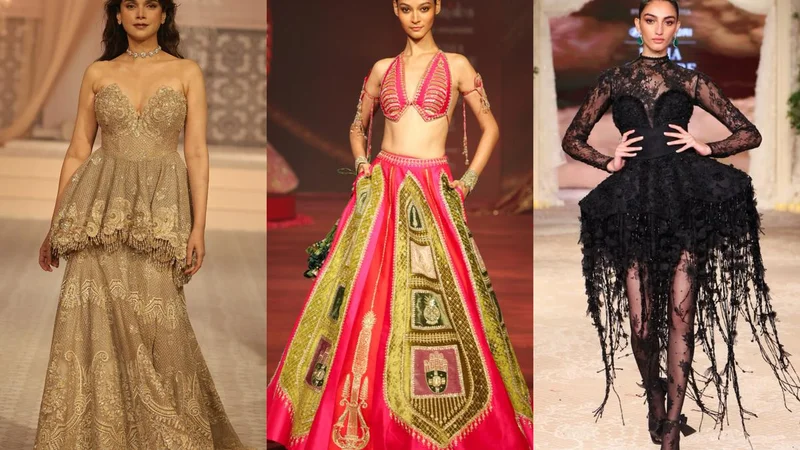
For designers participating at the Hyundai India Couture Week 2026 , the modern bride was about inventiveness and whimsy, as much as she was about tradition.
Held in association with Nexxus New York, the Fashion Design Council of India (FDCI) led showcase in New Delhi witnessed 13 leading designers of India re-examine contemporary bridal couture with a fresh lens.
Looking beyond the tried-and-tested lehenga cholis and sherwanis, this season saw designers experiment with newer silhouettes and unexpected embroidery techniques, and propose a sartorial palate-cleansing wedding closet for brides, grooms and their families. So, should you pick embellished blazers or dramatic trains? Read on for our picks from the season, to get your wardrobe wedding-ready.
Capes, Capelets & trains
There is no stopping the popularity of statement capes, capelets and trains seen across brands like Falguni Shane Peacock and JJ Valaya, to Arpita Mehta, Roseroom Couture, Jayanti Reddy and Masaba.
While Falguni Shane Peacock’s menswear saw cocktail and reception attires layered with billowing parachute-like long capes, Masaba’s capes in saturated hues evoked a playful destination pre-wedding bash., and JJ’s tasselled capelets added drama and movement to ornate ensembles.
“Capes and veils are definitely replacing the dupatta for a certain kind of consumer, but I think the market is divided into two categories. One wants a more experimental layer, which could be a cape or a veil. The other still prefers a dupatta because it can be treated as a separate piece, styled in different ways, and worn across multiple looks,” said designer Masaba.
“We see this in retail all the time. The way I bucket it in my head is that one is a creative need and the other is a commercial need. The cape and the veil will always fulfil a creative need, while the dupatta is an out-and-out retail need. So, it’s really about finding the balance between the two,” she added.
Jewellery informs couture
Known for high-octane shine and inventive textiles, Rimzim Dadu’s collection’s take-off point was mother-of-pearl, its luminosity and the way it constantly transforms as it catches and reflects light. The designer was fascinated by its ability to appear different from every angle and wanted to explore if she could translate that quality, into couture.
“The collection also draws inspiration from the intricate inlay work of Mughal architecture and the ornamentation and opulence of jewellery from that era. I’ve always been drawn to the precision of these crafts—whether it’s the way stones are meticulously set into jewellery or inlaid into marble to create extraordinary surfaces. Rather than interpreting these references literally, we wanted to capture their essence through our own design language,” she said.
Material innovation has always been at the heart of Rimzim’s work. “We paired mother-of-pearl with our signature steel wire textiles, metallic cords and sculptural constructions, experimenting with how these contrasting materials could coexist. The challenge was to make a hard, precious material feel fluid and effortless on the body while preserving its natural brilliance,” she shared.
Designers across design houses underscored the drama with a clever incorporation of jewellery accents — from beaded headgears to veils partially covering models’ faces. JJ Valaya’s brides came with bejewelled facial veils, and Masaba’s models sported striking headgears and maang tikas recalling indigenous cultural motifs.
The corset is the new blouse!
Tarun Tahiliani, Roseroom couture and Rimzim Dadu saw inventive and form-flattering corsets. Designer Isha Jajodia of Roseroom shared, “It offers a timeless silhouette that enhances the figure, provides structure and can be adapted for various styles, from classic to contemporary.”
For this outing, corsetry held the entire collection together. It ran through more than fifty looks: corseted gowns, skirts, sarees, tailored jackets, tuxedos and tulle skirts. That range was the experiment: proving corsetry isn’t a bridal-gown technique alone, but flexible enough to move through a sari as easily as a tuxedo, while letting a bride carry both softness and strength in the same silhouette. “That’s the appeal for brides today: they don’t want to choose between romance and power, they want both. Corsetry gives them that certainty,” she adds.
At Tarun’s showcase, sculpted bodices reinterpreted the human form through couture. Layers of padding, hand construction and meticulous tailoring carved the contours of the body, revealing collarbones, shoulder blades, the subtle curve of the navel and the quiet definition of the torso.
Embellished cocktail blazers
Designers strongly proposed pairing a beaded cocktail sari with a fully embroidered jacket or blazer. Sharply tailored jackets with surface texturing were seen across Falguni and Shane Peacock, JJ Valaya, Jayanti Reddy, Arpita Mehta and Anamika Khanna. Designers endeavoured to offset the fluidity of the ensembles with a sharp tailored piece.
Bold bralettes
Itsy bitsy bralettes replaced the traditional blouse seen at almost every designer showcase this season — from Falguni and Shane Peacock to Masaba and Arpita Mehta.
“As the new generation becomes more expressive, more body positive, and more confident regardless of shape, the bralette will definitely take up a fair amount of the blouse’s share. But the traditional blouse still rules. It’s similar to the sari. A traditionally draped sari will always have a stronger place than a gown sari or a pre-stitched sari. When something is associated with legacy and longevity, the original avatar always stands front and centre,” said Masaba.
Statement-making embroidery
Designer Jayanti Reddy’s collection explored the idea of refined opulence — how couture can feel incredibly luxurious without relying on excess. With the Gilded Era, she wanted to celebrate light as a design element, using shimmer, metallic textures and intricate embellishment in a way that feels subtle, fluid and modern rather than overtly ornate. The inspiration came from this idea of evolution. “ We refined our embroideries, introduced stronger contrasts through black, and focused on silhouettes that allow the craftsmanship to truly shine,” she shared.
Celebrated for his maximalist designs steeped with a deep heritage narrative, designer JJ Valaya was fascinated by the Siddis of India and by this extraordinary confluence of African origins and the many cultural influences absorbed over generations on the Indian subcontinent.
“But this is not a literal interpretation of a community or its dress. For me, it became a larger meditation on movement, memory and identity …. and on how cultures evolve when they travel,” he says. “Through the vocabulary of the House of Valaya, SIDDI translates that thought into a contemporary couture narrative of embellishment, colour, texture, geometry and ceremony.”
Staying faithful to India’s time-honoured savoir-faire yet contemporary in spirit, designers reconcile structure with drapery and embracing the precision and exactitude of couture, in both form and material.
Published - August 01, 2026 11:56 am IST