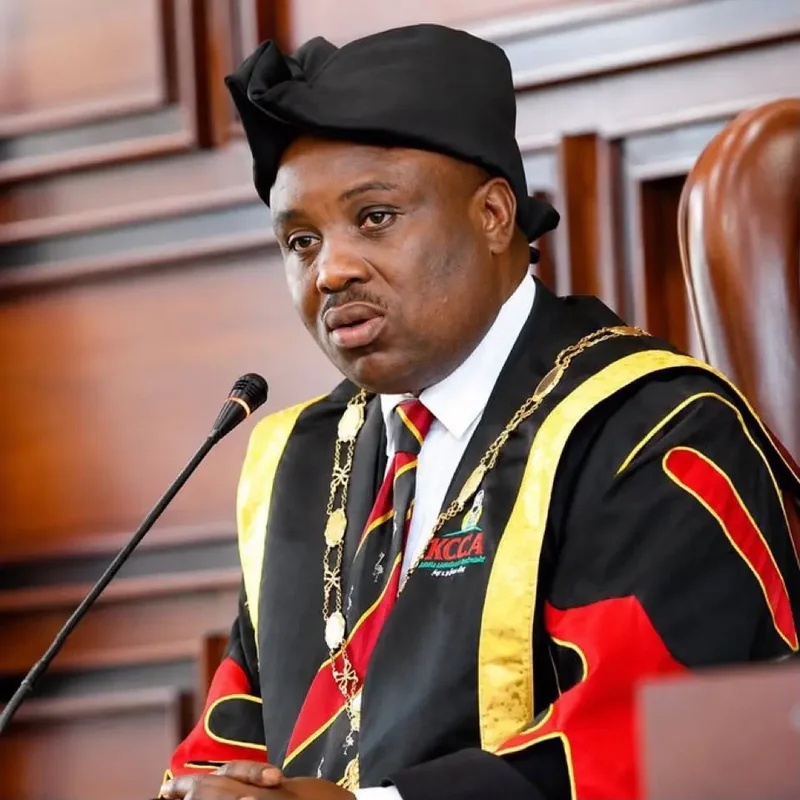
I recently watched a video that has gone viral, of former Kampala mayor Erias Lukwago’s court appearance. He is begging to be granted bail in order to seek further medical attention in a hospital that has quality healthcare as his health deteriorates.
“Your worship, I am sentenced to death. If no rescue is made to get my situation addressed, as advised by the consultants from Mulago National Referral Hospital, it’s a death sentence for me,” Lukwago pleads.
His eyes welling with tears, he helplessly asks: “And all I can say to Allah is: ‘If you are to take me, my Lord, the God who created me, kindly take me without a lot of pain.’”
The legal guru requests “to be put on some palliative care so that I die a less painful death. Otherwise, the pain is too much, I know I will die, I know all of us will die but I would not want to die a painful death. I beg to pray.”
Despite his pleading, the regime cadre judge, without a flicker of remorse, denied him bail and remanded him to prison.
Lukwago’s plight started on 15 June 2026 when heavily armed security men jumped over the fence around his property and broke into his house in the presence of his wife and children. They whisked him away in a van to an unknown detention centre. Days later images of him blindfolded and looking like he had been tortured surfaced on social media. Days later he was taken to court.
What is most unfortunate is that the barbaric, inhumane and humiliating abduction was ordered by people who are entrusted with a social contract to protect the lives and properties of all citizens, regardless of their political affiliations.
Readers must be wondering what crime Lukwago committed to deserve this kind of human denigration.
Well, it’s not that he raped or defiled a girl or woman, embezzled government funds or killed someone.
All Lukwago did was carry out his duty, as a lawyer representing Kiiza Besigye and Obed Lutaale, and serve a court notice on the military chief.
Lukwago has been a prominent champion of the rule of law and a national face of political dissent and opposition, something that irritates the military regime’s National Resistance Army (NRA).
Lukwago served as Kampala’s mayor from 2011 to 2026 and as an MP. He is an advocate of the high court, a champion of the rule of law and democracy, a voice of the voiceless and political party president of the People’s Front for Freedom.
Just like any other rational citizen, I also thought Lukwago’s rich political background, commendable status and his being an inspiration in the legal fraternity would allow him to be easily granted bail at his first court appearance.
Unfortunately, laws in the pearl of Africa have become secondary to the executive political decisions that have usurped all powers of the judiciary and legislature.
Under Article 23(6) of the 1995 constitution, an accused person is entitled to mandatory release on bail if they meet the court’s reasonable conditions.
Unfortunately, the judiciary, during several appearances, has denied him this constitutional right.
In a democratic society that is governed by the rule of law, this mandatory bail is a constitutional entitlement to all citizens who have not been found guilty.
Sadly, for political prisoners, like Lukwago and Alex Waisswa Mufumbiro, mandatory bail has become an indulgence at the court’s pleasure, thus turning the temples of justice into temples of oppression.
Through the misprision (the concealment or failure to report a known serious crime, like a felony or treason, by someone who did not participate in it), Lukwago is paying the price for his constitutional right to dissent and for belonging to the opposition.
The learned friend joins a litany of hundreds and thousands of people who have paid the price for their right to dissent since 1986.
It is clear that holding a view that is contrary to those of the 1986 military high command and NRA offspring is regarded as criminal, unacceptable, foreign interference and treasonous.
Dissent is resistance born of conscience and conviction against oppressive systems, often by choosing to speak out or write the uncomfortable truth to power and summoning consciences and conducting peaceful protests for a cause that defies social, economic, environmental and political injustices.
The right to dissent is enshrined in Article 29 of the 1995 constitution. Citizens are at liberty to exercise their freedom of expression, assembly and conscience within the confines of the laws.
Dissent is essential to nurturing democracy and constitutionalism. It allows for criticism of the government in order for the government to rectify its errors.
Unfortunately, under our watch, the Pearl of Africa has degenerated into full-scale authoritarianism-cum-totalitarianism that is determined to silence dissenting voices and active key opposition political figures.
Political intolerance towards dissent has been well entrenched in the constitution, with the enactment of Penal Code act, Anti-Terrorism Act, public order management, the act on computer misuse, sovereignty law and the Administration of Parliament Bill that will eventually erase the position of the leader of opposition in Parliament.
The well-orchestrated architecture of crushing dissent — in full view of cameras and on social media — is intended to instil fear in a strongman state that the citizenry can neither question nor hold accountable.
The constitutional and military whip on dissent undermines articles 2, 19, 20 and 21 of the Universal Declaration of Human Rights and the International Covenant on Civil and Political Rights, making the Pearl of Africa a defaulter of binding international treaties and agreements.
Locally, the ruthless whip undermines every essence of democracy envisaged in articles 69, 71 and 72 of the 1995 constitution that affords citizens the right to hold alternative political ideologies and belong to a political party of their choice.
Despite what the constitution and international treaties state, the reality is that dissent and membership of an opposition party makes one an immediate target of cyber stalking, frozen bank accounts, job losses and business disruption and, in worst-case scenarios, vulnerable to abduction, torture and enforced disappearance.
Participating in opposition politics has increasingly become more risky than swimming in a river full of crocodiles. Peaceful assembly and demonstrations could lead to you sniffing tear gas, sustaining permanent injuries or being sent to an early grave.
Do citizens deserve to live in fear in a place where dissenting voices are muzzled and voices of reason muted? The answer is definitely no. Fear alone limits human potential while silence weakens strong institutions.
If that’s the case, then the Pearl of Africa risks becoming another North Korea where dissent has been ruthlessly crushed into oblivion.
Nevertheless, the few remaining courageous men and women must push back and build better democratic societies, ones that allow accountability and transparency, political tolerance, unity, cohesion and coexistence.
The United Nations, African Union, Common Wealth secretariat and human rights watch dogs must ensure every member state protects citizens’ right to disagree, debate and challenge ideas and ensure that there is governance without censorship and intimidation.
Governments must dismiss bills and draconian laws that threaten and unleash violence on opponents and dissenting voices.
Equally, on the other side of the coin, the dissenting voices and opposition must desist from calling any sitting president every reprehensible name under the sun. They must instead honour meaningful dialogue.
Amid the shrinking civic spaces, using social media, art, cartoon, movies and music remains essential towards safeguarding dissent and civil disobedience.
Erias Lukwago’s plight serves as a red flag that the future of dissent is in a precarious state and on a lifeline. Soon the dissenting voices will be no more in the Pearl of Africa.
Robert Kigongo is a sustainable development analyst and a defender of defenders.