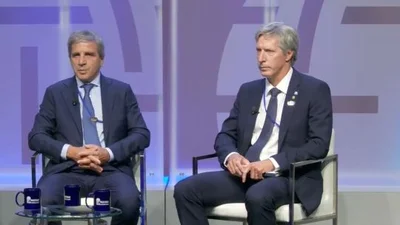
Argentina’s top economic officials said the country has weathered recent external shocks without breaking its exchange-rate regime or triggering major financial stress, arguing the outcome marks a sharp departure from past crises and shows the current policy framework is holding
That was the message delivered by Central Bank Governor Santiago Bausili and Economy Minister Luis Caputo during their appearance at an Atlantic Council event in Washington DC Thursday.
In the past, episodes of external stress have often ended with a break in Argentina’s currency regime, a domestic financial dislocation or both, said the officials. This time, they argued, the framework has held.
Bausili said this was one of the clearest signs that President Javier Milei’s stabilisation programme is diverging from past Argentine cycles.
“Most of the time in Argentina, whenever you went through a situation like that, the system was broken and the regime – in particular the FX regime – was changed,” said the Central Bank chief. “In this case, we came out stronger.”
Bausili said Argentina's Central Bank is not preparing to loosen policy despite an increase in unemployment – which hit 7.5 percent at the end of 2025 – and inflation, which has accelerated since the middle of last year. Consumer prices rose to 3.4 percent in March and 2.9 percent in February, with annual inflation currently at 32.6 percent.
The governor said the latest uptick in inflation should be understood as a by-product of relative-price adjustments, rather than evidence that the broader disinflation process has stalled.
“Our focus in terms of monetary policy remains on underlying inflation trends and not trying to adjust to shocks in relative prices,” said the governor, citing petrol and beef prices as examples.
“We continue to maintain a tight monetary policy stance and we will continue to do so until we reach a level where our domestic inflation converges to the international inflation level,” he declared.
The International Monetary Fund, which confirmed a staff-level agreement with Argentina on the latest review of its US$20-billion loan programme earlier this week, has called on the Milei administration to prioritise the accumulation of Central Bank reserves.
Bausili said Thursday a reserve build-up that many investors doubted last year is now taking place “at a much faster pace than I think anybody anticipated,” noting that the Central Bank purchases were “‘almost at the US$6 billion mark’ by mid-April, since the start of the year.”
He presented accumulation as another sign that the government’s macro framework is starting to gain credibility.
Total reserves stood at US$45.4 billion as of April 13, according to Central Bank data. The IMF wants Argentina’s net international reserves to increase by at least US$8 billion this yeare, with the monetary authority purchasing at least US$10 billion in 2026.
Caputo echoed Bausili’s remarks, arguing that Argentina was facing volatility from a stronger external footing than in the past. This stronger position is due in part to the country’s emergence as an energy exporter, argued the minister, noting rising oil and gas output rising from the Vaca Muerta formation, which has helped shift the energy balance into surplus. This has made the nation more resilient to global shocks, he noted.
Argentina is no longer among the most vulnerable to global shocks as it now combines fiscal surplus, improving credibility and access to markets for resources the world needs, said Caputo, noting the importance of Argentina’s “oil, natural gas, food, critical minerals.”
Referring to the framework discussed during IMF meetings, he said Argentina is “for the first time in the right quadrant” of countries in the best position – those with fiscal surpluses and energy exports.
Caputo said that the government’s broader strategy now is to convert macroeconomic order into competitiveness by “lowering taxes, lowering regulations, and improving logistics,” rather than relying on what he called the “old-fashioned ways” of previous governments which, in his reading, carried out mega-devaluations to mask deeper productivity problems.
The minister pointed to the Milei administration's recent labour reform bill passed by Congress, the government’s to bring undeclared dollar savings into the formal financial system and a new infrastructure agenda covering roads, rail and ports.
Caputo revealed the government had already auctioned more than 9,000 kilometres of roads and planned another 12,000 kilometres of new, arguing that logistics and infrastructure in Argentina would look “totally different” within two years.
He also insisted the administration would not retreat from its current course, stating: “We are not going to move one centimetre from this path.”
The pitch in Washington was that Argentina is beginning to break with its old crisis script. Rather than seeing external volatility spill over into a currency rupture or broader financial stress, the two officials argued that the current framework has absorbed the shock and held together.
For Caputo and Bausili, two of Milei’s key lieutenants, that is the clearest sign yet that the stabilisation plan is starting to gain credibility.