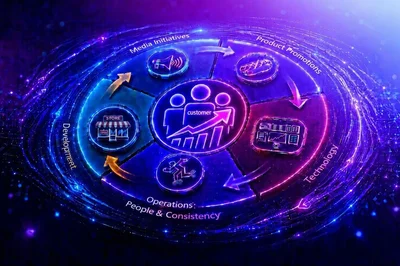
Don't take momentum for granted. Sometimes the flywheel stalls.
Clifford Hudson and Craig Miller
Momentum is never permanent; it has to be continually renewed to keep the flywheel turning as conditions change… without abandoning the value proposition that fueled sustained momentum and growth in the first place.
As we explored in our previous blog, enduring companies don’t merely react to change; they reinforce the core while adapting with discipline. As markets shift, customer expectations evolve, and new technologies reshape the field, the strongest leaders harness change as a catalyst for building new sources of momentum.
When Inspire took control of Sonic, the flywheel wasn’t broken. It had already begun to roar after almost a decade of planning, investment, and implementation. In fact, after decades of disciplined innovation and a differentiated service model, a new 21st-century digital retrofit had the brand ready to compound momentum, as we detailed in Bricks and Clicks.
But momentum is unforgiving. You strip out the capabilities that create competitive advantage, and the engine that once powered growth starts grinding. Having navigated this dynamic across several multi-brand portfolios, I (Craig) have seen how easy it is to strip away differentiation and momentum in the pursuit of efficiency and standardization.
After receiving the benefit of that new technology through COVID, Inspire soon standardized what was unique, rebuilt what already worked, and sidelined the very capabilities that powered Sonic’s enduring momentum. In pursuing portfolio efficiency, they now appear to have unintentionally dismantled the engine that created Sonic’s advantage, built over generations.
Where it Went Wrong for Sonic
Inspire had a good overall strategy: acquire iconic brands and use a shared-services model to leverage the combined portfolio’s size, scale, and synergies. The intent was to create competitive advantage and additional horsepower through expanded market presence, common distribution channels, supplier leverage, shared capabilities, and operating efficiencies.
Their first misread of Sonic’s assets became destructive. Their execution turned battle-tested strategic assets into liabilities.
They failed to recognize Sonic’s drive-in service delivery model as an intangible asset and differentiated competitive advantage — the foundation of the brand’s value proposition for decades.
Inspire’s instinct toward efficiency and standardization was intended to capture operational savings by reducing drive-in stalls, cutting carhop labor, and shifting volume to the higher-margin drive-thru windows. But the economic modeling appears to have fallen into a familiar trap — it was incomplete. They failed to fully account for the demand-side economics of Sonic’s differentiated service model: metrics like customer preference, visit intent, traffic elasticity, and check impact. The analysis likely assumed customer traffic would transfer from drive-in to drive-thru without eroding customers’ affinity for the drive-in experience.
Following this rationale, Inspire then dropped the drive-in and carhops from its marketing, abandoned the iconic Two Guys campaign — one of QSR Magazine’s highest-performing creative assets, sustained and refreshed for nearly two decades — and began physically dismantling drive-in-based customer-facing technologies. In doing so, they weakened demand for the very experience that differentiated Sonic, eroding the traffic, check, and momentum that had powered decades of sustained growth.
Their second misread turned into a missed opportunity for every brand in their portfolio.
Sonic’s Integrated Customer Engagement — “ICE” — was already built for the next era of brand-building. It’s a proven architecture capable of embedding data and AI-enabled intelligence directly into the customer experience and operating model. Its digital plumbing was already in place and ready to scale beyond Sonic. We had built the underlying data and media networks to function as connective tissue across the ICE ecosystem — capable of ingesting, integrating, and distributing data and content from virtually any system, data source, device, or customer touchpoint.
Inspire’s initial due diligence reached the right conclusion: Sonic’s ICE platform was years ahead of their other brands and represented the fastest, cheapest path to digitally modernizing their marketing efforts, but also the technological infrastructure of their entire portfolio.
After Sonic’s acquisition, we waited as Sonic customers to see how Inspire would build on ICE’s digital marketing capabilities. Instead, they reversed course, apparently convinced that ICE was too proprietary and complex to extend. But the larger issue was the failure to use ICE’s foundational architecture: a platform already designed to reach the 21st-century customer where they lived, while supporting a multi-brand shared-services operating model — a design lineage traced back to Craig’s early work with PepsiCo and Tricon, now Yum.
We had input from disappointed staff, but see this as a familiar pattern: Organizations chasing standardization and leveraging shared infrastructure often default to rebuilding rather than reusing, assuming anything built by another company must be too constraining, inflexible, or complex to scale. It’s a classic case of “not invented here,” compounded by the instinct to chase perfection instead of accelerating progress with a proven solution already in hand.
Given the proven track record of adapting and reusing the ICE blueprint with other top-tier brands, retrofitting ICE to support the other Inspire brands would still have required some effort, including reactivating its multi-tenant attributes. But that effort would have been far less costly and time-consuming than rebuilding the platform from scratch, delivering a much faster time-to-value across the portfolio.
Had it been utilized, ICE could have helped Inspire sustain Sonic’s COVID-era momentum, commercialize first-party customer data, activate the CRM-powered marketing hub, andscale proven AI-enabled capabilities across the portfolio. This is exactly what it was built for!
Extending ICE across the multi-brand enterprise could have created a competitive moat that rivals would have spent years trying to overcome. Instead, Inspire abandoned the platform, missing the chance to turbocharge each brand’s flywheel with 21st-century customer engagement, AI-enabled intelligence, and sustained momentum.
Sonic paid the steepest price: new management pulled the plug on two engines that could have powered Sonic’s momentum for years. The strategy didn’t fail. Their execution unwound it from the inside.
When you abandon what competitors can’t easily copy, customers notice first, and eventually leave.
Where Sonic is Headed
The Sonic flywheel is not broken beyond repair, but it is spinning in the wrong direction. Declining traffic. Negative sales. Reduced profitability. Store closures. This downward spiral is not just a sign of a soft market; it is a sign of a brand that has compromised the very experience that made it distinctive, as we detailed in Bricks and Clicks.
A recurring storyline, for sure. Just ask those who worked at Howard Johnson’s, Quiznos, Boston Market, or TGI Fridays —different menus, same lesson. Or, what about Sears, Kmart, Blockbuster, or Circuit City?
In How the Mighty Fall, Jim Collins argues that great companies rarely collapse suddenly. Decline is often self-inflicted, not externally imposed, and unfolds in five stages — each detectable and each reversible if leaders recognize and confront reality early.
Stage 1, hubris born of success, begins when leaders lose sight of — or in some cases, never correctly understood — why the flywheel worked. Success breeds overconfidence; overconfidence hardens into presumption; and presumption eventually obscures the actual source of momentum. When leaders misidentify their competitive advantage, every subsequent strategic decision is built on a false foundation.
We believe that Sonic’s decline wasn’t overt hubris but misclassification: Inspire rightly credited Sonic’s scale, franchise model, and distinctive menu… but misclassified the differentiated drive-in service model as operational complexity needing to be streamlined, rather than the core value proposition and competitive advantage powering the flywheel.
That gave way to stage 2, the undisciplined pursuit of more, as they doubled down on identifying and achieving shared-services efficiencies, cost synergies, and improving portfolio economics, all aimed at the drive-thru window.
Now, Sonic sits in stage 3, denial of risk and peril, not because management fails to see the deterioration in the business, but because it appears to misdiagnose it. Leadership seems to view the problem as an industry slowdown that can be solved through pricing, promotions, product changes, and additional cost reductions. Those may be symptoms to manage, but unless leadership restores the core value proposition, the company risks moving into stage 4, grasping for salvation, chasing tactical fixes while the flywheel continues to lose more momentum.**
I recently had lunch with a major franchisee and learned that Sonic’s leadership wants to fix the drive-thru because total sales are down. Wrong diagnosis. They created this problem by gutting what made the drive-in the customers’ choice! What’s left looks like Arby’s with a better drink menu. You don’t cure a self-inflicted wound by treating the symptom.
To put this into perspective, during my (Cliff) 25 years leading Sonic, the brand experienced accelerated growth powered by positive same-store sales, doubled its store count, and quadrupled systemwide sales. Had Sonic sustained that momentum over the last seven years as a private company, it might now be an $8 billion brand in systemwide sales. Instead, the new owners have spent seven years methodically and systematically commoditizing a differentiated brand with a clear competitive advantage. At great cost. And with no end in sight.
Their decline is now in its fifth consecutive calendar year.
The good news is that the brand is still recoverable, avoiding stage 5, capitulation to irrelevance. The flywheel can still be restarted. But the turnaround begins only when leadership recognizes that the path back will require more than tactical adjustments. It will come from rebuilding the core elements of the flywheel that once made the brand great.