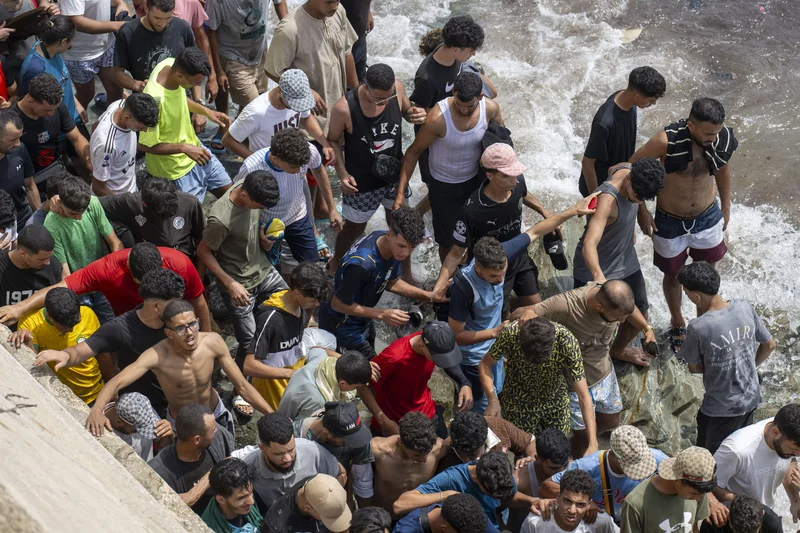
Spain said migrant crossings into its North African enclave of Ceuta had stopped overnight, as police began installing a 500-metre (1,640-foot) floating barrier on Saturday off its border with Morocco following a mass rush that killed at least 67 people.
According to Spanish authorities, about 50,000 people had crossed into Ceuta by land and sea from Thursday in an unprecedented surge at one of the European Union's only land borders with Africa. More than 48,000 of them returned to Morocco within 48 hours without major incident, Spain said.
Reuters footage on Saturday showed Spanish soldiers and police patrolling a mostly empty Tarajal beach shrouded in fog.
Civil Guard police started laying the new barrier at 7:50 a.m. (0550 GMT) on the Tarajal breakwater, one of the main points used by people trying to enter the tiny Spanish territory, the government said in a statement.
The pneumatic barrier, alongside a line of anchored naval buoys, is designed to stand 30 to 70 centimeters (12 to 28 inches) above water and extend as much as one meter below the surface, it added, while a channel between the barriers will allow Civil Guard vessels to patrol the area.
At least 67 bodies have been recovered on the Spanish side of the frontier, officials said, after some migrants drowned and others were crushed while trying to climb the breakwater and border fence. Many were driven to migrate by economic hardship and encouraged by social media rumors.
Spanish Interior Minister Fernando Grande-Marlaska blamed people-smuggling networks for exploiting vulnerable migrants and spreading misleading interpretations of a recent Spanish Supreme Court ruling that migrants intercepted at sea cannot be summarily returned in the absence of a physical barrier.
Speaking from Ceuta, Grande-Marlaska told reporters Spain had largely restored order within 24 hours, but warned that the crisis was not yet formally over and that reinforced police and military deployments would remain as long as needed, though overnight crossings had fallen to about zero.
"Morocco isn't any threat to Ceuta or the rest of Spain — it's a fully reliable partner," he said, adding there had been no intelligence indicating a mass entry was imminent.
Ceuta and Spain's other North African enclave, Melilla, sit on Morocco's Mediterranean coast and periodically face attempted crossings by migrants seeking to reach Europe.
The latest attempt caused division in the EU, with several countries calling for Spain to ensure that the incident was contained.
Twenty-two EU governments called on Saturday for an emergency meeting of interior ministers over the Ceuta crisis, urging the bloc to help Madrid regain control of its border with Morocco.
Meanwhile, Spain's center-left Prime Minister Pedro Sanchez also asked EU leaders to convene interior ministers urgently, but criticized governments that had called for Spain's exclusion from the bloc's passport-free Schengen travel area.
Italy's right-wing government announced on Friday it was suspending Schengen arrangements with Spain for one month.
"In the current international context, the EU cannot afford this kind of selfish, polarizing and unlawful reaction," Sanchez wrote.
Officials in Rome did not immediately respond to a request for comment on Saturday.
In the EU governments' letter to Ireland, which holds the bloc's rotating presidency, the countries said the crossings challenged the EU's external frontier and risked encouraging further illegal migration.
They called for a coordinated response, including possible extra support from EU border agency Frontex and a review of cooperation with Morocco. France, Luxembourg and Portugal did not sign the letter, alongside Spain and Ireland.
Madrid said the people who entered Ceuta irregularly could not travel onwards to mainland Spain or elsewhere in the Schengen zone.
In a statement, the Foreign Ministry added that travelers leaving Ceuta by sea or air undergo police identity checks, representing a second layer of control after the land border with Morocco.
In contrast to most of Europe, Spain has adopted a more open stance on migrants, introducing a program to grant residency to more than half a million undocumented people.
But it has rejected suggestions that the regularization scheme had encouraged the rush into Ceuta, saying applicants must prove residence in Spain before January 1, 2026, and five continuous months of residence when applying.
Sanchez, who visited Ceuta on Friday, described the crossings as a violation of Spain's territorial sovereignty and said returns were being accelerated with Moroccan cooperation.