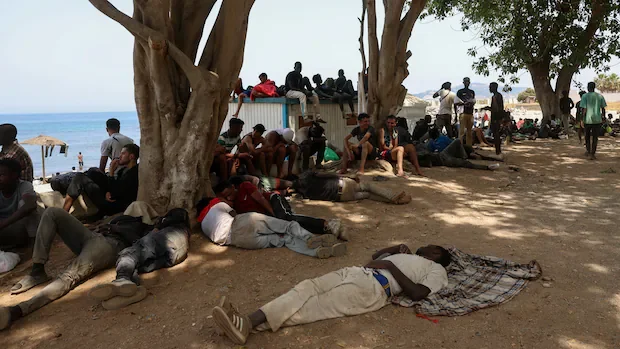
Hunger and hostility cited by migrants as reason for return to Morocco from Spain's Ceuta
More than 50,000 migrants rushed into Ceuta from Morocco on Friday, resulting in at least 67 deaths
Migrants who swam or jumped over fences to rush into Spain's African enclave of Ceuta this week were returning home on Saturday, with many saying hunger, exhaustion and hostility from locals had crushed their hopes of a new life in Europe.
The news comes as Spain announced it was erecting a 500-metre-long containment barrier on the sea border between its North African territory of Ceuta and neighbouring Morocco after more than 50,000 migrants breached the frontier earlier this week, with at least 67 dead.
Those heading back told Reuters they had initially been drawn by viral social media videos and messages from friends suggesting that the heavily guarded border could be breached.
But after reaching Ceuta, many said they found no way to continue onwards to mainland Spain.
"We came to make progress, not to be fooled," said Brahim, a bakery worker from Fez who left his job and crossed the border after watching clips of thousands doing the same. "I thought I'd build a better future there. But I was surprised in Ceuta."
WATCH | Migrants have died during the mass border breach:Brahim said he survived for three days on water alone and could not afford the high food prices on the Spanish side.
Spain's Interior Ministry said about 48,300 people who entered Ceuta had returned to Morocco.
'Ceuta was like a prison'
In Fnideq, the Moroccan city opposite Ceuta, Reuters saw nearly empty streets leading to the border crossing, a stark contrast to the thousands who had gathered there on Thursday.
Young men walked away from the frontier along the highway or waited for taxis to leave Fnideq, where shops have also been closed for days.
The returnees' accounts included repeated complaints of shuttered supermarkets and shops, leaving them searching for food and water while their soaked clothes dried on the streets.
"Ceuta was like a prison — nothing to do there. Everything was closed," said a worker at Morocco's Tanger Med port, who declined to give his name because he was due back at work.
Moroccan waiter Yassine Ichou described being hit and chased away from El Principe.
"They imposed a siege to force us to leave Ceuta by ourselves.... They succeeded in their plan," he said, referring to the widespread shop closures.
- 'Absolute chaos' as thousands of Moroccan migrants breach Spain's Ceuta border
- What is Ceuta, and how was the Spanish enclave near Morocco breached by 60,000 migrants?
Spain's Interior Ministry said two people sustained minor injuries from knife attacks in two separate incidents, and police had arrested one of the assailants. No deaths from knife attacks had been recorded in Ceuta since Thursday, it added.
Rachid, a worker at a Fnideq hotel near the crossing, said all six of its kitchen staff had left for Ceuta during the height of the influx and none had returned, forcing management to search for replacements.
WATCH | Why did tens of thousands of migrants move into Spanish territory?:Now, Spain is erecting the floating barrier — a move that comes after some European leaders questioned the country's ability to control its borders.
Spanish PM slams some European leaders' reactions
Spanish Prime Minister Pedro Sánchez slammed the reaction of some other European Union leaders to the events in Ceuta, saying calls for Spain to be suspended from the EU's borderless Schengen area were "driven by prejudice, fake news, ignorance or political interest."
A handful of exhausted migrants who swam to Ceuta’s urban Tarajal beach Saturday morning were met by soldiers who escorted them back across the border. Spain's Interior Ministry says the majority of those who entered the territory have already returned to Morocco.
"We are relentless against those who break the law," Spanish Interior Minister Fernando Grande-Marlaska told journalists in Ceuta on Saturday.
Questioned how this massive border breach could have happened given the heavy security on both sides of the border and whether Morocco posed a threat to Ceuta, Marlaska defended the government in Rabat.
WATCH | Migrants return home after chaotic Spanish border breach:The leaders of 22 EU countries called for a co-ordinated response to the situation in Ceuta.
In a letter to top EU officials, released Saturday by the Danish prime minister's office, the countries asked the EU’s current Irish presidency to urgently convene an extraordinary videoconference of the bloc's interior ministers.
"We cannot allow uncontrolled mass crossings, the instrumentalization of migration or other hybrid threats to create the perception that illegal entry into the European Union is possible. That a migrant's illegal entry can turn into legal stay," the letter said. "Such a perception would encourage further attempts, undermine confidence in our common migration policy and have repercussions for all member states."
The letter was signed by the leaders of Italy, Denmark, Austria, Belgium, Bulgaria, Cyprus, Croatia, the Czech Republic, Estonia, Finland, Germany, Greece, Hungary, Latvia, Lithuania, Malta, the Netherlands, Poland, Romania, Slovenia, Slovakia and Sweden.
Future for remaining migrants unclear
For those migrants who've remained, their futures remain unclear.
Mohamed Ahmed, a 43-year-old Sudanese man, said a truck dropped him and other migrants near the border and then he swam for four hours to reach Ceuta.
He said police were blocking them from taking the road to a migration centre, but he remained determined to stay in Spain.
"I'm not going back. I'd rather die trying here."
With files from The Associated Press