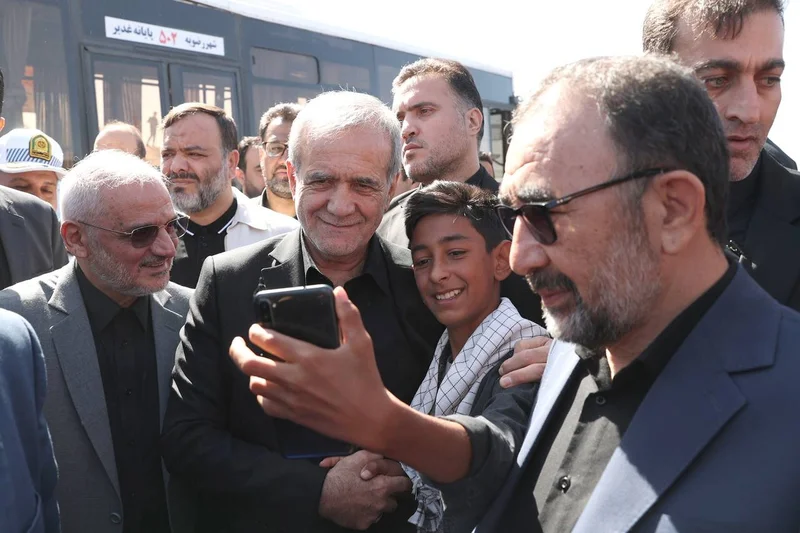
President Pezeshkian hails Iranians as ‘true heroes’ shaping the nation’s future
TEHRAN — President Masoud Pezeshkian has praised the Iranian people as "true heroes," insisting that the country's future belongs to its citizens despite "imposed wars" and pressure from the United States and Israel.
Writing on X as his administration enters its third year, Pezeshkian honored the nation's steadfastness through two years of foreign hostility. He emphasized that no external power can weaken Iran and reiterated that its people alone will shape the country's future.
Pezeshkian was sworn in at the Iranian Parliament on July 30, 2024, following his election victory earlier that month. The vote was called after his predecessor, Ebrahim Raisi, passed away in a helicopter crash.
Senior international and regional officials attended Pezeshkian's inauguration, including leaders of Palestinian resistance groups such as then-Hamas political chief Ismail Haniyeh. Haniyeh was assassinated in Tehran in an Israeli strike after attending the ceremony. Israel has a long history of targeted assassinations involving regional resistance leaders, Iranian nuclear scientists, and military personnel who played key roles in defeating the ISIL terrorist group.
This campaign of hostility eventually culminated in open aggression against Iran.
In June 2025, Israel launched a war against Iran, with the United States later joining the conflict to bomb Iranian nuclear facilities. Over 12 days of strikes, target sites extended beyond military assets to include civilian residential infrastructure. Iran’s powerful military response against Israel and a key US airbase in Qatar eventually pushed Washington and Tel Aviv to accept an end to the hostilities.
However, the US and Israel repeated that scenario this year. On February 28, they initiated a new 39-day war against Iran, resulting in thousands of casualties, many of whom were civilians. On the first day of the conflict, Iran’s Leader, Ayatollah Seyyed Ali Khamenei, was assassinated in his Tehran office. That same day, 168 people—mostly schoolchildren—were killed when a US Tomahawk cruise missile struck a school in the southern city of Minab. Iran’s retaliatory strikes against Israel and American bases in the Persian Gulf region ultimately forced President Donald Trump to announce a unilateral ceasefire, which took effect on April 8. Despite that truce and a memorandum of understanding signed by Trump and Pezeshkian in June, US strikes against Iranian civilian infrastructure have persisted.
Reflecting on these events, President Pezeshkian wrote on his X post: "Two years ago, the start of our tenure coincided with the assassination of our honored guest (Haniyeh) by the Zionist regime—two years in which imposed wars, pressure, and relentless hostility were inflicted upon the people of Iran. Throughout all these difficult days, the true heroes were the people themselves. The future of Iran will be forged by the people of Iran."
Since taking office, Pezeshkian has focused heavily on fostering internal unity and strengthening diplomatic ties with foreign nations, particularly neighboring countries. He has repeatedly warned of joint US-Israeli attempts to create rifts between Iran and its regional neighbors, clarifying that Iranian strikes against US bases in the Persian Gulf are strictly defensive responses to external aggression, and that Tehran fully respects the sovereignty and territorial integrity of neighboring states.
Pezeshkian’s governance continues to draw continuity from the country's leadership structure. During his official endorsement, the late Ayatollah Seyyed Ali Khamenei characterized Pezeshkian as wise, honest, and a president with a common touch. Following his martyrdom, the new Leader, Ayatollah Seyyed Mojtaba Khamenei—selected by a majority vote of the Assembly of Experts—reaffirmed that characterization and expressed full confidence in Pezeshkian’s administration.
As the administration steps into its third year, President Pezeshkian’s message underscores a strategic push to maintain domestic cohesion amid external military pressure. By emphasizing national self-reliance and regional diplomacy, the government seeks to navigate continuous security challenges while reaffirming that Iran's sovereign path will remain firmly in the hands of its people.