Liam Dann, Business Editor at Large for New Zealand’s Herald, works as a writer, columnist, radio commentator and as a presenter and producer of videos and podcasts.
Subscribe to listen
Access to Herald Premium articles require a Premium subscription. Subscribe now to listen.
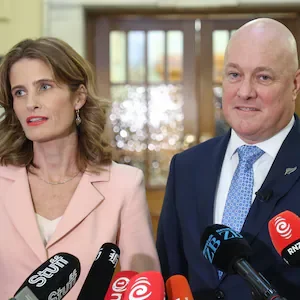
If National are to win the election this year, Christopher Luxon and Nicola Willis are going to have to sell a broader and bolder vision of where New Zealand is going. Photo / Mark Mitchell
Will the economy ever actually recover?
You could be forgiven for doubting it right now. But it will.
Of course it will; New Zealand still has plenty going for it.
The cycle, painfully slow as it has been, will turn.
Either the international volatility will settle down, or we’ll getused to it and carry on.
There’s no shortage of big long-term structural issues to worry about.
But the structures that maintain our short-term viability remain robust.
We have open markets, a free-floating currency, a reputable Reserve Bank, a powerhouse export sector and considerable household net wealth (at more than $2.5 trillion; we’re richer than we tend to acknowledge).
Immigration and tourism will keep picking up; the country is still beautiful, and the people are still friendly.
Our housing market will pick up; confidence will return to our big cities and, Bob’s your uncle, there’ll be cranes dotting the Auckland skyline again.
New Zealand will get its mojo back. It always does.
But here’s the pressing political issue for the Government: it’s not going to happen before November 7.
It’s not even going to be close.
Blame tariffs, blame oil prices or blame the spending spree of the last Labour Government.
However you cut it, we’ve run out of time for economic conditions to materially improve in time for the election.
We might still see some signs of growth and recovery coming through.
But there simply isn’t enough time for them to flow through and deliver material benefits for most Kiwis.
That doesn’t mean National and its coalition partners can’t still win.
But if they were counting on an economic recovery to do the heavy lifting for them – and I suspect they were – then they have big problems.
We can see it in the polls. This election is shaping up as an incredibly tight race.
Such low levels of support for National, as a first-term incumbent, are highly unusual.
It’s more than 50 years since an incumbent was thrown out after one term – Labour in 1975 – and a mitigating circumstance there was that their leader (Norm Kirk) died in office.
Only two other Governments have achieved the feat in the past century.
Labour was also turfed out in 1960, unforgiven by the public for Arnold Nordmeyer’s infamous Black Budget.
The only conservative party to lose after one term was the United-Reform Party coalition, thrown out in 1935 against the backdrop of (um, checks notes) ... the Great Depression!
In 1975, though many considered Labour’s Bill Rowling no match for Rob Muldoon, the incumbent Government was also coping with an oil shock and a trade shock (as Britain joined the European common market).
There’s a theme here.
There’s been a lot of focus on Luxon’s leadership.
But anyone who’s met him in person will tell you he’s actually very likable. He’s friendly and affable, funny and often self-deprecating.
I’ve got plenty of left-wing friends who can’t stand him, but I don’t recall them having much love for John Key either.
Perhaps on camera Luxon’s personality doesn’t resonate with enough strength to be considered a strong asset for National.
His leadership has also been consistently undermined by both his coalition partners and, at times, his own party.
But he hardly seems so deficient that it explains the precarious position the party finds itself in.
No, as the saying goes: it’s the economy, stupid.
The political aphorism (attributed to Bill Clinton strategist James Carville) remains almost as true as ever.
I don’t doubt the culture wars have knocked the edge off it for some voters.
Like the MAGA Republican Party in the US, NZ First continues to successfully position itself as an anti-establishment party (despite having been embedded in that establishment for 30 years).
The lousy economy won’t shift its base.
But for National, a party that has always tied the economy to its metaphorical mast, it is the No 1 issue.
It’s a big problem.
There’s something quite remarkable about the downturn of the past few years.
It started as an engineered recession. The Reserve Bank pushed interest rates up rapidly to control post-Covid inflation.
What’s remarkable is that we’ve now come out the other side – we’ve been through a cycle of low interest rates and high export commodity prices.
That’s a traditional formula for economic good times in this country.
Now interest rates are on the rise again, and there is a risk that the commodity boom runs out of steam.
In other words, we’ve come back around to the part of the cycle that traditionally slows the economy without experiencing any kind of recovery – let alone an economic boom.
When they came into power, Luxon, Nicola Willis and National’s strategists had to be assuming the economic cycle was on their side.
We all did.
Everyone was disappointed when the economy couldn’t shrug off high interest rates in 2024, but we smiled and turned “survive till 25” into a popular business meme.
Cut to late 2026, and that joke isn’t funny any more.
It is still plausible that we’ll see the recovery really take hold in 2027.
That’s what most economic forecasts suggest.
But trying to convince people of that right now is a thankless task.
Trust me, I regularly speak to business groups, and I’ve heard the groans.
Even in a best-case scenario (the Iran war ends tomorrow), it’s unlikely we’ll get enough improvement by November for ordinary Kiwi voters to feel particularly upbeat.
And the war won’t end tomorrow.
Based on what we’ve seen in the past couple of months, there appears to be no easy path to a total resolution of the US-Iran conflict.
I think a reasonable assumption is a stuttering – two steps forward, one step back – path towards peace.
That could take several more months to fully play out.
Meanwhile, we can expect the price of petrol to keep fluctuating but remain elevated relative to what we were paying last summer.
Even if inflation has peaked by November, it will still be elevated – compounding voter anger about the cost of living.
It will also force the Reserve Bank to keep lifting interest rates.
Financial markets are currently pricing a 95% chance the OCR will be hiked at the next meeting on September 2, with a 65% chance of another hike on October 28.
The labour market will still be weak. It’s typically the last part of the economy to improve.
New data on Wednesday is forecast to show unemployment has risen again.
Many economists expect it to keep rising into 2027.
Even if you don’t lose your job, the weakness of the job market will keep wage inflation low.
That’s technically good news for the Reserve Bank’s inflation fight, but not nearly so appealing for the average worker.
History suggests National and the coalition Government could still get across the line in November despite the economic headwind.
But to do so, Luxon and Willis are going to have to sell a broader and bolder vision of where New Zealand is going and how they are going to lead us there.
Liam Dann is business editor-at-large for the New Zealand Herald. He is a senior writer and columnist, and also presents and produces videos and podcasts. He joined the Herald in 2003.
Catch up on the debates that dominated the week by signing up to our Opinion newsletter – a weekly round-up of our best commentary.