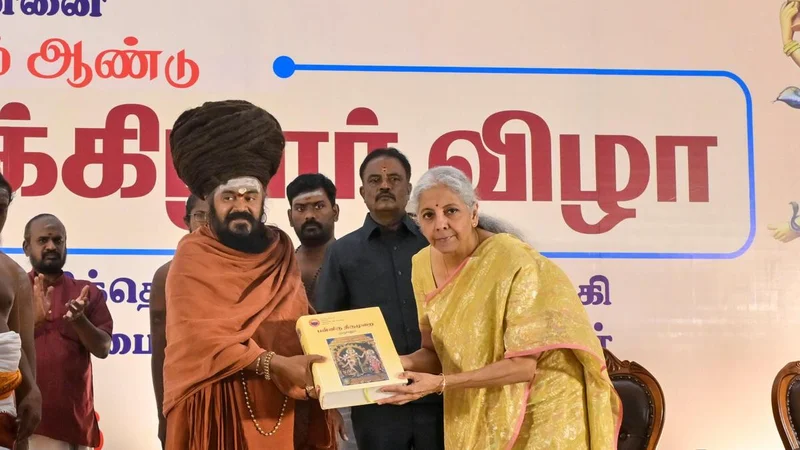
Union Finance Minister Nirmala Sitharaman said the Saiva Tirumurais played a pivotal role in enabling ordinary people to understand and sing devotional Tamil literature. She also highlighted that many classical ragas performed on Carnatic music stages today originated from the panns of the Tirumurais.
She was speaking at the 34th annual Deiva Sekkizhar Festival in Chennai, jointly organised by the Sekkizhar Research Centre and Sri Ramachandra Institute of Higher Education and Research.
On Saturday, the second day of the festival, two books — The Panniru Tirumurais and the Thiruchendur Sthala Puranam — were released by the pontiff of the Dharmapuram Adheenam, Sri Masilamani Gnanasambanda Desika Paramacharya Swamigal, and received by the Finance Minister.
Addressing the gathering, Ms. Sitharaman said: “These 12 Tirumurais are enough for anyone to praise Lord Shiva in simple Tamil. They helped democratise Tamil literature, once thought to be the sole domain of scholars, and brought it into the hearts and voices of the common folk.”
Emphasising the rich literary and musical traditions embedded within the Tirumurais, she highlighted as an example how Thirunavukkarasar extensively used the Tamil poetic form known as Thandagam in his hymns.
“Even today, many ragas sung on Carnatic stages trace their roots directly back to the panns in which the Tirumurais were composed — a fact acknowledged by musicians across generations. Over a thousand years ago, when these hymns were compiled, the specific panns for each song were systematically documented. They were performed with traditional musical instruments such as the yazh, udukkai, and kottu,” she said.
Historical archives
Ms. Sitharaman also said the scriptures double as invaluable historical archives. “In the Periyapuranam, Sekkizhar chronicles the conversion of King Mahendra Pallava to Saivism. Similarly, Sundaramurthy Nayanar documents King Nintraseer Nedumara Nayanar’s victory in the Battle of Nelveli. Furthermore, both temple inscriptions and the Tirumurais record that when King Rajasimha Pallava scheduled the consecration of the Kanchi Kailasanathar Temple, Lord Shiva revealed He would instead attend the temple built within the mind of Pusalar Nayanar on that very day.”
Reflecting on the Thiruchendur Sthala Puranam, authored by Ventrimalai Kavirayar, she recounted how the original manuscript was cast into the sea and later recovered along the coast of Sri Lanka.
Highlighting the Union Government’s recognition of Tamil spiritual heritage under Prime Minister Narendra Modi, Ms. Sitharaman cited the conferment of the Padma Shri upon an othuvar (one who dedicates themselves to singing the devotional hymns of Thevaram and Thiruvasagam) and the ceremonial installation of the sacred sengol (scepter) in the new Parliament building.
Velakurichi Adheenam pontiff Sri Satya Gnana Mahadeva Desika Paramacharya Swamigal, Rasika Ranjani Sabha president A.R. Santhanakrishnan, and Sekkizhar Research Centre president S. Jagadeesan were among those who attended the event held in the city.
Published - August 01, 2026 10:49 pm IST